
On September 8, 1944, a thunderous explosion ripped through the
London suburb of Chiswick. Three people died instantly, ten more were
injured. But there had been no warning—no air raid siren, no drone of
approaching bombers, not even the distinctive buzz of a V-1 flying bomb.
The blast simply appeared from nowhere, followed seconds later by a
sonic boom that rattled windows across the city.
Britain’s government initially blamed the explosion on a faulty gas
main. They knew the truth would cause panic: Nazi Germany had just
unleashed the world’s first ballistic missile.
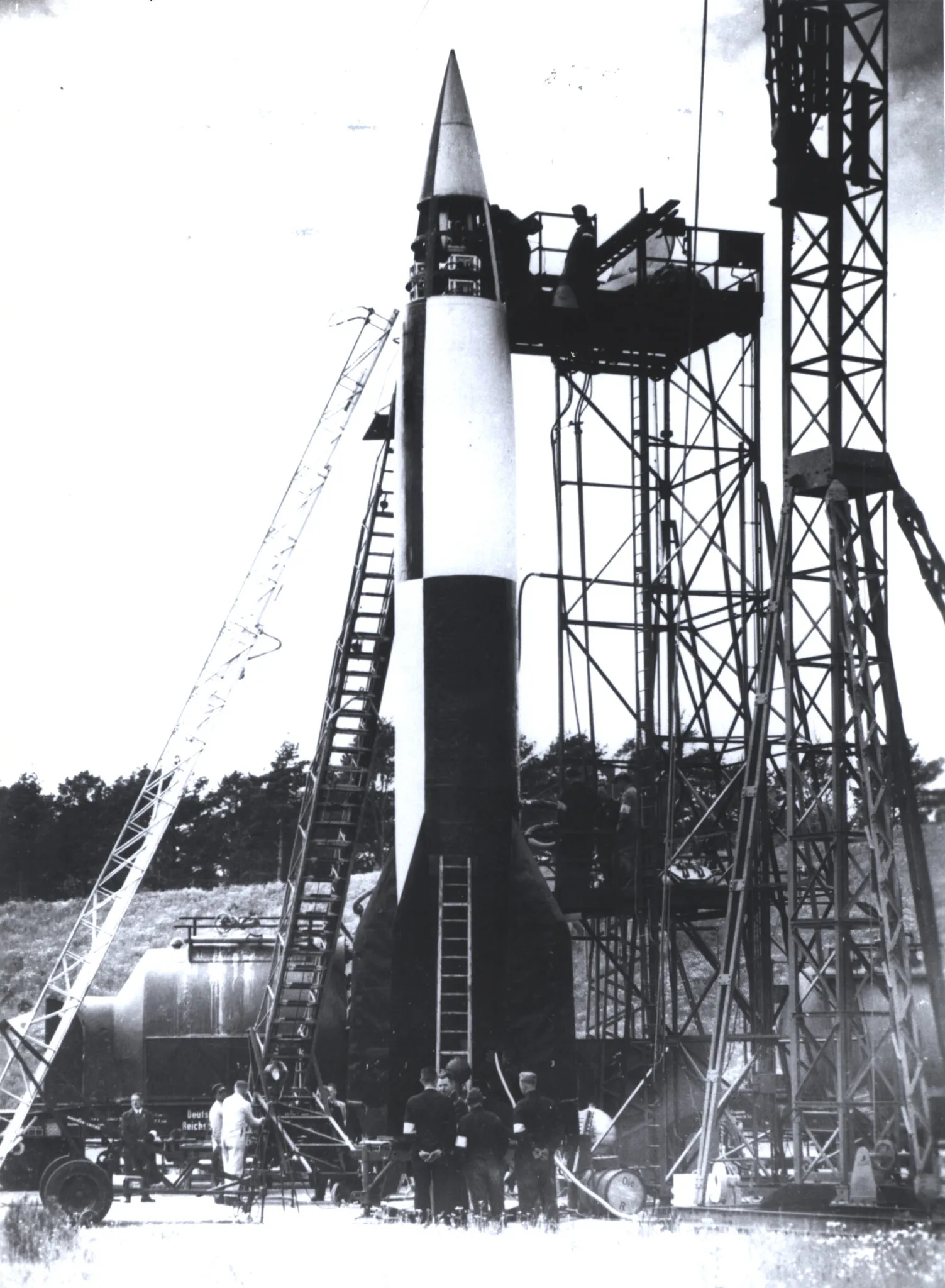
The V-2 rocket—Hitler’s Vergeltungswaffe 2, or “Vengeance Weapon
2”—represented a quantum leap in military technology. Traveling faster
than sound itself, it struck without warning and could not be
intercepted. Over the next seven months, more than 3,000 V-2s would rain
down on Allied cities, killing thousands. Yet this weapon of terror
would have an unexpected legacy: it would become the technological
foundation for humanity’s journey into space.
The Rocket Dreamers of
Peenemünde
Space Museum)
The story of the V-2 begins not with military ambitions, but with
dreams of space travel. In the 1920s, a young German engineer named
Wernher von Braun became obsessed with Hermann Oberth’s visionary book
“The Rocket into Interplanetary Spaces.” While still a teenager, von
Braun began experimenting with liquid-fueled rockets, imagining vehicles
that could one day carry humans beyond Earth’s atmosphere.
His experiments caught the attention of Captain Walter Dornberger, a
German Army artillery officer tasked with developing long-range weapons.
In 1932, Dornberger secured funding for von Braun’s research, forging a
partnership that would change history. The young dreamer would get
resources to pursue his passion; the military would get a revolutionary
weapon.
By 1937, their small operation had outgrown its facilities. The
German Army established a massive research center on the remote Baltic
island of Peenemünde. Here, von Braun served as technical director while
Dornberger commanded the military side. Their goal: create a missile
that could carry a one-ton warhead over 172 miles—far beyond the range
of any artillery piece.
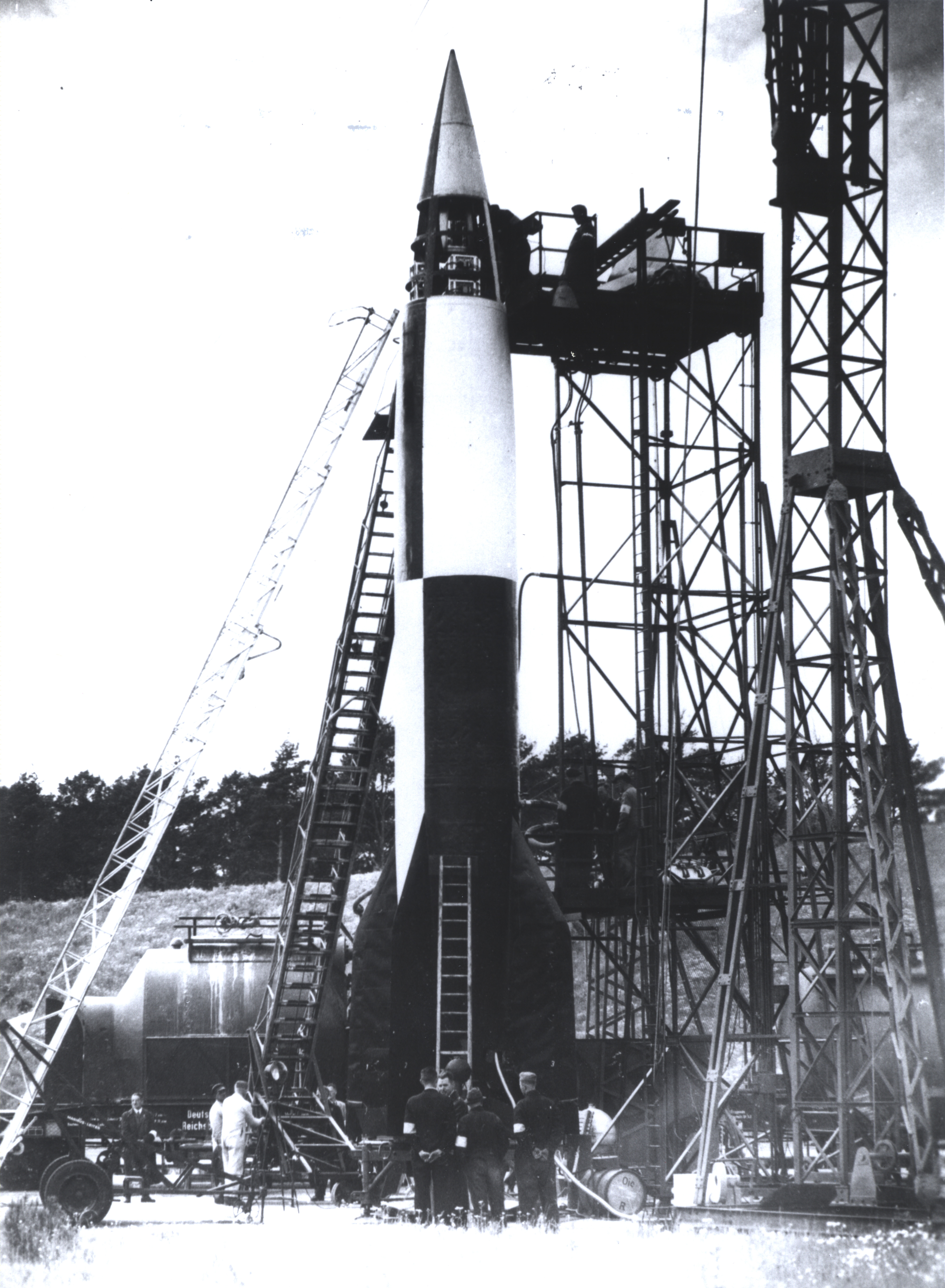
The breakthrough came on October 3, 1942. After numerous failures,
the team’s A-4 rocket (later renamed V-2) soared to an altitude of 53
miles and traveled 118 miles downrange. It became the first human-made
object to reach space. Dornberger, watching the successful launch,
declared it “the first of a new era… that of space travel.”
He had no idea how prophetic those words would prove.
A Technological
Marvel Born from Desperation
(Smithsonian Institution)
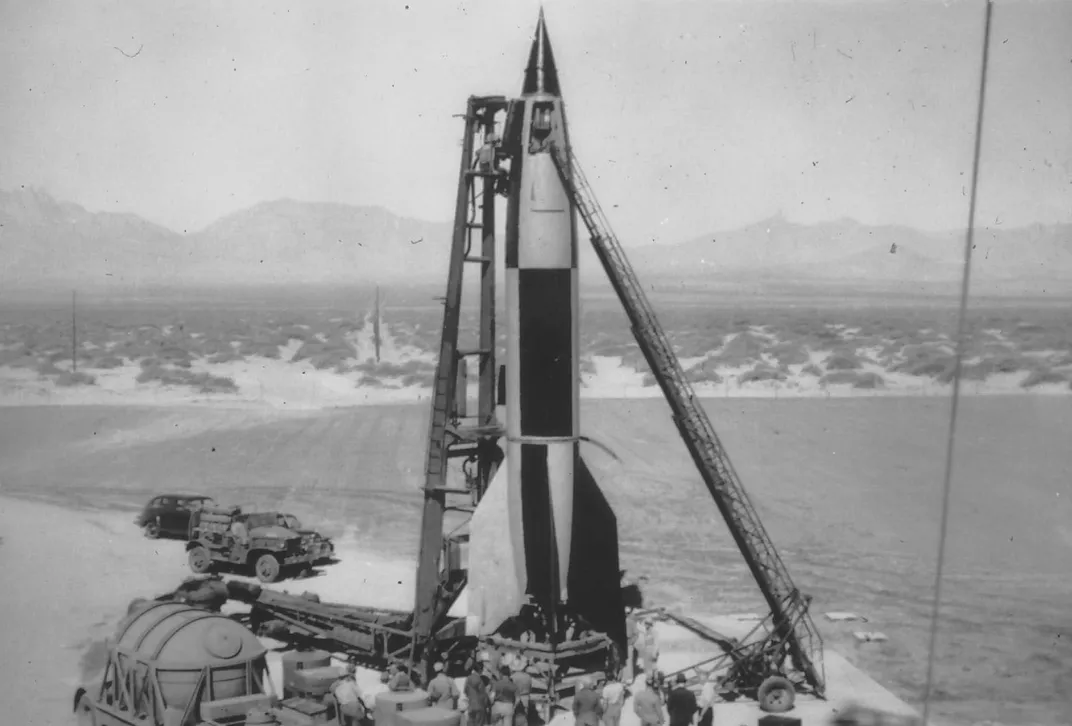
The V-2 was an engineering masterpiece that pushed the boundaries of
1940s technology. Standing 46 feet tall and weighing over 27,000 pounds
at launch, it was powered by a sophisticated liquid-fuel engine that
burned a mixture of ethanol and liquid oxygen. A turbopump, driven by
steam from hydrogen peroxide, fed propellants into the combustion
chamber at 125 liters per second, generating 25 tons of thrust.
The rocket could reach speeds of 3,580 mph—more than four times the
speed of sound. It climbed to altitudes of 55 miles before arcing down
toward its target up to 200 miles away. Four external fins and internal
graphite rudders in the exhaust stream provided steering during the
powered phase of flight. After the engine cut off, the missile followed
a ballistic trajectory, essentially becoming an unstoppable falling
object carrying 2,200 pounds of high explosives.
What made the V-2 truly revolutionary was its guidance system.
Gyroscopes controlled the rocket’s trajectory during its 65-second burn,
while an accelerometer measured velocity to determine the precise moment
of engine cutoff. This was cutting-edge technology for an era when most
“computers” were rooms full of people with mechanical calculators.
Initially, Adolf Hitler was unimpressed by the V-2, viewing it as an
expensive artillery shell. But after viewing footage of the successful
1942 test, he became convinced it was a “wonder weapon” that could
terrorize Allied populations and turn the tide of war. He authorized
mass production, pouring enormous resources into the program even as
Germany’s military situation deteriorated.
Terror from the Sky
last German V-2 rocket to fall on London, March 27, 1945. (Imperial War
Museums, HU 88803)
The operational V-2 campaign began with that September 8, 1944 strike
on Chiswick. Over the following months, Germany launched over 3,000
V-2s, primarily targeting London and the Belgian port city of
Antwerp.
The psychological impact was immense. Unlike conventional bombers or
even the V-1 “buzz bomb,” the V-2 gave no warning. It traveled faster
than sound, so the explosion came before the sound of its approach.
Londoners learned to listen for the distinctive double boom—first the
sonic boom of the descending rocket, then the explosion itself. If you
heard it, you had survived.
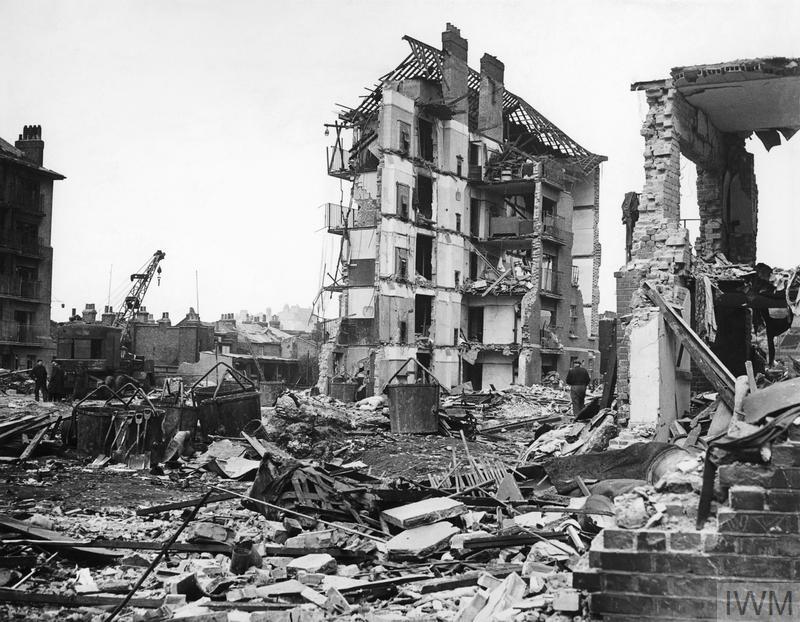
Approximately 1,358 V-2s struck London, killing 2,754 civilians and
injuring 6,523 more. One of the deadliest attacks occurred on November
25, 1944, when a rocket hit a crowded Woolworth’s department store in
New Cross, killing 160 people.
But Antwerp suffered even more. As a crucial Allied supply port, it
became the most heavily targeted city, earning the grim nickname “City
of Sudden Death.” Over 1,600 V-2s struck the city and surrounding areas.
The single deadliest V-2 attack of the entire war occurred on December
16, 1944, when a rocket hit the packed Cine Rex cinema during an
afternoon showing. The explosion killed 567 people—mostly Allied
soldiers on leave—and injured 291 more.
The last V-2s were launched on March 27, 1945, as Allied ground
forces overran the launch sites in the Netherlands and Germany.
The Hidden Cost:
Mittelbau-Dora
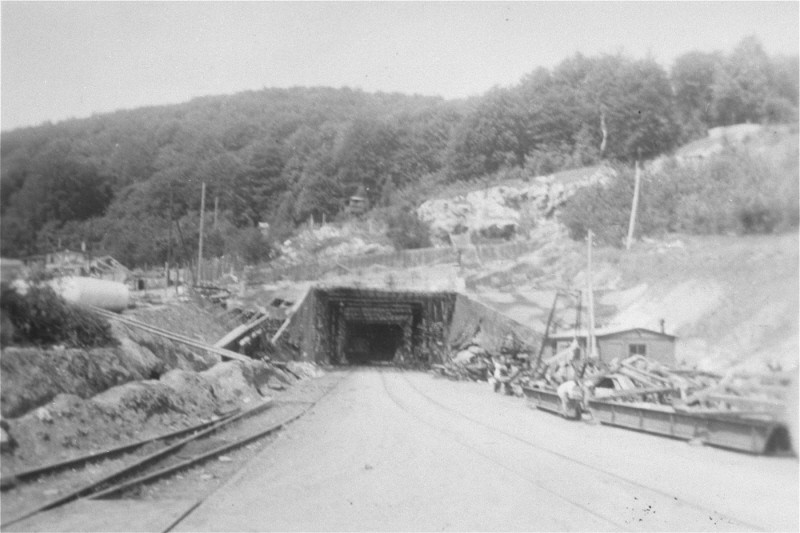
at liberation, April 1945. (US Holocaust Memorial Museum)
The human cost of the V-2 program extended far beyond its targets. In
August 1943, the RAF bombed Peenemünde in a daring night raid, killing
hundreds of workers and damaging facilities. In response, the Nazi
leadership decided to move V-2 production underground, beyond the reach
of Allied bombers.
They chose a series of tunnels in the Kohnstein mountain near
Nordhausen, which became the Mittelwerk factory. To excavate the tunnels
and assemble the rockets, the SS established the Mittelbau-Dora
concentration camp.
Approximately 60,000 prisoners from across occupied Europe were
forced into slave labor under conditions of unimaginable brutality. For
months, they lived and worked underground, deprived of daylight, fresh
air, and basic sanitation. They toiled 14-hour shifts, suffering from
starvation, disease, and constant violence from SS guards. Prisoners who
collapsed from exhaustion were beaten or hanged as examples to
others.
The mortality rate was catastrophic. Over 20,000 prisoners died at
Mittelbau-Dora—more people than were killed by the V-2 as a weapon. When
American troops liberated the camp on April 11, 1945, they found scenes
of horror that shocked even battle-hardened soldiers.
This grim statistic reveals the ultimate failure of the V-2 program:
more lives were lost building the weapon than it took in combat.
A Strategic Failure
Despite its technological sophistication and the terror it inflicted,
the V-2 was a strategic disaster. It arrived too late and in too few
numbers to affect the war’s outcome. The program consumed vast
resources—an estimated 50% of Germany’s total wartime research
budget—that could have been used for conventional weapons like tanks and
fighter aircraft.
The V-2’s guidance system, while revolutionary, was imprecise.
Rockets often missed their targets by miles, making them indiscriminate
terror weapons rather than precision military tools. The total tonnage
of explosives delivered by all V-2s over seven months was less than what
a single heavy bomber raid could deliver in one night—and at a fraction
of the cost.
The V-2 stands as a prime example of the Nazi regime’s misguided
faith in “wonder weapons” to stave off inevitable defeat. As one
historian noted, Germany would have been better served by building more
conventional weapons and fewer rockets.
From Vengeance to the Stars
As Germany collapsed in spring 1945, a new race began between the
United States and Soviet Union to capture the spoils of the V-2 program.
The prize wasn’t just the hardware—it was the human expertise.
Wernher von Braun, foreseeing Germany’s defeat, orchestrated the
surrender of himself and over 100 of his top scientists to American
forces. Through a secret program called Operation Paperclip, the U.S.
government brought more than 1,600 German scientists and engineers to
America. The objective was clear: leverage their knowledge for U.S.
military programs and deny it to the Soviets.
The Nazi pasts of many of these individuals—including von Braun’s
membership in both the Nazi Party and the SS—were deliberately
overlooked or “whitewashed” in the interest of national security. This
moral compromise would haunt the space program for decades.
Von Braun’s team was first sent to Fort Bliss, Texas, then to
Redstone Arsenal in Huntsville, Alabama. They became instrumental in
developing America’s first ballistic missiles. A modified Redstone
rocket launched Explorer I, America’s first satellite, in 1958. In 1960,
von Braun’s team transferred to the newly formed NASA, where they
designed the mighty Saturn V rocket—the vehicle that carried Apollo
astronauts to the Moon.
Meanwhile, the Soviets captured the V-2 production facilities and
many lower-level German technicians. They used this foundation to
jump-start their own rocket program, which led to the R-7 Semyorka—the
rocket that launched Sputnik in 1957 and later carried Yuri Gagarin, the
first human in space.
The Cold War space race, one of humanity’s greatest technological
achievements, was built on the foundation of Hitler’s vengeance
weapon.
A Paradoxical Legacy
The V-2 rocket embodies one of history’s most troubling paradoxes. It
was a weapon of terror, built by slave labor, that killed thousands of
innocent civilians. Yet it also represented a genuine breakthrough in
human capability—the first step toward space exploration and our
understanding of ourselves as a spacefaring species.
When Neil Armstrong stepped onto the Moon in 1969, he did so atop
technology that traced its lineage directly back to those September 1944
strikes on London. The same basic principles that guided V-2s toward
their targets guided Apollo spacecraft to the Moon and back.
This legacy forces us to confront uncomfortable questions about
scientific progress and moral responsibility. Can we celebrate the
achievement of space exploration while acknowledging its roots in Nazi
terror and slave labor? Should we?
Perhaps the answer lies in remembering both truths simultaneously.
The V-2 was born from humanity’s darkest impulses—the desire to
terrorize and destroy. But it also carried within it humanity’s highest
aspirations—the dream of reaching beyond our world to touch the
stars.
The rocket that once brought death from the sky ultimately helped us
see Earth from space, a fragile blue marble floating in the cosmic void.
That perspective, more than any weapon, may be the V-2’s most important
legacy: a reminder that we share one small planet, and that our choice
is not between vengeance and exploration, but between destruction and
survival.
The V-2 taught us that we have the power to reach the heavens. The
question it leaves us with is: what will we do when we get there?