
Operation
Weserübung: Germany’s Audacious Invasion of Norway
On the morning of April 9, 1940, the people of Oslo awoke to the
sound of aircraft overhead and warships in the fjord. By nightfall,
German troops occupied the capitals of two sovereign nations. In a
single day, the so-called “Phony War” — that strange, quiet period after
Germany’s invasion of Poland — was over. The real war had come to
Scandinavia.
Operation Weserübung (literally “Weser Exercise”) was one of the most
audacious military operations of World War II: a simultaneous,
coordinated invasion of Norway and Denmark by air, land, and sea. It
introduced the world to large-scale airborne warfare, produced one of
history’s most infamous traitors, and — in a twist of fate — helped
bring Winston Churchill to power.

Operation Weserübung, April 1940. — Bundesarchiv / Wikimedia
Commons | CC BY-SA 3.0 DE
Why Norway? The Iron Ore
Lifeline
To understand why Hitler invaded Norway, follow the iron ore.
Germany’s war machine ran on steel, and steel required iron ore. Much
of that ore came from mines in northern Sweden. During winter months,
when the Gulf of Bothnia froze over, the ore was transported by rail to
the Norwegian port of Narvik and then shipped south along the Norwegian
coast — through what were technically neutral waters — to German
ports.
Winston Churchill, then First Lord of the Admiralty, had long
recognized this vulnerability. He pushed for mining Norwegian coastal
waters to cut off the supply. The British were even planning to land
troops at Narvik. Hitler, aware of Allied intentions, decided to strike
first.
There was a second motive: naval strategy. Grand Admiral Erich Raeder
had been lobbying for Norwegian bases for months. U-boats and surface
raiders operating from Bergen, Trondheim, or Narvik could break out into
the North Atlantic far more easily than from German ports bottled up
behind the British naval blockade. Norway wasn’t just a supply route —
it was a strategic gateway.
The invasion was planned under General Nikolaus von Falkenhorst, who
assembled six reinforced divisions for the operation. Denmark was added
to the plan in early March 1940, primarily to secure airfields for
Luftwaffe fighter cover and to serve as a staging area for the Norwegian
campaign.
April 9, 1940: The
Day of Simultaneous Strikes
The invasion began in the early hours of April 9 — “Weser Day.” What
made it remarkable was its scope: six Norwegian cities were targeted
simultaneously, while German forces crossed the Danish border at
dawn.
Denmark fell in six hours. German troops crossed into Jutland while
naval units landed in Copenhagen. Faced with the threat of Luftwaffe
bombers over the capital and hopelessly outnumbered, the Danish
government capitulated to avoid civilian bloodshed. It was the fastest
conquest of the war.
Norway was a different story.
German naval groups raced toward Oslo, Kristiansand, Bergen,
Trondheim, and Narvik. German paratroopers — Fallschirmjäger —
seized the airfields at Fornebu (Oslo) and Sola (Stavanger) in the first
major opposed airborne assaults in history. The surprise was
near-total.
But at Oslo, something went wrong for the Germans.

by cannon fire and torpedoes from the Norwegian coastal fortress
Oscarsborg. She sank a short time later. — Wikimedia Commons /
Norwegian Archives | Public Domain
The Fortress That Changed
History
As the German invasion fleet sailed up the Oslofjord toward the
capital, it passed through the narrow Drøbak Sound, guarded by the
ancient Oscarsborg Fortress. The fortress’s commander, Colonel Birger
Eriksen, faced a fateful decision. The warships below had not identified
themselves. He gave the order to fire.
The fortress’s 19th-century Krupp guns and torpedo batteries opened
up on the lead vessel — the brand-new German heavy cruiser
Blücher. Hit repeatedly, the Blücher caught fire,
capsized, and sank with over 800 men aboard. Among the dead were many of
the Gestapo and administrative personnel intended to immediately seize
the Norwegian government.
That delay — just a few critical hours — was enough. King Haakon VII,
the royal family, the government, and the national gold reserves escaped
Oslo by train. The Germans had planned to capture the king and force an
immediate surrender. Instead, they found an empty capital.
Colonel Eriksen reportedly said afterward: “Either I will be
decorated, or I will be court-martialed.” He was decorated.
The King Who Said No
King Haakon VII became the moral center of Norwegian resistance. When
German envoys caught up with the government at Elverum and presented
their demands — capitulate and appoint the fascist Vidkun Quisling as
prime minister — the king consulted his cabinet and delivered a flat
refusal.
“I cannot appoint Quisling as prime minister,” he told his ministers.
“I know that the Norwegian people will not accept it, and I cannot go
against the will of the people.”
It was a remarkable act of defiance. The king and government fled
north, pursued by German forces and bombed from the air. They eventually
evacuated to Britain, where they established a government-in-exile that
would continue the fight for five years.
Meanwhile, Vidkun Quisling — the Norwegian fascist leader who had met
with Hitler in December 1939 to encourage the invasion — seized his
moment. On the evening of April 9, he broadcast a radio address
declaring himself Prime Minister and ordering Norwegian forces to lay
down their arms. The coup was a fiasco. It had no popular support, no
military backing, and even the Germans found him an embarrassment. He
was removed within a week.
But his name endured. “Quisling” entered the English language — and
most European languages — as a permanent synonym for traitor and
collaborator.

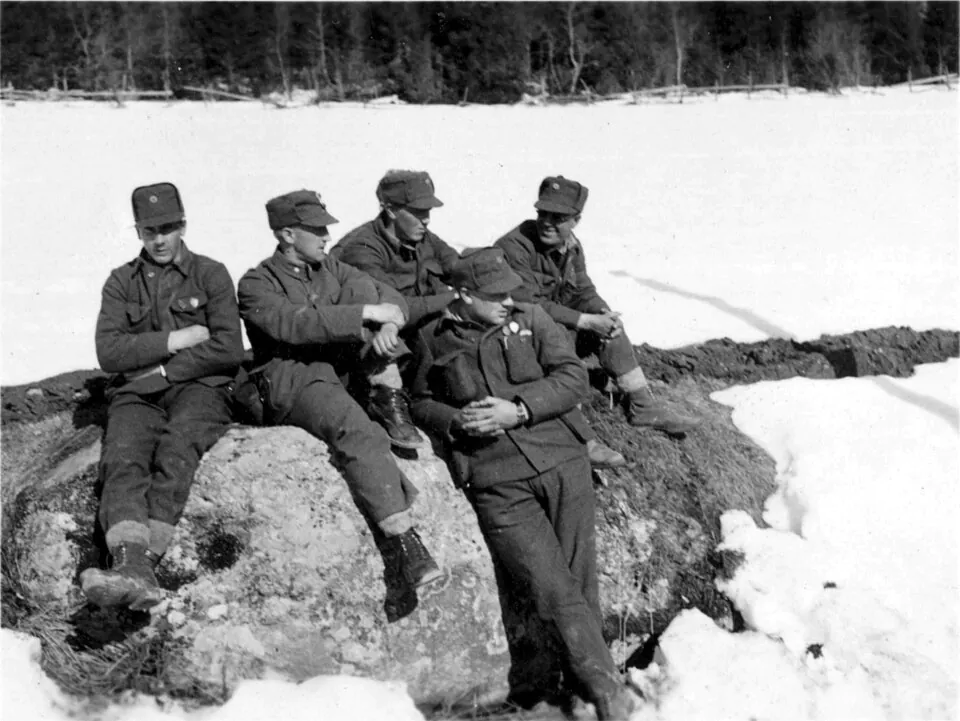
along the roadside. — Arkiv i Nordland | CC BY-SA 2.0
The Battle for
Narvik: A Rare Allied Victory
While southern Norway fell quickly, the fight for Narvik became the
campaign’s most dramatic chapter.
On April 9, ten German destroyers carrying elite mountain troops
under General Eduard Dietl captured Narvik after sinking two Norwegian
coastal defense ships. The Royal Navy responded with fury.
In the First Battle of Narvik (April 10), five
British destroyers launched a surprise attack inside the fjord, sinking
two German destroyers and damaging several others — though losing two of
their own in the withdrawal.
Three days later, the Second Battle of Narvik (April
13) was decisive. The battleship HMS Warspite led a powerful
force into the fjord and systematically destroyed all eight remaining
German destroyers, which were trapped, low on fuel, and unable to
escape. It was a complete naval victory.
Allied and Norwegian ground forces then pushed Dietl’s isolated
mountain troops back into the hills. On May 28, 1940,
Allied forces recaptured Narvik — the first city seized by Nazi Germany
to be liberated. It was a genuine triumph.
It lasted ten days.
The catastrophic German breakthrough in France forced the Allies to
evacuate Norway between June 5-8. Narvik was abandoned. The last
Norwegian forces surrendered on June 10, 1940.
The
Consequences: Five Years of Occupation — and Churchill
Germany occupied Norway for five years, garrisoning some 300,000
troops there for the duration of the war — soldiers who could not be
deployed elsewhere. Norwegian resistance, both armed and passive,
continued throughout the occupation, supported by the
government-in-exile in London, which also controlled Norway’s
substantial merchant fleet.
The strategic gains for Germany were real but costly. Norwegian and
Danish bases extended the reach of U-boats and Luftwaffe aircraft into
the North Atlantic and Arctic, complicating Allied convoy routes to the
Soviet Union. But the price in ships, men, and resources was steep.
In Britain, the Norwegian campaign’s failure triggered a political
earthquake. Prime Minister Neville Chamberlain faced a devastating
parliamentary debate on May 7-8, 1940. Members of his own party turned
against him. On May 10 — the very day Germany launched its invasion of
France — Chamberlain resigned and Winston Churchill became Prime
Minister.
The man who had pushed hardest for action in Norway, whose plans had
been outpaced by German boldness, now led Britain’s war effort. History
has a dark sense of irony.

Public Domain
A New Kind of War
Operation Weserübung was more than a conquest. It was a demonstration
of a new form of warfare — integrated, fast, and multi-dimensional. The
combination of airborne troops seizing airfields, naval forces landing
infantry at multiple points simultaneously, and ground forces advancing
overland was unprecedented in scale.
It showed the world what Germany was capable of. And it showed that
even a small, determined nation — with an ancient fortress, a defiant
king, and soldiers willing to fight in the snow — could make that
conquest costly.
Eighty-six years ago this week, the guns of Oscarsborg fired into the
dark waters of the Oslofjord, and a cruiser went to the bottom. The war
had truly begun.
The invasion of Norway on April 9, 1940 marked the 86th
anniversary this week. Operation Weserübung remains one of the most
complex and consequential operations of the early war — a campaign that
shaped the conflict’s leadership, strategy, and moral landscape for
years to come.