
The
Tuskegee Airmen: Breaking Barriers at 30,000 Feet
They were told they couldn’t fly. Not because of any lack of skill or
courage — but because of the color of their skin. In the early 1940s,
the United States Army Air Corps maintained that Black men were
intellectually and temperamentally unfit for aerial combat. Official
studies backed this view. Military policy enforced it. And yet, between
1941 and 1945, nearly 1,000 African American pilots trained at Tuskegee,
Alabama, flew over 15,000 combat sorties across North Africa and Europe,
and earned a reputation as the finest bomber escorts in the entire 15th
Air Force. They were the Tuskegee Airmen — and they changed America
forever.
A Program Born from Protest
The road to Tuskegee was paved by decades of civil rights advocacy.
Organizations like the NAACP and leaders such as A. Philip Randolph had
long demanded that African Americans be allowed to serve as military
pilots. The U.S. Army resisted, citing a 1925 Army War College report
that questioned Black soldiers’ suitability for combat — a document
rooted in racism rather than evidence.
The breakthrough came on April 3, 1939, when Congress passed Public
Law 18, which included funding for the training of African American
pilots. On January 16, 1941, the War Department announced the formation
of the 99th Pursuit Squadron — the first all-Black flying unit in
American history. Training would take place at the Tuskegee Institute in
Alabama, a historically Black college founded by Booker T. Washington.
The program officially began on July 19, 1941.
The selection process was deliberately rigorous. Many cadets already
held civilian pilot certificates from the Civilian Pilot Training
Program. Between 1941 and 1946, the program produced 992 pilots and over
1,000 additional navigators, bombardiers, and support personnel. As
Coleman Young — a Tuskegee veteran who later became mayor of Detroit —
recalled, they were “unquestionably the brightest and most physically
fit young Blacks in the country.”

Ramitelli, Italy, March 1945. Photo by Toni Frissell. Library of
Congress Prints and Photographs Division. No known restrictions on
publication.
Fighting Two Wars at Once
While preparing to fight fascism abroad, the Tuskegee Airmen waged a
daily battle against racism at home. The U.S. military was deeply
segregated, and Black officers faced discrimination at every turn —
inferior facilities, hostile commanders, and a system designed to remind
them of their supposed inferiority.
At Freeman Field, Indiana, the situation came to a head in April
1945. Colonel Robert Selway issued Base Regulation 85-2, formally
segregating the base’s officers’ clubs. The club for white officers was
well-appointed; the one for Black officers was spartan and derisively
nicknamed “Uncle Tom’s Cabin.” In response, Black officers began
peacefully entering the whites-only club in small groups. Over three
days, 101 officers were arrested for refusing to sign a document
acknowledging the discriminatory regulation.
This act of coordinated nonviolent resistance — now known as the
Freeman Field Mutiny — was a direct precursor to the
Civil Rights movement’s tactics of the 1950s and 1960s. Three officers
were court-martialed; one, Roger “Bill” Terry, was convicted and
dishonorably discharged. President Bill Clinton pardoned him in 1995.
The courage shown at Freeman Field was as significant as any aerial
victory.
The Leaders Who Made It
Possible
No figure was more central to the Tuskegee Airmen’s success than
Colonel Benjamin O. Davis Jr. The son of the Army’s
first Black general, Davis graduated from West Point — where white
cadets subjected him to four years of deliberate silence — and was among
the first five pilots to earn his wings at Tuskegee. He commanded the
99th Pursuit Squadron and later the entire 332nd Fighter Group,
personally flying combat missions and earning a Silver Star for valor.
After the war, Davis helped draft the military’s desegregation plan and,
in 1954, became the first African American general in the U.S. Air
Force.
The program also received a crucial boost from an unlikely source:
First Lady Eleanor Roosevelt. During a visit to
Tuskegee on March 29, 1941, she requested a flight with chief civilian
instructor C. Alfred “Chief” Anderson. After 40 minutes in the air, she
emerged and declared, “Well, I see you can fly all right!” Photographs
of the flight were widely published, challenging racist stereotypes and
helping secure a $175,000 loan to complete construction of Moton Field,
the primary training base.

Brown and Marcellus G. Smith at Ramitelli, Italy, March 1945. Davis
commanded the 332nd Fighter Group and later became the first African
American general in the U.S. Air Force. Photo by Toni Frissell.
Library of Congress Prints and Photographs Division. No known
restrictions on publication.
Red Tails Over Europe
The 332nd Fighter Group arrived in the Mediterranean theater in early
1944, flying P-40 Warhawks and later P-47 Thunderbolts before
transitioning to the iconic P-51 Mustang. It was the Mustang that gave
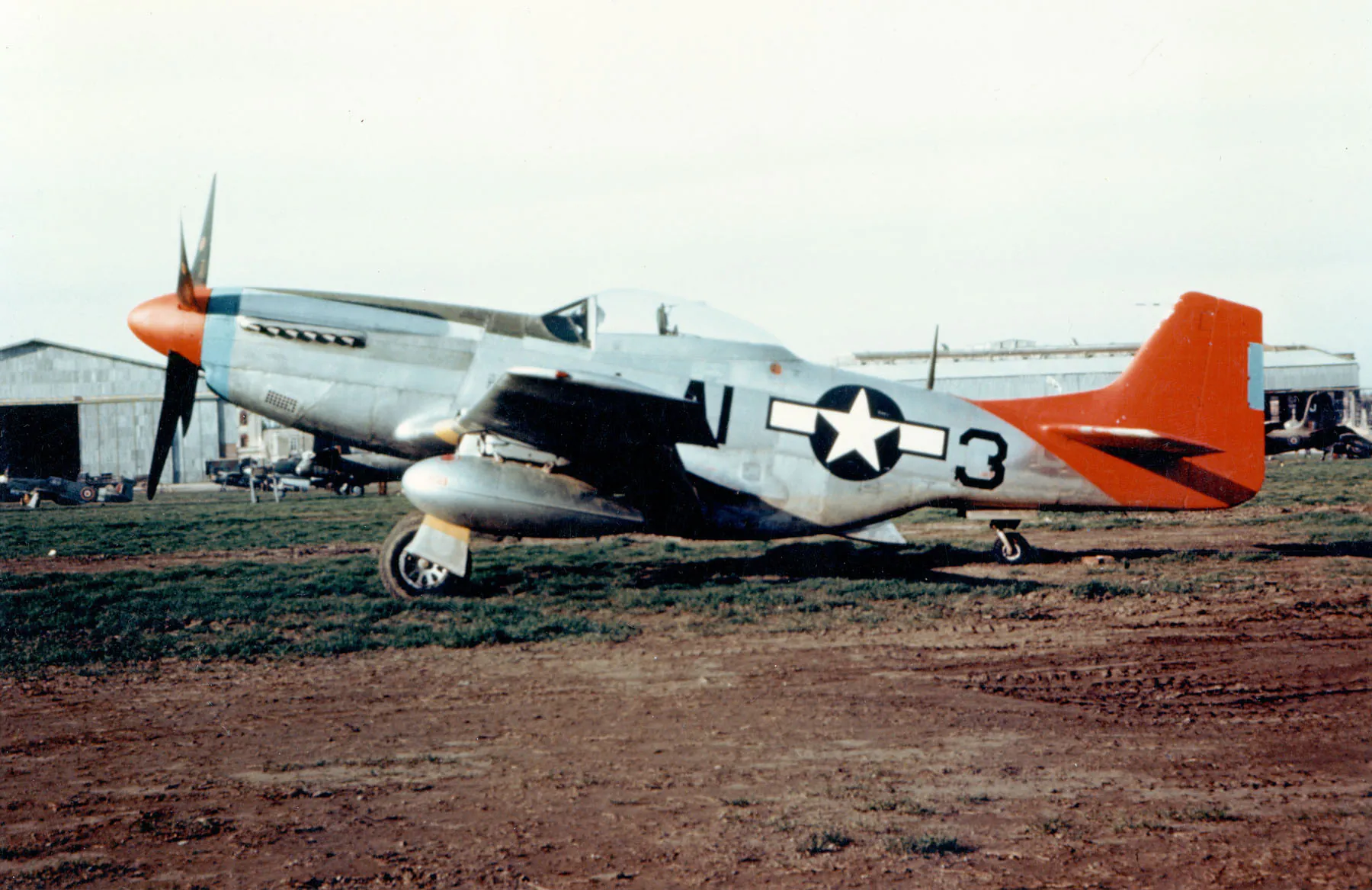
them their most famous distinction: the pilots painted their aircraft’s
tails a vivid red, earning them the nickname “Red
Tails” — and, among the bomber crews they protected, the name
“Red-Tail Angels.”
Their combat record was extraordinary. Flying over 15,000 sorties
between 1943 and 1945, the 332nd Fighter Group:
- Destroyed 111 enemy aircraft in aerial combat
- Destroyed 150 more aircraft on the ground
- Knocked out 950 railcars, trucks, and vehicles
- Sank a German destroyer using only machine-gun fire
Their first aerial victory came on July 2, 1943, when Lieutenant
Charles B. Hall shot down a German fighter over Tunisia. On January
27–28, 1944, pilots of the 99th Squadron shot down 12 German aircraft
over the Anzio beachhead in two days — a performance that silenced
critics who had questioned their combat effectiveness.

distinctive red tail markings that gave the unit its famous nickname,
Ramitelli, Italy, 1944. U.S. Army Air Forces photograph. U.S.
National Archives (NARA). Public domain.
The Berlin Mission: Proof
Beyond Doubt
On March 24, 1945, Colonel Davis led the 332nd on what would become
their most celebrated mission: a 1,600-mile round-trip escort of B-17
bombers to a tank factory in Berlin. It was the longest escort mission
flown from Italy. Over the target, they encountered Germany’s most
advanced aircraft — the Messerschmitt Me 262, the world’s first
operational jet fighter.
Despite being outpaced by the jets and running critically low on
fuel, the Red Tails engaged the Me 262s and successfully defended every
bomber in their charge. Not a single B-17 was lost to enemy fighters
that day. For this mission, the 332nd Fighter Group was awarded a
Distinguished Unit Citation — one of three they
received during the war.
Across 179 bomber escort missions, the 332nd lost only 27 escorted
bombers to enemy fighters — compared to an average of 46 for other P-51
groups in the 15th Air Force. Bomber crews began specifically requesting
the Red Tails for their missions. The men who had been told they
couldn’t fly were now the most sought-after escorts in the theater.
A Legacy That Changed
America
The Tuskegee Airmen paid a heavy price for their achievements: 66
pilots were killed in action and 32 were captured as prisoners of war.
In total, they earned over 150 Distinguished Flying Crosses, 744 Air
Medals, 14 Bronze Stars, and three Distinguished Unit Citations.
But their most enduring victory was won not in the skies over Europe,
but in the halls of American power. Their unimpeachable record of
excellence dismantled the racist arguments used to justify military
segregation. On July 26, 1948, President Harry S. Truman signed
Executive Order 9981, mandating the desegregation of
the United States Armed Forces. The Tuskegee Airmen’s performance — and
their acts of resistance like the Freeman Field Mutiny — had made that
order possible.
In 2006, the surviving Tuskegee Airmen were collectively awarded the
Congressional Gold Medal, the nation’s highest civilian
honor. They had fought for a country that didn’t fully recognize their
humanity, and they had done so with a grace and excellence that forced
that country to change.
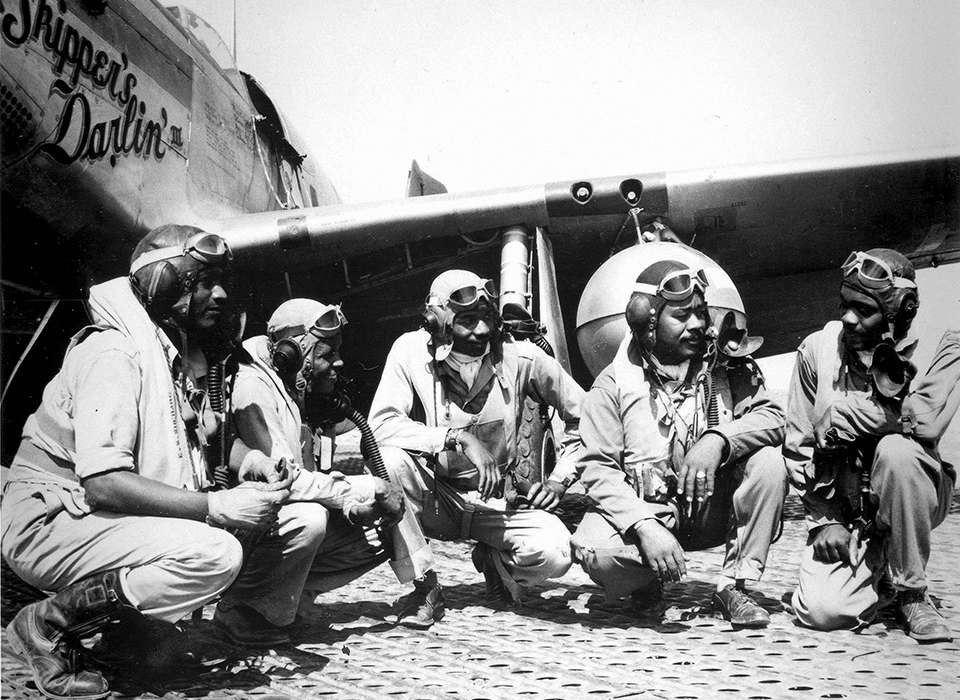
in Italy, 1944–1945. These men flew over 15,000 combat sorties and
earned more than 150 Distinguished Flying Crosses. U.S. Army Air
Forces photograph. Courtesy of The National WWII Museum.
Conclusion: The Dual Victory
The Tuskegee Airmen understood that they were fighting two wars
simultaneously — one against fascism in Europe, and one against racism
at home. They called it the “Double V” campaign: Victory abroad, Victory
at home. They won both.
Their story is not merely a chapter in military history. It is a
testament to what human beings can achieve when they refuse to accept
the limits others place upon them. The Red Tails flew into history at
30,000 feet, and they brought America — however reluctantly — with
them.