
The
Siege of Malta: The Island That Refused to Surrender
Imagine living underground for two years. Not by choice, but because
the sky above you is filled with enemy bombers — day and night,
sometimes every two and a half hours. Imagine watching your city
crumble, your food rations shrink to near-starvation levels, and your
neighbors die in the rubble. Now imagine refusing to give up anyway.
That was Malta from 1940 to 1942. A tiny island — just 122 square
miles, smaller than the city of Chicago — that became the most bombed
place on Earth and one of the most strategically vital pieces of land in
the entire Second World War. Its story is one of extraordinary
suffering, remarkable courage, and a defiance that helped turn the tide
of the war in North Africa.

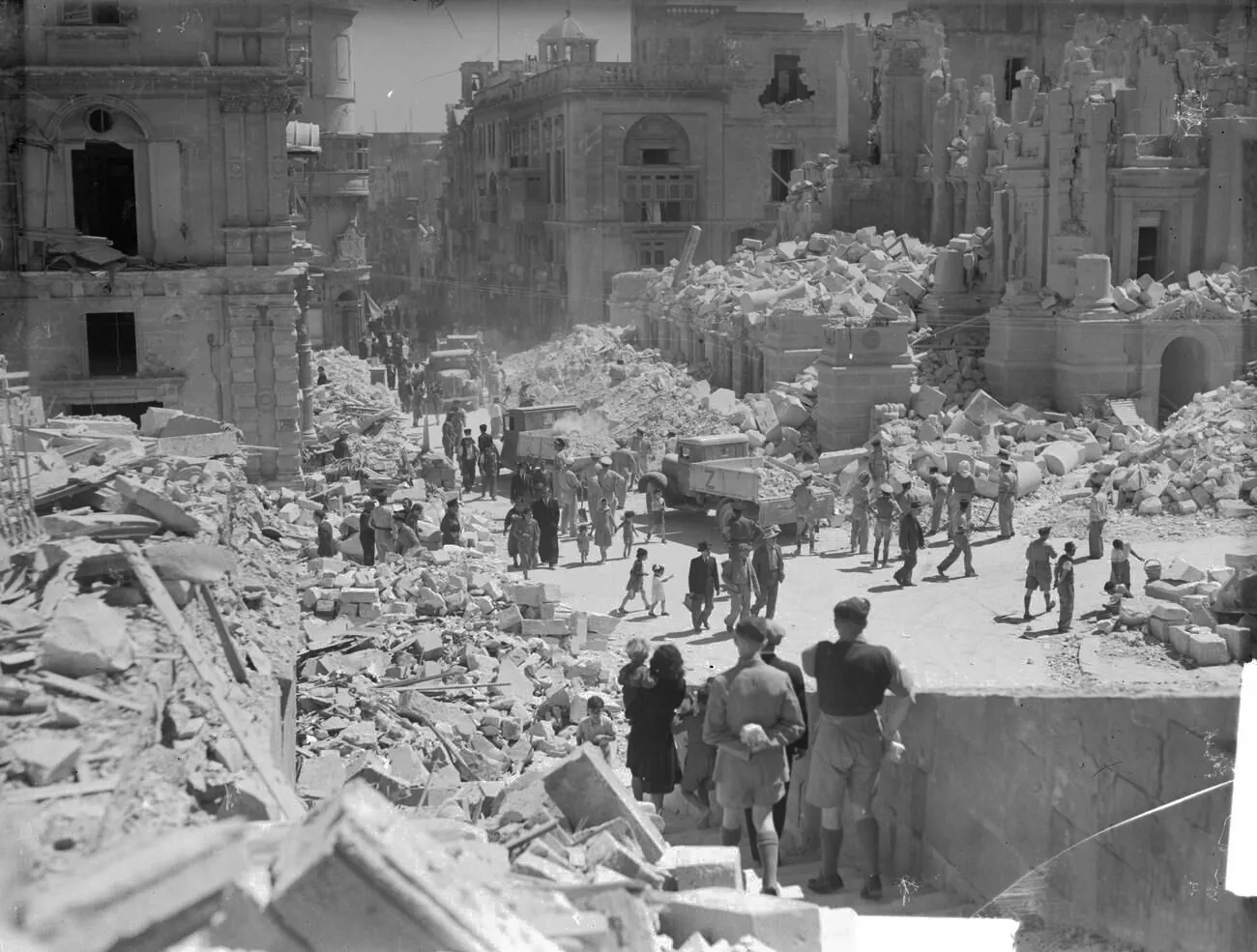
1942. Service personnel and civilians clear debris after an Axis air
raid. Photo: Lt. J.E. Russell / Imperial War Museums (Public
Domain)
A Rock in the Middle of
Everything
To understand why Malta mattered so much, look at a map. The island
sits almost exactly in the center of the Mediterranean Sea, roughly 60
miles south of Sicily and 180 miles north of the Libyan coast. In 1940,
that geography made it the most important piece of real estate in the
theater.
For the British, Malta was the only Allied base between Gibraltar and
Alexandria, Egypt. From its airfields and harbors, the Royal Navy and
RAF could strike at the Axis supply lines running from Italy to North
Africa — the lifeline feeding General Erwin Rommel’s Afrika Korps.
Rommel himself understood this perfectly. In May 1941, he wrote bluntly:
“Without Malta the Axis will end by losing control of North
Africa.”
For the Axis powers, neutralizing Malta wasn’t optional — it was
existential. As long as the island held, every convoy carrying tanks,
fuel, and ammunition to Rommel was at risk. The solution, in their
minds, was simple: bomb it into submission, or starve it out.
Three Biplanes Against the
World
On June 11, 1940, just hours after Mussolini declared war on Britain
and France, the first Italian bombs fell on Malta. The island’s air
defenses at that moment consisted of a handful of obsolete Gloster Sea
Gladiator biplanes — fabric-covered, open-cockpit relics from another
era — flown by volunteer pilots who had never trained as fighter
pilots.
Three of these aircraft became legendary. The Maltese people named
them Faith, Hope, and Charity. They were
slower than the Italian bombers they faced, let alone the fighters
escorting them. Yet their pilots threw themselves into the fight anyway,
disrupting raids, scoring kills, and providing something more valuable
than any military asset: proof that Malta would fight back.
Faith survived the war and is preserved today in the Malta
War Museum in Valletta. Hope and Charity were lost in
combat. Their story became the founding myth of Malta’s resistance.
The Blitz That Tried to
Break an Island
The Italian raids were merely the opening act. When the German
Luftwaffe arrived in January 1941, the bombing intensified to a scale
that defied comprehension. Over the course of the siege, Axis forces
launched approximately 3,000 bombing raids on Malta,
dropping an estimated 15,000 tons of bombs on the
Maltese islands.
April 1942 was the worst month. In those 30 days alone, 6,700
tons of bombs fell on Malta — more than the island had received
in the entire previous year. Air raid sirens sounded on average every
two and a half hours. The Grand Harbour, the airfields at Luqa, Hal Far,
and Ta’ Qali, and the ancient streets of Valletta were pounded
relentlessly.
The human cost was devastating. 1,581 civilians were
killed and 3,780 injured. Over 10,700
buildings were destroyed or severely damaged. The Royal Opera
House in Valletta — one of the finest in Europe — was reduced to a
shell. By the end of the siege, 50,000 people, nearly a
fifth of the entire population, were homeless.
Much of Malta’s population retreated underground, sheltering in
ancient catacombs and hastily excavated tunnels. Families lived for
months in these subterranean warrens, emerging only when the all-clear
sounded. The crowded, unsanitary conditions bred disease — typhoid,
diphtheria, and dysentery swept through the shelters. Food rations were
cut to near-starvation levels as the Axis blockade strangled supply
convoys.
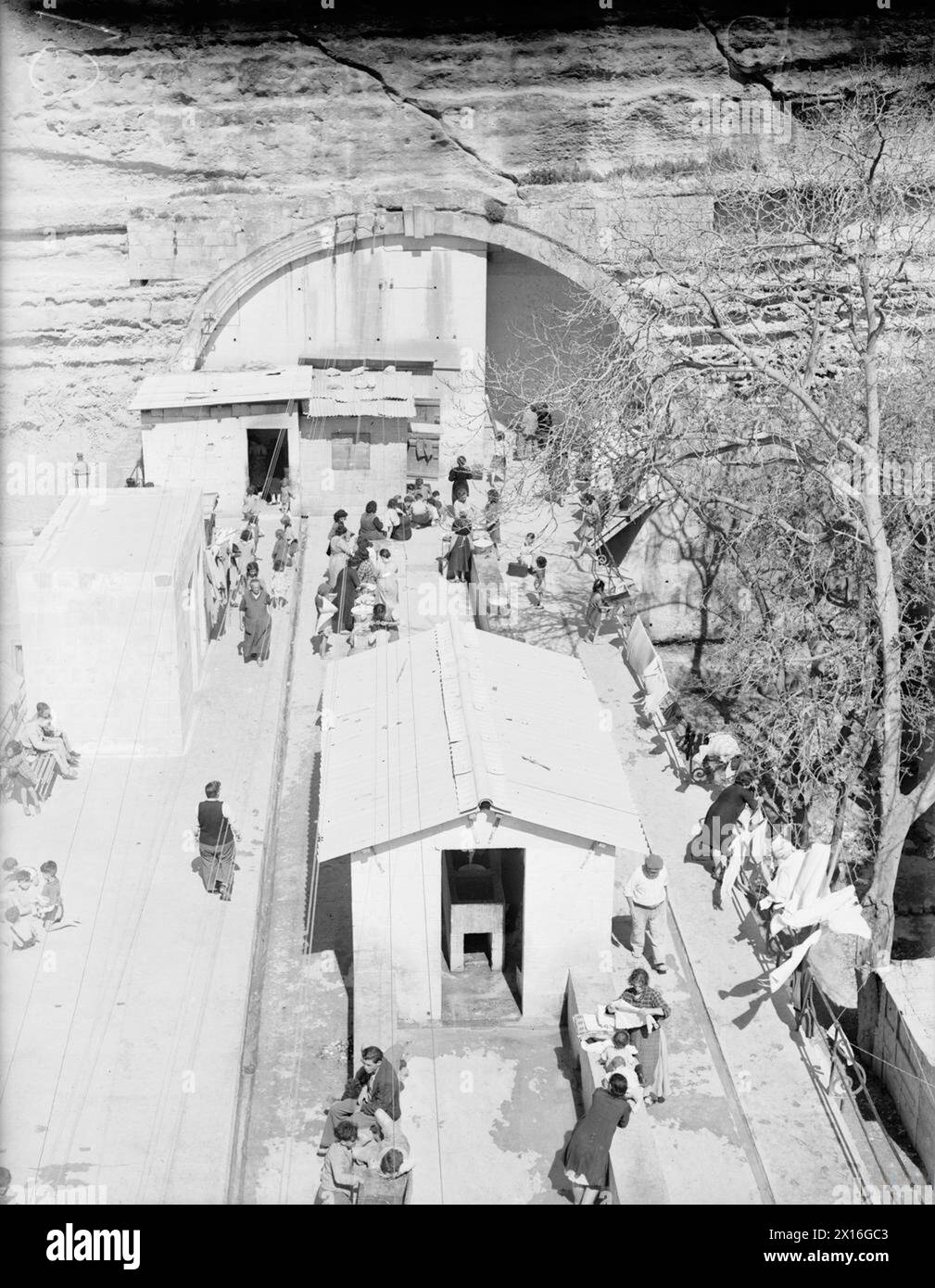
air raid, April 7, 1942. Thousands of civilians lived underground for
months during the siege. Photo: piemags/ww2archive (Public
Domain)
The Men Who Held the Sky
Malta’s survival depended on a handful of determined leaders and the
pilots who flew against impossible odds.
Governor Sir William Dobbie led the island through
the initial and most intense phases of the siege. A deeply religious man
who distributed daily Bible verses to his troops, Dobbie tirelessly
lobbied London for modern aircraft and supplies. His calm, resolute
leadership helped steady civilian morale when panic might have been
understandable.
The real turning point in the air war came in July 1942 with the
arrival of Air Vice-Marshal Sir Keith Park — the same
man who had commanded 11 Group RAF during the Battle of Britain. Park
immediately scrapped the defensive tactics that had been bleeding
Malta’s fighter strength. Instead of waiting for enemy formations to
arrive over the island, he ordered his Spitfires to intercept them
early, over the sea, before they could form up for their bombing runs.
The results were dramatic. Axis losses mounted, and Malta’s air defenses
began to bite back.
Among the pilots who flew from Malta’s battered airfields, one name
stands above the rest: George “Screwball” Beurling, a
Canadian ace who arrived in June 1942. In just four months of combat
over Malta, Beurling shot down 29 Axis aircraft,
becoming one of the highest-scoring Allied aces of the war. He flew with
a cold, almost mathematical precision, calculating deflection angles in
his head mid-dogfight. His fellow pilots called him a natural killer.
The Maltese called him a savior.
“To Honour Her Brave People”
On April 15, 1942 — at the very height of the blitz,
when the island seemed on the verge of collapse — King George VI made a
gesture unprecedented in British history. He awarded the George
Cross, the highest civilian honor for bravery, to the entire
island of Malta.
His handwritten message read:
“To honour her brave people I award the George Cross to the
Island Fortress of Malta to bear witness to a heroism and devotion that
will long be famous in history.”
It was the first and only time the George Cross had ever been awarded
to an entire people rather than an individual. The award was
incorporated into Malta’s national flag, where the cross remains to this
day — a permanent reminder of what the island endured and refused to
yield.

Square), Valletta, September 13, 1942. Chief Justice George Borg
received the George Cross on behalf of the people of Malta. Photo:
The National Archives of Malta
Operation
Pedestal: The Convoy That Saved Malta
By August 1942, Malta was weeks away from collapse. Fuel reserves
were nearly exhausted. Food stocks were critically low. The island’s
Spitfires would soon be grounded for lack of aviation fuel. If a supply
convoy didn’t get through, Malta would have to surrender.
Operation Pedestal was the answer — and it was a
desperate gamble. Fourteen merchant ships, escorted by one of the
largest naval forces ever assembled in the Mediterranean (including four
aircraft carriers, two battleships, seven cruisers, and 32 destroyers),
set out from Gibraltar on August 3, 1942.
The Axis knew they were coming. The convoy ran a gauntlet of
submarines, torpedo boats, and aircraft for five days. The losses were
catastrophic:
- 9 of 14 merchant ships were sunk
- The aircraft carrier HMS Eagle was torpedoed and
sunk in eight minutes - Two cruisers and a destroyer were also lost
- Hundreds of sailors died
Yet five ships made it through. And among them was the one that
mattered most: the American tanker SS Ohio.
Ohio had been hit by a torpedo, bombed twice, and had a crashed
German aircraft embedded in her deck. She was on fire, her back nearly
broken, barely afloat. But she carried 11,500 tons of aviation fuel —
the lifeblood of Malta’s air defenses. Her crew refused to abandon her.
Lashed between two destroyers, she was towed into Grand Harbour on
August 15, 1942, her deck awash, her engines dead, her crew standing at
attention on the listing deck.
The crowds lining the harbor walls wept. The Ohio had saved
Malta.
Allied planners had been aided throughout the siege by Ultra
intelligence — the decrypted Axis signals from Bletchley Park —
which provided crucial insight into enemy convoy routes and attack
plans, allowing Malta’s forces to strike with devastating precision.
The Tide Turns
The arrival of Pedestal’s supplies marked the beginning of the end
for the siege. With fuel restored and air superiority gradually
regained, Malta switched from desperate defense to aggressive
offense.
The results were immediate and decisive. From December 1942 to May
1943, Malta-based aircraft and submarines sank 230 Axis
ships, achieving the highest Allied sinking rate of the entire
war. Rommel’s supply lines, already strained, were severed. His Afrika
Korps, starved of fuel and ammunition, could not withstand the Allied
offensives that followed.
The siege was formally lifted in May 1943. Within weeks, Malta had
become the primary Allied headquarters and staging area for
Operation Husky — the invasion of Sicily that opened
the door to Italy and the soft underbelly of Fortress Europe.
The island that had been bombed to the brink of annihilation had not
merely survived. It had become the platform from which the liberation of
Europe began.
An Island’s Legacy
The Siege of Malta lasted 906 days. In that time, the Maltese people
endured more bombs per square mile than any other place on Earth. They
lived underground, went hungry, buried their dead, and kept fighting.
They were awarded the highest civilian honor in the British Commonwealth
— not one person, but an entire nation.
Rommel was right: without Malta, the Axis would lose North Africa.
But he was wrong about one thing. He assumed Malta could be broken. It
couldn’t. The island’s defiance cost the Axis the desert war, opened the
Mediterranean to Allied shipping, and set the stage for the invasion of
Europe.
Sometimes, the smallest places change the biggest wars.
The George Cross awarded to Malta in 1942 is displayed at the
Palace of the Grand Masters in Valletta. The tanker SS Ohio’s anchor is
preserved as a memorial at the Malta Maritime Museum. Faith, the last
surviving Gladiator biplane, can be seen at the Malta War
Museum.
References
- Siege of Malta (World War II) — Wikipedia
- How Malta Survived The Second World War — Imperial War Museums
(iwm.org.uk) - Operation Pedestal: The Rescue of Malta — Warfare History
Network - The George Cross awarded to island of Malta — RAF Benevolent
Fund - Forgotten Fights: Malta’s Faith, Hope, and Charity, 1940 — National
WWII Museum - Malta awarded the George Cross on April 15, 1942 — Times of
Malta