
On the afternoon of March 7, 1945, a group of American soldiers
crested a hill overlooking the small German town of Remagen and couldn’t
believe their eyes. There, spanning the Rhine River—Germany’s last
natural defensive barrier—stood an intact railway bridge. Every other
crossing for miles had been blown to rubble by retreating German forces.
This one, impossibly, was still standing.
What happened next would become one of the most dramatic episodes of
World War II’s final chapter: a desperate dash across a bridge rigged to
explode, a furious Hitler ordering executions, ten days of relentless
German attacks involving everything from jet bombers to V-2 rockets, and
a collapse that ultimately came too late to matter.
This is the story of the “Miracle at Remagen.”

forces in March 1945, photographed from the Erpeler Ley. (U.S. Army
Signal Corps, Public Domain)
Germany’s
Last Line: The Strategic Importance of the Rhine
By early March 1945, Nazi Germany was a nation in its death throes.
Allied armies had liberated France, Belgium, and the Netherlands. They
had pushed through the Siegfried Line and stood poised on the western
bank of the Rhine River. But the Rhine represented more than just
another river—it was Germany’s final natural fortress, a wide,
swift-flowing barrier that the German High Command believed could delay
the inevitable Allied victory for months.
Understanding this, the Germans had systematically destroyed nearly
every bridge spanning the Rhine. Allied commanders, including Supreme
Commander Dwight D. Eisenhower, were preparing for massive amphibious
assault operations. Field Marshal Bernard Montgomery’s Operation
Plunder, scheduled for late March, would involve elaborate river
crossings with pontoon bridges, naval support, and airborne drops—a
costly, time-consuming endeavor.
The Ludendorff Bridge at Remagen was a 325-meter steel railway bridge
built during World War I. Named after German General Erich Ludendorff,
it connected the town of Remagen on the west bank to the village of
Erpel on the east. In the grand scheme of Allied planning, it was a
minor crossing in a quiet sector. Nobody expected it to change the
course of the war.
“The Bridge Is Still
Standing!”: March 7, 1945
Combat Command B of the U.S. 9th Armored Division, under Brigadier
General William Hoge, was advancing through the Rhineland as part of
Operation Lumberjack, clearing German forces from the west bank. When
scouts reported that the Ludendorff Bridge was still intact, officers
initially dismissed it as a mistake. Bridges didn’t survive this close
to the front.
But it was true. And the reason it still stood was a perfect storm of
German confusion, Hitler’s paranoid micromanagement, and sheer bad
luck.
Hitler, furious after an Allied bomb had accidentally triggered
demolition charges on another bridge, had decreed that explosives could
only be armed when the enemy was within 8 kilometers and required
written authorization to detonate. This created a paralyzing hesitation
among German officers, who feared execution for destroying a bridge too
early—or too late.
As American tanks and infantry approached around 3:15 p.m., the
German defenders made their move. The first demolition attempt blew a
30-foot crater in the western approach ramp but left the main bridge
intact. The second, larger charge—meant to drop the central span into
the Rhine—failed catastrophically. Whether due to faulty wiring, the use
of weaker civilian-grade “Donarite” explosives instead of military
charges, or sabotage by forced laborers, the massive explosion merely
lifted the bridge and shook it violently before it settled back onto its
piers, damaged but usable.

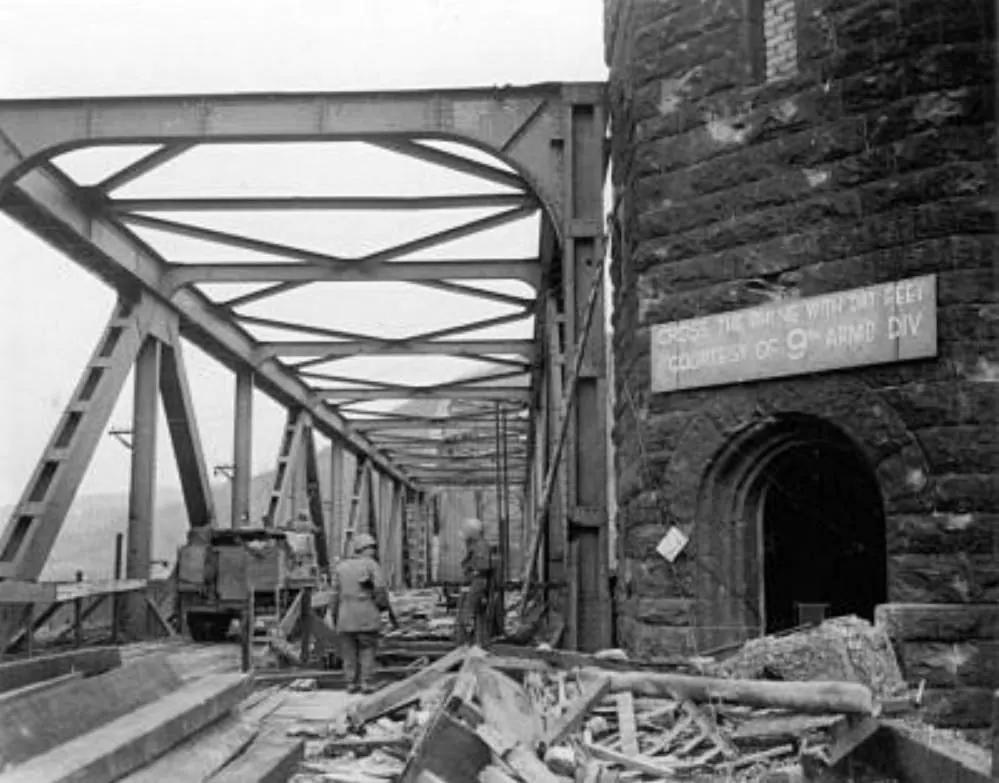
Bridge reads “CROSS THE RHINE WITH DRY FEET COURTESY OF 9TH ARM’D DIV”.
(U.S. Army Signal Corps, Public Domain)
Lieutenant Karl Timmermann, who had been promoted to command Company
A, 27th Armored Infantry Battalion just hours earlier, saw his chance.
“We’re going across!” he shouted. Under withering machine-gun fire from
German defenders on the eastern bank, Timmermann led his men in a
desperate sprint across the bridge’s catwalks. Soldiers cut demolition
wires as they ran. Sergeant Alexander A. Drabik became the first
American to reach the far side, with Timmermann close behind as the
first officer.
Within minutes, they had secured the eastern bank. Within 24 hours,
over 8,000 Allied troops had crossed the Rhine. The impossible had
happened.
Hitler’s Rage:
Executions and Retribution
When news reached Adolf Hitler’s bunker that the Americans had
captured an intact bridge over the Rhine, the Führer exploded in fury.
He viewed the failure as nothing short of treason. Within days, he
convened a special court-martial and ordered the execution of several
officers responsible for the bridge’s defense.
Major Hans Scheller, who had arrived to take command of the bridge
defenses only hours before its capture, was among those executed.
Captain Willi Bratge, the bridge’s actual commander, was sentenced to
death in absentia after being captured by the Americans. The brutal
purge sent shockwaves through the German officer corps, but it did
nothing to recapture the bridge.
Hitler’s response was not limited to executions. He ordered the
bridge destroyed at any cost, unleashing a ten-day campaign of attacks
that would employ nearly every weapon in Germany’s dwindling
arsenal.
Ten Days of Fury: The
German Assault
From March 7 to March 17, the Ludendorff Bridge became the most
attacked target in the European theater. The Americans, recognizing its
value, assembled one of the largest anti-aircraft concentrations of the
war to protect it. What followed was a showcase of desperation and
technological warfare.
Conventional Bombardment: German artillery and
mortars pounded the bridge and bridgehead relentlessly. Ground forces
launched multiple counterattacks, but the growing American presence
repulsed them all.
Luftwaffe Attacks: Despite fuel shortages and Allied
air superiority, the Luftwaffe flew over 367 sorties against the bridge.
Among the attackers were Arado Ar 234B-2 jet bombers—the world’s first
operational jet bombers—representing Germany’s cutting-edge technology
thrown into a last-ditch effort.
Super-Heavy Artillery: The Germans deployed a 600mm
Karl-Gerät siege mortar, a massive weapon designed to destroy
fortifications, firing enormous shells at the bridgehead.
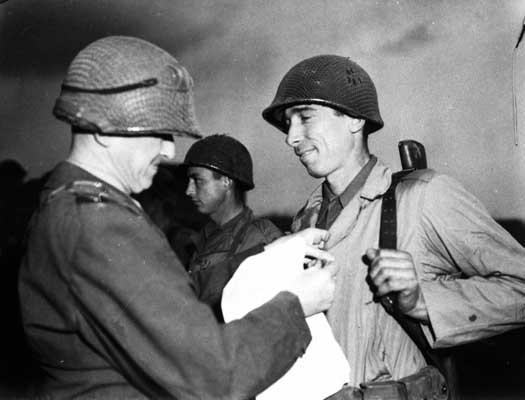
at Remagen, receiving the Distinguished Service Cross for his heroism on
April 5, 1945. (National Archives and Records Administration, Public
Domain)
V-2 Ballistic Missiles: In an unprecedented move,
Hitler ordered V-2 rockets—previously reserved for strategic terror
bombing of cities—to be used against a tactical target. On March 17,
eleven V-2s were launched from the Netherlands. While they caused
casualties in surrounding towns, the closest impact was 300 meters from
the bridge. The V-2’s inaccuracy made it useless for precision
strikes.
Special Operations: German engineers sent floating
mines and explosive-laden boats downriver. Elite navy frogmen attempted
to plant charges on the bridge piers under cover of darkness. But the
Americans deployed newly developed Canal Defence Lights—powerful
searchlights that illuminated the river—leading to the swimmers’ capture
or death.
Despite this extraordinary effort, none of the German attacks
succeeded in destroying the bridge.
The Collapse: March 17, 1945
Ironically, what German weaponry couldn’t accomplish, structural
stress did. The bridge had been damaged by the initial German demolition
attempt, weakened by constant shelling, and strained by the weight of
thousands of troops, tanks, and supply vehicles crossing day and night.
U.S. Army engineers worked around the clock to reinforce the structure,
but the cumulative damage was taking its toll.
At approximately 3:00 p.m. on March 17, 1945—exactly ten days after
its capture—the Ludendorff Bridge gave a final groan and collapsed into
the Rhine. Twenty-eight American engineers working on the structure were
killed, and 63 others were injured.
But by then, it didn’t matter.

ten days after its capture. (U.S. Army, Public Domain)
In those ten crucial days, the bridge had allowed approximately
125,000 Allied troops—five to six full divisions—to pour across the
Rhine with their tanks, artillery, and supplies. U.S. Army combat
engineers had already constructed several heavy-duty pontoon and Bailey
bridges nearby. The flow of men and materiel into Germany’s heartland
continued uninterrupted.
Legacy: The Miracle
That Shortened the War
The capture of the Ludendorff Bridge completely unhinged German
defensive strategy. It forced a rapid redeployment of German reserves,
disrupted defensive lines, and allowed Allied forces to envelop the
Ruhr—Germany’s industrial heartland. The unexpected breakthrough
accelerated the Allied timetable and changed operational plans on the
fly.
General Eisenhower and military historians widely agree that the
“Miracle at Remagen” shortened the war in Europe by weeks, possibly
months. Every week the war ended earlier meant thousands of lives
saved—Allied soldiers, German civilians, and concentration camp
prisoners racing against time.
Lieutenant Karl Timmermann, the young officer who led the charge
across the bridge, was awarded the Distinguished Service Cross.
Tragically, he died in 1951 at age 36 from a heart condition, possibly
related to the stress of that fateful day. Sergeant Alexander Drabik,
the first American across, returned to his job as a butcher in Ohio and
lived until 1993.
Today, the two surviving stone towers on the western bank house the
Peace Museum Bridge at Remagen, a memorial dedicated to the bridge’s
history and a monument to the costs of war. The eastern towers were
demolished in the 1970s. The bridge itself was never rebuilt—a pontoon
ferry now connects Remagen and Erpel.
The story of Remagen reminds us that in war, as in life, fortune
favors the bold. A young lieutenant’s split-second decision to charge
across a bridge that should have been destroyed changed the course of
history. Sometimes, the difference between victory and defeat comes down
to a faulty wire, a moment of courage, and a bridge that refused to
fall—at least, not when it mattered most.