
On the cold night of March 24, 1944, a group of Allied airmen crouched in the darkness 30 feet beneath a German prisoner-of-war camp. After nearly a year of backbreaking labor, their tunnel—codenamed “Harry”—was finally complete. One by one, they crawled through the narrow passage toward freedom, knowing that discovery meant death. By dawn, 76 men had escaped from Stalag Luft III in what would become the largest breakout of World War II.
What followed was a desperate manhunt across Nazi Germany, a shocking massacre ordered from the highest levels of the Third Reich, and a story of courage that would captivate the world for generations.

The “Escape-Proof” Prison
Stalag Luft III sat in the pine forests near Sagan, Lower Silesia (now Żagań, Poland), about 100 miles southeast of Berlin. The German Luftwaffe had designed it specifically to hold captured Allied airmen, and they were confident it was escape-proof.
The camp’s security was formidable. It was built on sandy soil—the top layer dark grey, but the sand below a bright, telltale yellow that would be instantly visible if scattered on the surface. The prisoner barracks were raised two feet off the ground so guards could easily spot tunnel entrances. Most ingeniously, the Germans had buried seismograph microphones nine feet deep around the perimeter to detect the sound of digging.
Despite these obstacles, the prisoners saw escape attempts as their duty. Every man who broke out, even if recaptured, tied up German resources that could otherwise be used at the front. And life in Stalag Luft III, while restrictive, offered opportunities. The Luftwaffe treated captured airmen with a degree of professional respect, and Red Cross parcels supplemented meager rations. The prisoners organized classes, built a library, staged theatrical productions, and even ran sports leagues.
But beneath this veneer of civilized captivity, a massive conspiracy was taking shape.
Big X and the Audacious Plan
In spring 1943, Squadron Leader Roger Bushell—a South African-born RAF pilot and barrister known as “Big X”—proposed something unprecedented: a mass escape of 200 men through not one, but three simultaneous tunnels.
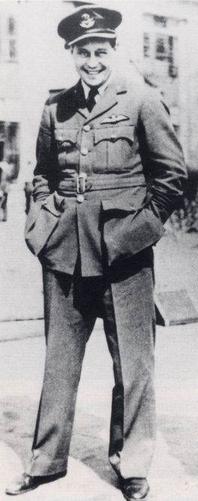
Bushell was a natural leader with a brilliant legal mind and an iron will. Shot down in 1940, he’d already made two escape attempts. The second time, he’d been sheltered by Czech resistance fighters and nearly made it to Switzerland before being betrayed. The Gestapo had interrogated him brutally, and he’d witnessed the execution of his Czech helpers. He returned to Stalag Luft III with a burning determination and a chilling warning from the Gestapo: if he tried to escape again, he would be shot.
Bushell’s plan was breathtakingly ambitious. Three tunnels—codenamed “Tom,” “Dick,” and “Harry”—would be dug simultaneously. If the Germans discovered one, they’d assume they’d found the only tunnel and stop searching. The tunnels would go 30 feet deep to avoid the seismograph microphones and stretch over 300 feet to reach the forest beyond the wire.
Over 600 prisoners were recruited for the operation. It became the most elaborate escape organization in POW history.
Engineering the Impossible
The construction of the tunnels was a masterpiece of improvisation and ingenuity. Prisoners scavenged materials from every corner of the camp:
- 4,000 wooden bed boards were “liberated” to shore up the tunnel walls (prisoners slept on sagging mattresses)
- 1,700 blankets were used to muffle sounds and line the tunnels
- 1,400 powdered milk cans from Red Cross parcels were fashioned into digging tools, lamps, and air ducts
- 90 double bunk beds were dismantled for timber
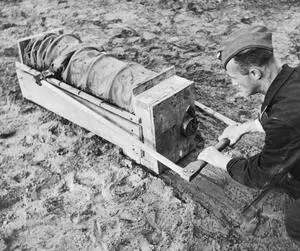
The tunnels themselves were engineering marvels. Each was just two feet square—barely large enough for a man to crawl through. Wooden shoring prevented collapse in the treacherous sandy soil. A hand-operated air pump, built from kit bags and hockey sticks, pushed fresh air through pipes made from milk cans. A rope-pulled trolley system on wooden rails transported diggers and excavated sand.

But the greatest challenge was disposing of over 100 tons of bright yellow sand. Enter the “penguins”—prisoners who filled long bags made from socks or underwear, wore them inside their trousers, and casually strolled around the compound. Through small holes in the bags, they’d release the sand bit by bit, kicking it into the darker topsoil. It was painstaking, nerve-wracking work done under the constant watch of guards.
Meanwhile, other teams worked on equally vital tasks. Forgers created hundreds of fake identity papers and travel documents. Tailors transformed blankets and uniforms into civilian clothing. A network of “stooges” developed an elaborate warning system to alert workers when guards approached.
The Germans discovered “Tom” in September 1943, and “Dick” was abandoned and used for storage. But “Harry” continued, inching forward through the winter months.
The Night Everything Went Wrong
March 24, 1944, was chosen for the breakout—a moonless night that would provide maximum darkness. Two hundred men were selected and given numbers determining their order of escape. The first 30 were “serial offenders” with the best chance of making it home. They’d go first, with the best forged papers and civilian clothes.
At 10:30 PM, the first man crawled into Harry’s entrance, hidden beneath a stove in Hut 104. But from the start, nothing went according to plan.
When the lead escapee broke through to the surface, he made a horrifying discovery: the tunnel was short. Instead of emerging in the concealing darkness of the forest, the exit was several feet from the tree line, in clear view of a guard tower. A partial tunnel collapse had to be repaired, causing delays. Then an air raid cut the camp’s electricity, plunging the tunnel into darkness for an hour.
The escape rate slowed to a crawl—fewer than a dozen men per hour instead of the planned one per minute. Escapees had to wait in the freezing darkness at the tunnel exit, watching for the guard to turn away before making a dash for the trees.
At approximately 5:00 AM on March 25, a German patrol guard nearly fell into the exit hole. The alarm was raised. Guards rushed to Hut 104 and found prisoners still waiting to escape. The operation was over.
Seventy-six men had made it out. It was far fewer than the planned 200, but it was still the largest escape from a German POW camp in the entire war.
The Manhunt and Hitler’s Rage
The escape triggered a massive manhunt. The Gestapo, Wehrmacht, and local police mobilized across Germany. Roadblocks went up. Train stations were watched. The entire Nazi security apparatus was focused on finding 76 Allied airmen.
Within two weeks, 73 of the escapees had been recaptured. Only three men achieved what prisoners called a “home run”:
- Per Bergsland and Jens Müller, two Norwegian pilots, made it to the port of Stettin and stowed away on a Swedish freighter, reaching neutral Sweden.
- Bram van der Stok, a Dutch pilot, traveled by train across occupied Europe, made it through France and into Spain, and eventually reached Gibraltar.

For the others, recapture seemed to mean a return to camp and perhaps solitary confinement. But Adolf Hitler had other plans.
The Sagan Order: Murder by Decree
Hitler was enraged. He viewed the mass escape as a profound humiliation and initially ordered that all recaptured prisoners be shot. Heinrich Himmler, head of the SS, and Hermann Göring, head of the Luftwaffe, reportedly persuaded him to reduce the number to “more than half” to avoid potential Allied reprisals.
Himmler issued what became known as the “Sagan Order,” instructing the Gestapo to execute 50 of the recaptured airmen. The selection was deliberate: troublemakers, serial escapers, and leaders were marked for death.
In a flagrant violation of the Geneva Convention, Gestapo agents took the condemned men in small groups to remote locations. Under the pretext of stopping for a rest or being transported to another camp, they were shot—typically at close range. The Gestapo fabricated reports claiming the men were “shot while trying to escape.”
Roger Bushell was among them. Captured near Saarbrücken with a French resistance member, he was driven to a remote road and shot in the back. He was 33 years old.
The bodies were cremated, and urns containing the ashes were returned to Stalag Luft III. The remaining prisoners held a memorial service, and the grim message was clear: the Nazis would not tolerate defiance.
Justice and Legacy
After the war, the British government launched a major investigation to bring the murderers to justice. RAF investigators tracked down dozens of former Gestapo officers. In 1947, a military tribunal in Hamburg tried 18 of them, resulting in 13 executions and several long prison sentences.
The Great Escape became one of the most famous episodes of World War II, immortalized in Paul Brickhill’s 1950 book (Brickhill had been a prisoner at Stalag Luft III and helped with the escape preparations) and the iconic 1963 film starring Steve McQueen, James Garner, and Richard Attenborough.
While the film took significant artistic liberties—most notably by inserting American characters into the breakout itself and inventing the famous motorcycle chase—it captured the spirit of ingenuity, courage, and defiance that defined the real escape.
Today, a memorial stands at the site of the former camp in Żagań, Poland, honoring the 50 men who were murdered for their audacious bid for freedom. Their names are inscribed in stone, a permanent reminder of both the courage of those who refused to accept captivity and the brutality of the regime they fought against.
The Great Escape didn’t change the course of the war. But it tied up thousands of German troops in the manhunt, exposed the Nazi regime’s willingness to commit war crimes even against Western Allied prisoners, and demonstrated that the human spirit—even behind barbed wire—could never truly be imprisoned.