
The date was January 7, 1942. Just one month after Pearl Harbor
plunged America into World War II, the last remnants of U.S. and
Filipino forces in the Philippines were making a desperate retreat.
Behind them, the Japanese 14th Army was advancing on Manila. Ahead lay
the rugged, jungle-covered Bataan Peninsula—a natural fortress that
would become the stage for one of the Pacific War’s most harrowing
sieges.
For 99 days, approximately 80,000 soldiers would hold the line
against overwhelming odds, buying precious time for the Allied cause.
But they would pay a terrible price: starvation, disease, and
ultimately, surrender followed by one of history’s most brutal war
crimes.

of Bataan, January-April 1942. U.S. Army Center of Military History.
Retreat to the Last Line of
Defense
When Japanese forces invaded the Philippines on December 8, 1941—just
hours after Pearl Harbor—General Douglas MacArthur initially abandoned
the pre-war defensive strategy known as War Plan Orange-3. Instead, he
attempted to defend the entire archipelago along its coastlines. It was
a catastrophic miscalculation.
The speed and ferocity of the Japanese landings at Lingayen Gulf on
December 22 quickly overwhelmed the ill-equipped defenders. Within days,
MacArthur was forced to revert to the original plan: a fighting retreat
to the Bataan Peninsula, where the rugged terrain and narrow front would
favor the defenders.
There was just one critical problem. Because supplies had been
dispersed across the islands for MacArthur’s coastal defense plan, the
depots on Bataan were woefully understocked. Only a two-month supply of
food awaited the forces that would soon be trapped there—and that
estimate assumed a garrison of 43,000 men, not the 80,000 troops and
26,000 civilians who would ultimately crowd onto the peninsula.
Manila was declared an open city on December 26 to spare it from
destruction. By January 2, 1942, Japanese forces occupied the capital.
Five days later, the last USAFFE (United States Army Forces in the Far
East) troops completed their withdrawal into Bataan. The siege had
begun.
The Battling Bastards of
Bataan
The defenders of Bataan quickly earned a nickname that captured both
their pride and their abandonment: the “Battling Bastards of Bataan.” A
bitter poem circulated among the troops:
“We’re the battling bastards of Bataan;
No mama, no papa, no Uncle Sam,
No aunts, no uncles, no cousins, no nieces,
No pills, no planes, or artillery pieces,
And nobody gives a damn.”
The sentiment was understandable. MacArthur’s communiques from his
headquarters on Corregidor Island promised that “thousands of planes”
and reinforcements were on the way. They never came. The reality was
stark: after Pearl Harbor, the U.S. Pacific Fleet was crippled, and
Europe took priority. The Philippines were on their own.
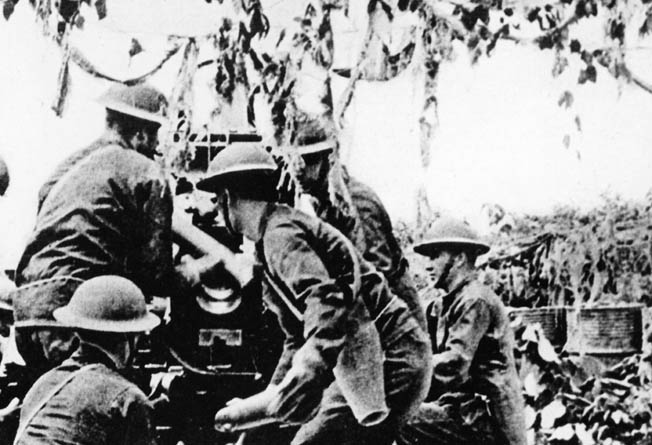
Peninsula during the siege, January-March 1942. U.S. Army Signal Corps /
National Archives.
A Slow Death by Starvation
The defenders established two main defensive lines across the
peninsula. The first, the Abucay-Mauban Line, stretched across the
northern part of Bataan, anchored on the towering Mount Natib. When the
Japanese launched their first major assault on January 9, the defenders
held for over two weeks of brutal fighting. But the Japanese eventually
exploited a gap in the line around the mountain’s impassable terrain,
forcing a withdrawal to the second line—the Bagac-Orion Line—by January
26.
While the terrain favored defense, the lack of supplies was
catastrophic. In early January, all troops were placed on half-rations.
By March, rations were cut again. Soldiers began losing dramatic amounts
of weight and strength. Many became too weak to perform their
duties.
To survive, the men ate anything they could find. The horses of the
26th Cavalry Regiment were slaughtered for meat. Soldiers hunted
monkeys, iguanas, snakes, and even rats. One officer recalled, “We ate
everything that walked, crawled, or flew.”
But hunger was only part of the ordeal. Bataan was a highly malarial
region, and quinine supplies were quickly exhausted. Dysentery,
beriberi, and scurvy became rampant. Field hospitals overflowed with
sick and dying men. By April, less than half the force was considered
combat-effective.
The Final Assault
Through February and March, a stalemate developed as the Japanese
forces, also exhausted and undersupplied, awaited reinforcements. For
the defenders, it was a slow descent into hell. Lieutenant General
Masaharu Homma, the Japanese commander, had underestimated the tenacity
of the Allied defense. The prolonged resistance disrupted his
operational timetable and embarrassed Imperial Headquarters.
On March 12, President Roosevelt ordered MacArthur to evacuate to
Australia to assume command of Allied forces in the Southwest Pacific.
As he departed by PT boat, MacArthur made his famous vow: “I shall
return.” Command of forces in the Philippines passed to Lieutenant
General Jonathan Wainwright, a respected field commander who would face
an impossible situation.

Signal Corps.
Reinforced and resupplied, Homma launched his final offensive on
April 3, 1942. It began with one of the most intense artillery and
aerial bombardments of the Pacific War. For five hours, Japanese guns
and aircraft pounded the Allied positions on Mount Samat, the anchor of
the Bagac-Orion Line. The bombardment shattered the defenders’ lines and
broke their will to resist.
The Filipino and American troops, weakened by months of starvation
and disease, could no longer mount an effective defense. The lines
crumbled. Thousands of sick and wounded soldiers streamed southward in a
chaotic retreat toward the tip of the peninsula.
The Largest Surrender
in American History
Major General Edward P. King Jr., commander of the Luzon Force and
the troops on Bataan, faced an agonizing decision. His army was no
longer a viable fighting force. Continuing to fight would result in a
wholesale slaughter. Against the orders of his superiors—Wainwright had
ordered him to fight to the last man—King decided to surrender.
On April 9, 1942, King met with Japanese officers under a white flag.
He surrendered approximately 75,000 Filipino and American troops—the
largest capitulation in U.S. military history. King wept as he signed
the surrender documents, knowing what awaited his men.
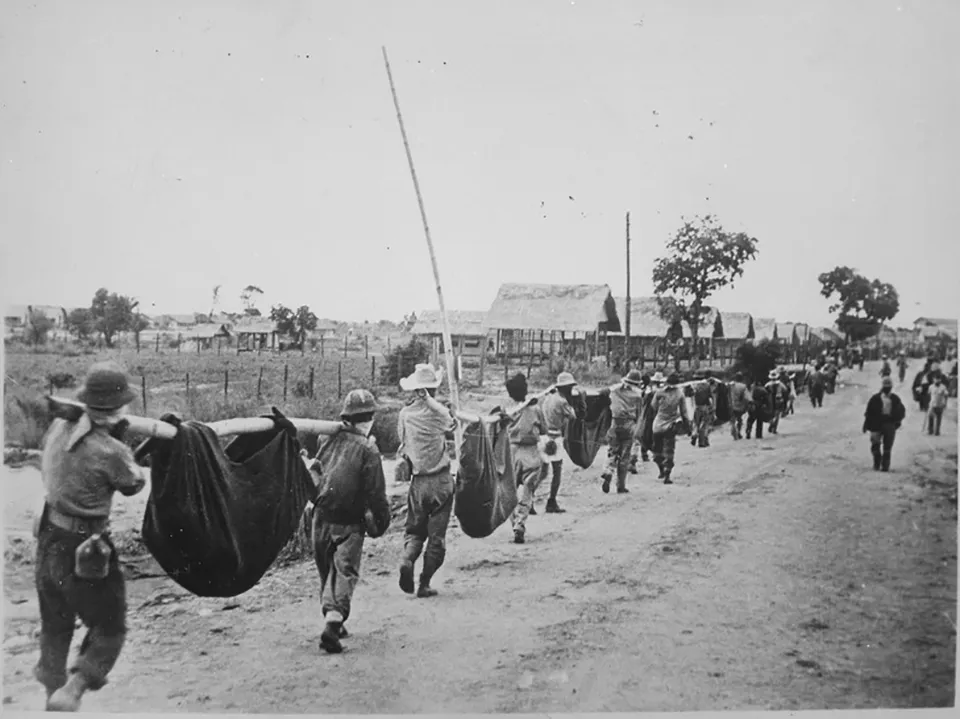
What followed was one of the most notorious war crimes of World War
II: the Bataan Death March.
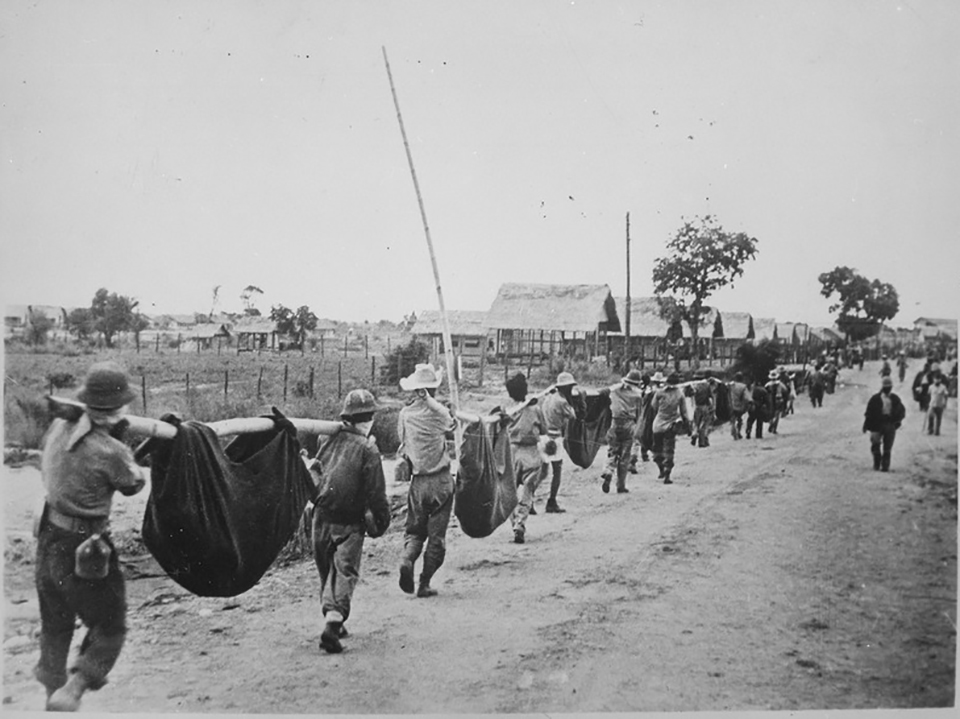
March, April 1942. U.S. National Archives (NARA 535565).
The Death March
The Japanese command was unprepared for the massive number of
prisoners. They decided to march them approximately 65 miles north from
the southern tip of Bataan to a railhead at San Fernando, from where
they would be transported to Camp O’Donnell.
The prisoners, already suffering from severe malnutrition, injury,
and disease, were forced to walk in intense tropical heat with almost no
food or water. The march was characterized by extreme brutality.
Japanese guards subjected prisoners to beatings, bayoneting, and summary
executions. Those who fell or could not keep pace were often killed on
the spot. One common form of torture was the “sun treatment,” where men
were forced to sit in direct sunlight for hours without cover.
Thousands died on the march. Estimates vary, but between 5,000 and
18,000 Filipino and 500 to 650 American soldiers perished during the
ordeal. The suffering continued at Camp O’Donnell, where thousands more
died from disease and starvation in the subsequent weeks.
A Sacrifice That Mattered
Though it ended in defeat and tragedy, the defense of Bataan had
significant strategic consequences. The 99-day siege upset the Japanese
Imperial Headquarters’ timetable for conquest in the Pacific. The fierce
resistance tied down General Homma’s 14th Army for months, preventing
those elite troops from being deployed to other critical theaters.
The delay provided the Allies with invaluable time to regroup and
reinforce their positions in the Pacific. This contributed to later
victories like the Battle of the Coral Sea in May 1942 and the
Guadalcanal campaign that began in August—turning points that halted
Japanese expansion.
The “Battling Bastards of Bataan” became legendary symbols of courage
and endurance against impossible odds. Their sacrifice is commemorated
in the Philippines, where April 9 is a national holiday known as
Araw ng Kagitingan (Day of Valor). In the United States, the
Bataan Memorial Death March is held annually in New Mexico to honor
their memory.
General Homma, held responsible for the atrocities of the Death
March, was tried and executed for war crimes in 1946. And MacArthur did
return, liberating the Philippines in 1944-1945.
The siege of Bataan stands as a testament to the human capacity for
endurance in the face of overwhelming adversity—and a stark reminder of
the cost of war.