
The sounds of battle echoed across the frozen steppe. German soldiers
trapped in the Stalingrad pocket could hear the distant rumble of tank
engines and artillery fire—their salvation, just 30 miles away. It was
December 19, 1942, and Field Marshal Erich von Manstein’s relief force
had fought through brutal winter conditions and fierce Soviet resistance
to reach the Myshkova River. The trapped 6th Army needed only to break
out and link up with the advancing panzers.
But they never came.
Operation Winter Storm, Germany’s last desperate attempt to rescue
the encircled forces at Stalingrad, would end in failure. With it died
the last hope for 300,000 men and the German dream of victory in the
East.
The Trap Closes at
Stalingrad
By late November 1942, the German 6th Army under General Friedrich
Paulus had pushed deep into the ruins of Stalingrad, fighting a brutal
house-to-house battle for control of the city. But while German
attention focused on the urban warfare, Soviet commanders were preparing
a masterstroke.
On November 19, the Red Army launched Operation Uranus—a massive
pincer movement that smashed through the weakly defended Romanian flanks
north and south of the city. Within four days, Soviet forces had linked
up, trapping approximately 300,000 Axis soldiers in a pocket around
Stalingrad.
Adolf Hitler’s response was immediate and catastrophic: the 6th Army
would not retreat. Instead, it would hold Stalingrad as a “fortress”
while being supplied by air. Luftwaffe chief Hermann Göring assured the
Führer that his aircraft could deliver the necessary supplies.
It was a fatal miscalculation. The trapped army required 680-700 tons
of supplies daily. The Luftwaffe, hampered by winter weather, Soviet
fighters, and insufficient transport aircraft, delivered less than 20%
of that amount. Inside the pocket, soldiers began to starve.
Manstein’s Gamble

Russia. Von Manstein commanded Army Group Don and led Operation Winter
Storm, the failed relief attempt to rescue the German 6th Army trapped
at Stalingrad in December 1942. (Library of Congress, LC-USZ62-104994)
With the air bridge failing, the German High Command turned to Field
Marshal Erich von Manstein, widely regarded as the Wehrmacht’s most
brilliant strategist. On November 21, he was appointed commander of the
newly formed Army Group Don with a single mission: save the 6th
Army.
Manstein devised an audacious plan. The 4th Panzer Army under Colonel
General Hermann Hoth would launch the main relief effort from
Kotelnikovo, about 75 miles southwest of the pocket. Simultaneously,
Army Detachment Hollidt would attack from the west to tie down Soviet
forces. The operation was codenamed Wintergewitter—Winter
Storm.
The plan’s success hinged on a critical assumption: the trapped 6th
Army would launch its own breakout operation, codenamed “Thunderclap,”
to link up with the relief force. Manstein needed Paulus to act.
But Manstein faced a daunting challenge. He had requested four panzer
divisions, four infantry divisions, and three Luftwaffe field divisions.
What he received was far less. The main burden fell to Hoth’s depleted
4th Panzer Army—approximately 50,000 men and 250 tanks. The spearhead,
the LVII Panzer Corps, consisted primarily of just two divisions: the
6th Panzer Division with 159 tanks and the 23rd Panzer Division with
only 30.
It was a shadow of the force needed for such a monumental task. But
it was all Manstein had.
The Desperate Push
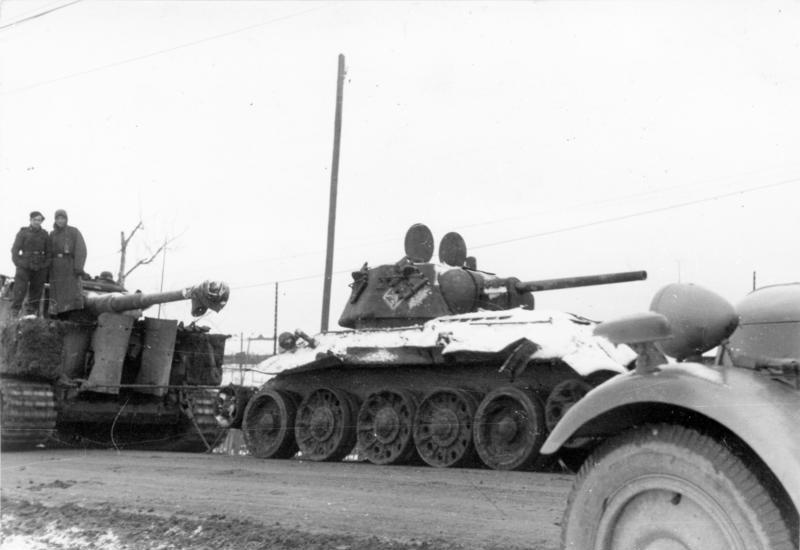
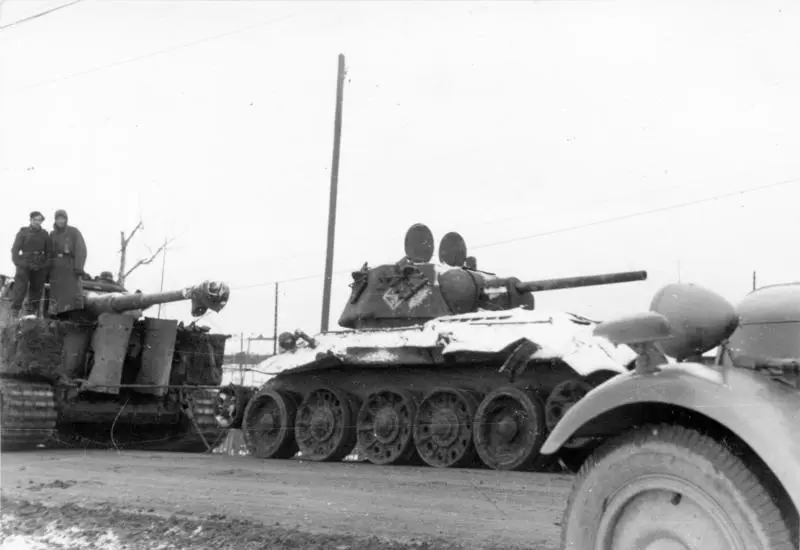
during the fighting in the southern Soviet Union. This photograph was
taken during Operation Winter Storm, Field Marshal von Manstein’s relief
attempt to break through to the encircled German 6th Army at Stalingrad
in December 1942. (Bundesarchiv Bild 101I-457-0065-36, CC BY-SA 3.0 DE)
Operation Winter Storm launched on December 12, 1942. The initial
assault achieved tactical surprise—Soviet intelligence had expected a
relief attempt from the west, not the southwest.
Hoth’s panzers, led by the 6th Panzer Division, smashed through the
Soviet 302nd Rifle Division and made rapid gains. By December 13, they
had crossed the Aksai River and were pushing toward the Myshkova. The
advance was a testament to German tactical skill and the determination
of soldiers who knew their comrades’ lives depended on their
success.
But the conditions were hellish. Temperatures plummeted to -22°F
(-30°C). Tank engines seized. Fuel lines froze. Weapons malfunctioned.
Soldiers suffered frostbite. And with every mile, Soviet resistance
stiffened.
The Red Army reacted swiftly. Colonel-General Andrey Yeryomenko,
commander of the Stalingrad Front, rushed reserves to the threatened
sector. At the village of Verkhnekumsky, Soviet units held up the German
advance for five critical days, buying time for reinforcements to
arrive.
Despite the obstacles, the German spearhead continued its desperate
race against time. By December 19, elements of the 6th Panzer Division
had reached the Myshkova River—just 30 miles from the southern perimeter
of the Stalingrad pocket.
Inside the pocket, the trapped soldiers could hear the sounds of
battle. Salvation was within reach.
The Moment of Decision

Stalingrad, cleaning their weapons. Soviet defensive tactics utilized
destroyed buildings as strongpoints, holding out against overwhelming
German attacks throughout late 1942. Photo by Georgii Zelma. (Library of
Congress, LC-USZ62-121772)
But at the Myshkova River, Hoth’s exhausted panzers encountered a
formidable new obstacle: the Soviet 2nd Guards Army under
Lieutenant-General Rodion Malinovsky. This fresh, well-equipped force
had been rushed to the sector by the Soviet High Command specifically to
stop the relief effort.
The Germans could advance no further without help from inside the
pocket. Everything now depended on General Paulus and the 6th Army
launching their breakout.
Manstein sent urgent messages to Paulus: attack southwest and link up
with Hoth’s forces. On December 19, he even sent his intelligence chief,
Major Hans Eismann, into the pocket to personally brief Paulus and
convince him to act.
But Paulus hesitated. He argued that his army had fuel for only a
20-mile advance—not enough to cover the 30 miles to Hoth’s position. His
tanks were immobile. His infantry was starving and weak. And most
critically, Hitler had explicitly ordered him to hold Stalingrad. Paulus
refused to disobey.
His chief of staff, Major General Arthur Schmidt, was vehemently
opposed to any breakout attempt. The decision was sealed: the 6th Army
would not move.
The Storm Breaks
Without a corresponding move from the 6th Army, Hoth’s panzers could
not break through the 2nd Guards Army’s defenses. And Manstein faced a
new crisis: on December 16, the Soviets had launched Operation Little
Saturn, a major offensive that shattered the Italian 8th Army on his
northern flank. Soviet forces were now threatening to encircle his
entire army group.
Manstein had no choice. On December 23, he ordered the LVII Panzer
Corps to halt its attack and begin a fighting withdrawal. By Christmas
Eve, the relief force was in full retreat.
The last hope for the 6th Army was gone.
The Aftermath

Stalingrad after the surrender of the German 6th Army in February 1943.
Approximately 91,000 German soldiers surrendered at Stalingrad, though
only about 6,000 would survive Soviet captivity to return home after the
war. (Imperial War Museums, HU 5068)
The failure of Operation Winter Storm sealed the fate of the trapped
army. Left to starve in the frozen steppe, the 6th Army was
systematically destroyed by the Red Army in Operation Ring. On February
2, 1943, Field Marshal Paulus (promoted by Hitler at the last minute)
surrendered.
Of the nearly 300,000 men trapped at Stalingrad, approximately
150,000 died during the siege. Of the 110,000 who surrendered, only
about 5,000-6,000 would survive Soviet captivity and return home after
the war.
The German defeat at Stalingrad, cemented by the failure of Winter
Storm, marked the decisive turning point on the Eastern Front. The
strategic initiative passed to the Soviet Union. From this point
forward, the Wehrmacht would be largely on the defensive in the East,
reacting to Soviet offensives rather than initiating its own.
The Great What-If
The most debated question of Operation Winter Storm remains: what if
Paulus had attacked?
Manstein argued in his memoirs that a breakout on December 19 was
“the only chance to save Sixth Army.” Had Paulus disobeyed Hitler and
attacked southwest, a link-up might have been achieved. The 6th Army
could have escaped the pocket, preserving a significant fighting force
and avoiding one of Germany’s most catastrophic defeats.
But Paulus later countered that with his tanks immobile and his
infantry starving, a breakout attempt across 30 miles of open, frozen
steppe against prepared Soviet forces would have resulted in the army’s
annihilation outside the pocket rather than inside it.
The truth likely lies somewhere in between. A breakout would have
been costly and chaotic, but it might have saved tens of thousands of
lives and prevented the complete destruction of an entire army.
Legacy of a Failed Rescue
Operation Winter Storm stands as a testament to the fatal flaws in
the German command structure. Hitler’s rigid orders overrode sound
military judgment. Paulus’s loyalty to those orders doomed his men. And
even Manstein’s strategic brilliance could not overcome inadequate
resources and overwhelming Soviet strength.
The operation was a gamble born of desperation, and its failure
confirmed that the tide of the war in the East had irrevocably turned.
The sounds of battle that echoed across the frozen steppe on December
19, 1942, were not the sounds of salvation—they were the death knell of
German ambitions in the Soviet Union.
For the men trapped in the Stalingrad pocket, those distant guns
represented their last hope. When the sounds faded and the relief force
withdrew, they knew their fate was sealed. The winter storm had passed,
leaving only the cold certainty of defeat.