
The
Malmedy Massacre: A Dark Chapter in the Battle of the Bulge
On a frigid December afternoon in 1944, in a snow-covered field at a
Belgian crossroads, one of the most shocking atrocities against American
forces in World War II unfolded. The Malmedy Massacre, as it came to be
known, would galvanize U.S. troops during the desperate Battle of the
Bulge and spark one of the most controversial war crimes trials in
history.
Hitler’s Last Gamble
By December 1944, Nazi Germany was on the defensive on all fronts.
The Allies had liberated France and were pushing toward the German
border, while Soviet forces advanced relentlessly from the east. In a
desperate bid to turn the tide, Adolf Hitler conceived a bold
counteroffensive through the Ardennes Forest of Belgium and
Luxembourg—the same route Germany had used to devastating effect in
1940.
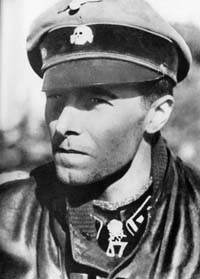
past abandoned American equipment early in the Battle of the Bulge,
December 1944. (Warfare History Network)
The plan was audacious: split the Allied armies, recapture the vital
port of Antwerp, and force the Western Allies into a negotiated peace.
On December 16, 1944, Germany launched what would become known as the
Battle of the Bulge, the largest and bloodiest single battle fought by
the United States in World War II.
Leading the charge was the 6th SS Panzer Army, commanded by SS
General Sepp Dietrich. Hitler’s orders were chilling: the advance was to
be conducted with extreme brutality, mirroring the savage warfare of the
Eastern Front. This directive created an environment where atrocities
against prisoners and civilians were not just tolerated but
encouraged.
The Spearhead: Kampfgruppe
Peiper
The armored spearhead of the German offensive was Kampfgruppe Peiper,
a formidable battle group of approximately 4,800 men and 800 vehicles,
including powerful Panther and Tiger tanks. Its commander was
SS-Obersturmbannführer (Lieutenant Colonel) Joachim Peiper, a ruthless
29-year-old officer who had previously served as Heinrich Himmler’s
adjutant.
Peiper’s mission was clear: achieve a swift breakthrough, seize key
bridges over the Meuse River, and pave the way for the main German
force. But from the outset, nothing went according to plan. Destroyed
bridges, unsuitable roads for heavy armor, and unexpectedly fierce
American resistance delayed the advance. A small U.S. reconnaissance
platoon at Lanzerath held up the German column for nearly a full day—a
delay that would prove critical to the offensive’s ultimate failure.
As delays mounted and fuel ran short, the pressure on Peiper
intensified. The Kampfgruppe’s advance became increasingly brutal. In
towns like Honsfeld and Stavelot, SS troops summarily executed American
POWs and Belgian civilians. Caring for prisoners was viewed as an
unacceptable burden that would slow the advance.
The Crossroads of Death
On December 17, 1944—the second day of the offensive—Kampfgruppe
Peiper was already significantly behind schedule. Around midday, as the
German column advanced toward Ligneuville, it encountered an American
convoy at the Baugnez crossroads, located about two miles southeast of
the town of Malmedy.
The convoy belonged to B Battery of the 285th Field Artillery
Observation Battalion, a lightly armed, non-front-line unit of about 140
men. Their role was to locate enemy artillery positions, not to engage
in direct combat. They were moving to a new position, unaware that they
were driving straight into the path of Germany’s most powerful armored
spearhead.
The encounter was brief and one-sided. German tanks opened fire,
destroying the lead and rear vehicles and trapping the rest of the
convoy. Outgunned and overwhelmed, the American soldiers had no choice
but to surrender. The SS troops disarmed the captured men and herded
approximately 120 of them into an adjacent snow-covered farmer’s
field.
“They’re Shooting the
Prisoners!”
After the Americans were gathered in the field, Joachim Peiper and
the main body of his column continued westward, leaving a contingent of
SS soldiers behind. The Germans searched the prisoners, confiscating
watches, rings, and other personal items. The Americans stood in the
cold, uncertain of their fate but expecting to be marched to a
prisoner-of-war camp.
Then, without warning, the shooting began.
Two German machine guns opened fire on the defenseless men. The
sudden barrage killed many instantly. Some soldiers attempted to flee
toward the nearby woods, while others dropped to the ground and
pretended to be dead. Following the machine-gun fire, SS soldiers walked
methodically among the fallen, executing any wounded survivors with a
single pistol shot to the head at close range—a coup de
grâce.
A small group of Americans who managed to escape to a nearby café
were killed when the SS set the building on fire and shot anyone who
tried to flee the flames. In total, 84 American soldiers were murdered
in the field at Baugnez that day.
Survivors and Witnesses
Despite the brutality, between 40 and 43 American soldiers survived
the massacre. They did so by feigning death among the bodies of their
comrades or by successfully fleeing into the nearby woods during the
chaos.
Sergeant Henry “Roy” Zach later recounted the horror of playing dead
as bodies fell on top of him. He witnessed SS soldiers kicking the
fallen to find survivors before shooting them in the head. “I could hear
them walking around,” he recalled. “I could hear the shots. I just lay
there and prayed.”
These survivors made their way to American lines in Malmedy in the
hours following the massacre. Their harrowing testimonies spread rapidly
through the U.S. ranks, transforming the battle from a military
engagement into something more personal—a fight against barbarism.
The news of the massacre had a profound impact on American troops. It
fueled a desire for revenge and led to unofficial orders in some units
to take no SS prisoners. The atrocity hardened American resolve during
the desperate weeks of the Battle of the Bulge.
Discovery and Documentation
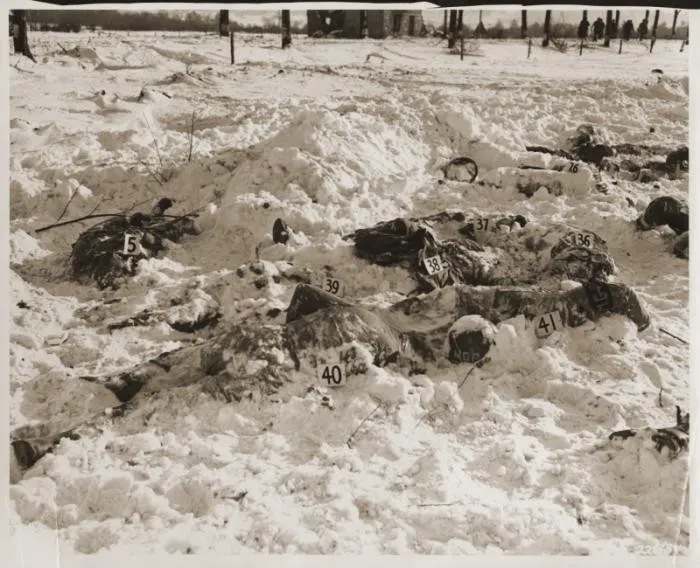
The Baugnez crossroads remained behind German lines for nearly a
month. On January 14, 1945, after the area was recaptured by U.S.
forces, military investigators reached the site. They discovered the
frozen bodies of the 84 victims, partially covered in snow.
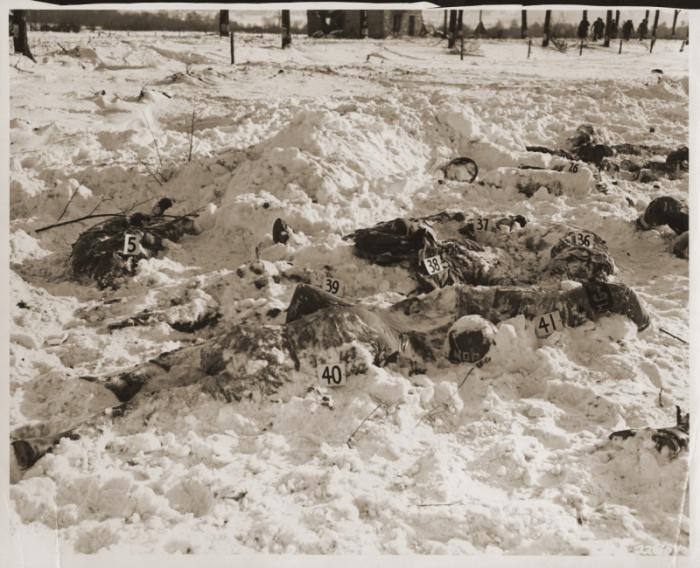
Massacre on December 17, 1944. Photographed by American investigators in
January 1945. (National Archives and Records Administration)
The scene was meticulously documented, and autopsies were performed.
The forensic evidence was damning: many of the victims had close-range
gunshot wounds to the head, confirming the survivors’ accounts of
systematic execution rather than death in combat. Bullet holes in the
backs of heads, powder burns indicating point-blank shots, and the
clustering of bodies all pointed to a deliberate war crime.
Justice Sought, Justice
Debated
After the war, the U.S. Army launched a manhunt for the perpetrators.
In May 1946, 74 members of Kampfgruppe Peiper, including Joachim Peiper
and his superior Sepp Dietrich, stood trial before an American military
tribunal at the former Dachau concentration camp.
The prosecution presented a compelling case: sworn confessions from
many defendants, testimony from seven survivors, and overwhelming
forensic evidence. On July 16, 1946, the tribunal found all defendants
guilty. Forty-three, including Peiper, were sentenced to death by
hanging.
But the story didn’t end there. The trial quickly became mired in
controversy. The defense, along with German veterans’ groups and
religious leaders, alleged that American interrogators had used mock
trials, psychological torment, and physical abuse to coerce false
confessions. These accusations gained traction in the press and led to
multiple investigations, including a U.S. Senate subcommittee hearing
led by Senator Joseph McCarthy.
While investigations largely concluded that the most serious
allegations of torture were unfounded, they did identify some procedural
irregularities. Amidst the growing political pressures of the nascent
Cold War and the strategic need to integrate West Germany as an ally,
the sentences were systematically reduced. All death sentences were
commuted. By December 1956, Joachim Peiper was released, and by 1957,
every individual convicted in the Malmedy massacre trial was free.
A Complex Legacy
The Malmedy Massacre stands as one of the most infamous war crimes
committed against American forces in the European theater of World War
II. It serves as a stark reminder of the brutal ideology of the
Waffen-SS and the nature of total war.
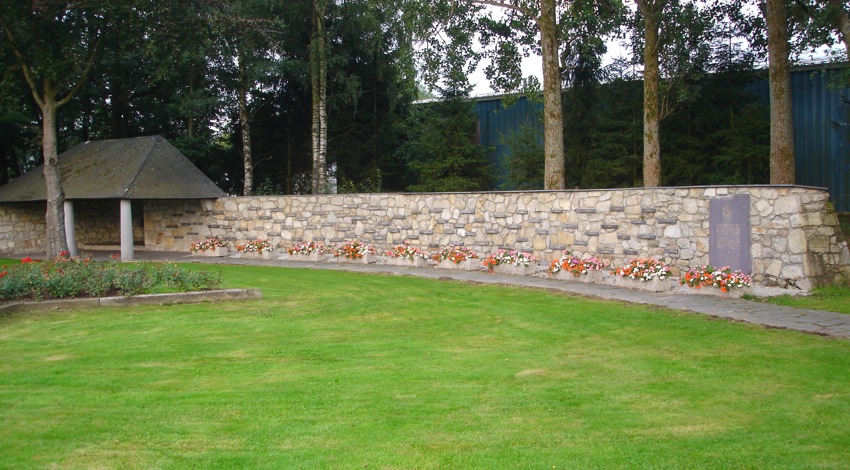
American soldiers murdered on December 17, 1944. (Wikimedia Commons)
The legacy of the post-war trial remains complex and debated. It
represents a determined effort to hold perpetrators of atrocities
accountable under international law. However, the controversy
surrounding the interrogations and the eventual release of all convicted
men have left lasting questions about whether justice was fully served
or was compromised by political expediency.
Recent historical analysis, based on declassified documents, has
strongly suggested that the claims of torture were largely fabricated in
a coordinated campaign by former Nazis and their sympathizers to
discredit the war crimes process—a sobering reminder that the battle for
historical truth often continues long after the guns fall silent.
Today, a memorial stands at the Baugnez crossroads, listing the names
of the 84 American soldiers who were murdered there. The site serves as
a solemn reminder of the atrocity and the sacrifice of soldiers who fell
not in the heat of battle, but as defenseless prisoners of war.
Joachim Peiper lived in France after his release until 1976, when he
was murdered in an attack on his home, believed to be an act of
retribution by former French Resistance members. Even in death, the
shadows of Malmedy followed him.
The massacre at Baugnez reminds us that even in the midst of a just
war against tyranny, the line between soldier and war criminal can be
crossed—and that the pursuit of justice for such crimes is never simple,
never complete, and always necessary.