
The
Casablanca Conference: When Roosevelt and Churchill Demanded
Unconditional Surrender
On January 24, 1943, President Franklin D. Roosevelt sat before a
crowd of war correspondents in the sun-drenched gardens of the Anfa
Hotel in Casablanca, Morocco. With Prime Minister Winston Churchill at
his side, he made a declaration that would reverberate through the
remainder of World War II and into the post-war world: the Allies would
accept nothing less than the “unconditional surrender” of Germany,
Italy, and Japan.
It was a phrase that would define the Allied war effort, eliminate
any hope of a negotiated peace, and spark debates among historians for
generations. But the Casablanca Conference was far more than a single
dramatic pronouncement. Over ten days of intense negotiations, the two
Western Allied leaders and their military chiefs hammered out the
strategic blueprint for 1943—decisions that would determine where and
when the next blows would fall, how the air war would escalate, and
ultimately, how the war would end.
A Secret Summit in North
Africa
The conference, codenamed SYMBOL, was held in extraordinary secrecy.
Roosevelt became the first sitting U.S. president to leave the country
during wartime, traveling by air and sea to reach Morocco. The location
was no accident. Just two months earlier, Allied forces had successfully
landed in North Africa during Operation Torch, securing French Morocco
and Algeria. The Anfa Hotel, a luxury resort overlooking the Atlantic,
was transformed into a heavily guarded compound where the fate of
nations would be decided.
By early 1943, the war had reached a critical turning point. The tide
was beginning to turn in favor of the Allies, but the path to victory
remained uncertain. In North Africa, British and American forces were
closing in on Axis troops trapped between them and Montgomery’s Eighth
Army advancing from Egypt. On the Eastern Front, the Soviet Red Army was
locked in the brutal final stages of the Battle of Stalingrad, grinding
down the German Sixth Army in a battle that would prove to be the war’s
decisive turning point.
Yet despite these successes, fundamental disagreements divided the
Western Allies. Where should they strike next? How could they best
support the Soviet Union? And what would victory actually look like?

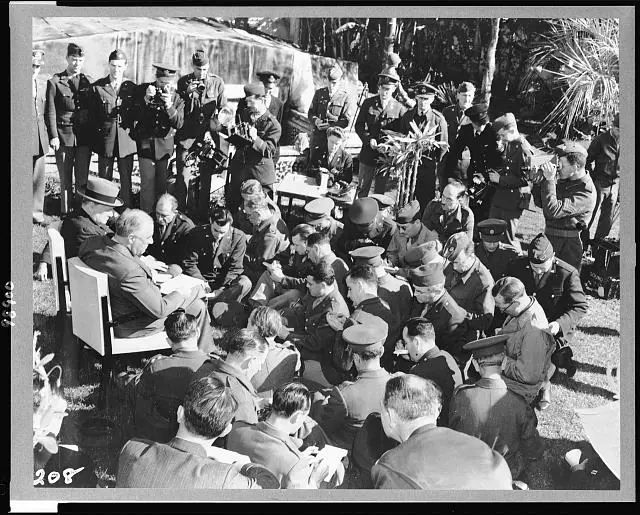
reading to the assembled war correspondents the “unconditional
surrender” announcement at the Casablanca Conference in French Morocco.
(U.S. Army Signal Corps / Library of Congress)
The
Participants: Two Leaders and a Notable Absence
Roosevelt and Churchill dominated the conference, their personal
chemistry and ability to forge compromises proving essential. But they
were not alone. Each brought their top military advisors, forming the
Combined Chiefs of Staff. The American delegation included General
George C. Marshall, Admiral Ernest J. King, and Lieutenant General H. H.
Arnold. The British were represented by General Sir Alan Brooke, Admiral
Sir Dudley Pound, and Air Chief Marshal Sir Charles Portal.
The most significant figure at Casablanca, however, was the one who
wasn’t there: Soviet Premier Joseph Stalin. Formally invited, Stalin
declined, citing the need to remain in Moscow to oversee the climactic
battle at Stalingrad. While his reason was legitimate, his absence meant
that crucial decisions about opening a “Second Front” in Europe were
made without Soviet input—a fact that would deepen Stalin’s suspicions
about his Western partners’ commitment to relieving pressure on the Red
Army.
Also present, though largely sidelined from military planning, were
the rival leaders of the Free French forces: Generals Henri Giraud and
Charles de Gaulle. Roosevelt and Churchill hoped to broker unity between
the two men, but their mutual animosity was palpable. The resulting
forced handshake for the cameras, which Roosevelt later called a
“shotgun wedding,” became one of the conference’s most awkward
moments.
The Great Debate: Where
to Strike Next?
The most contentious issue at Casablanca was strategic: where should
the Allies attack in 1943?
General Marshall and the American military staff advocated forcefully
for a cross-Channel invasion of France. They argued that only a direct
assault on Nazi-occupied Europe could deliver a knockout blow to Germany
and fulfill the promise of a second front to Stalin. The Americans
feared that further operations in the Mediterranean would be a
distraction, draining resources from the main event.
Churchill and General Brooke, however, argued that the Allies simply
weren’t ready. They lacked sufficient landing craft, trained troops, and
air superiority to guarantee success in France. A failed invasion would
be catastrophic, potentially delaying victory by years. Instead, the
British championed a Mediterranean strategy—attacking what Churchill
famously called the “soft underbelly of Europe.”
The British proposal was to invade Sicily (Operation Husky) in the
summer of 1943. The benefits were compelling: it would secure
Mediterranean shipping lanes, knock Italy out of the war, and force
Germany to divert troops from the Eastern Front to defend Southern
Europe. After days of heated debate, Roosevelt sided with Churchill. The
cross-Channel invasion would be postponed until 1944, and Sicily would
be the next major Allied offensive.
This decision would have profound consequences. It set the stage for
the Italian Campaign but also meant that the Soviet Union would bear the
brunt of fighting the German army for another year—a delay that would
shape the post-war map of Europe as the Red Army advanced westward.

Seated from left to right: Prime Minister Winston Churchill, President
Franklin D. Roosevelt, and General Sir Alan Brooke. (U.S. Army Signal
Corps / Library of Congress)
The
Combined Bomber Offensive: Round-the-Clock Destruction
Another major outcome of Casablanca was the authorization of a
massive escalation in the air war against Germany. The Combined Bomber
Offensive was a plan for coordinated, round-the-clock strategic bombing.
The British Royal Air Force would continue its large-scale night raids
on German cities and industrial centers, while the U.S. Army Air Forces
would conduct daylight precision bombing against specific military and
industrial targets—U-boat pens, aircraft factories, ball-bearing plants,
and oil refineries.
The stated goal was nothing less than “the destruction and
dislocation of the German military, industrial, and economic system.”
The campaign would grow into one of the most controversial aspects of
the Allied war effort, with debates continuing to this day about its
effectiveness and moral implications. But at Casablanca, it was seen as
a way to strike at Germany’s war-making capacity while the ground forces
prepared for the eventual invasion.
“Unconditional
Surrender”: A Policy That Changed Everything
The phrase that would define the conference came at the final press
event on January 24. With approximately 50 war correspondents assembled,
Roosevelt announced that the Allies would demand the “unconditional
surrender” of Germany, Italy, and Japan. He clarified that this did not
mean the destruction of the German, Italian, or Japanese people, but
rather the destruction of the “philosophies in those countries which are
based on conquest and the subjugation of other people.”
The policy had multiple objectives. First, it was meant to reassure
Stalin that the U.S. and Britain would not seek a separate peace with
Germany, leaving the Soviet Union to fight alone. Second, it aimed to
prevent the Axis powers from attempting to divide the Allies through
negotiated settlements. Third, it provided moral clarity and avoided the
ambiguities that had followed World War I, when the “stab-in-the-back”
myth arose in Germany claiming the army had not been truly defeated.
But the policy remains deeply controversial. Critics argue that it
was a strategic blunder that eliminated any incentive for anti-Nazi
elements within Germany to attempt a coup or for Axis leaders to seek
peace, thereby prolonging the war and increasing casualties. Some
evidence suggests that overtures from German resistance figures were
ignored by the Allies, partly due to this rigid stance.
Proponents counter that any negotiated peace with the Nazi regime was
unthinkable and that the doctrine provided essential reassurance to the
Soviet Union at a critical time. They also argue that internal German
resistance was too weak to have overthrown Hitler, making the prospect
of a negotiated peace an illusion.
Interestingly, some accounts suggest that Churchill was visibly
surprised by Roosevelt’s spontaneous public declaration, particularly
the inclusion of Italy, with whom Churchill had hoped to negotiate a
separate armistice. Regardless of any private reservations, Churchill
publicly endorsed the policy to maintain Allied solidarity.

the Casablanca Conference, where the policy of unconditional surrender
was announced to the world. (U.S. Army Signal Corps / Library of
Congress)
The Pacific Theater: Not
Forgotten
While Europe dominated the discussions, the war against Japan was
also addressed. Roosevelt, mindful of American public opinion and the
sacrifices being made in the Pacific, secured important commitments. The
conference approved the U.S. Navy’s “island-hopping” strategy through
the Central Pacific, agreed to continue operations in the Solomon
Islands, and authorized an offensive to open supply lines to China
through Japanese-occupied Burma.
These decisions ensured that the Pacific war would not be neglected,
even as the bulk of Allied resources flowed toward the defeat of
Germany.
Legacy: A Conference
That Shaped History
The Casablanca Conference set the Allied strategic agenda for 1943
and beyond. The invasion of Sicily in July 1943 led directly to the fall
of Mussolini and Italy’s surrender. The Combined Bomber Offensive
devastated German industry and paved the way for D-Day. And the
unconditional surrender policy ensured that the war would be fought to a
decisive military conclusion, giving the Allies complete authority over
the post-war reconstruction of Germany and Japan.
But the conference also had unintended consequences. The delay of the
second front deepened Stalin’s mistrust of his Western partners,
contributing to the tensions that would escalate into the Cold War. The
strategic disagreements revealed fundamental differences in how the U.S.
and Britain viewed the war and the post-war world.
Eighty-three years later, the Casablanca Conference stands as a
pivotal moment in World War II—a ten-day summit where two leaders,
meeting in secret under the North African sun, made decisions that would
shape not only the course of the war but the world that emerged from it.
Roosevelt’s declaration of unconditional surrender, whether masterstroke
or mistake, ensured that there would be no ambiguity about the war’s
end: only total victory would suffice.

Anfa Hotel during the Casablanca Conference, where they orchestrated the
famous “shotgun wedding” photo between rival French generals de Gaulle
and Giraud. (U.S. Army Signal Corps / U.S. National Archives)