
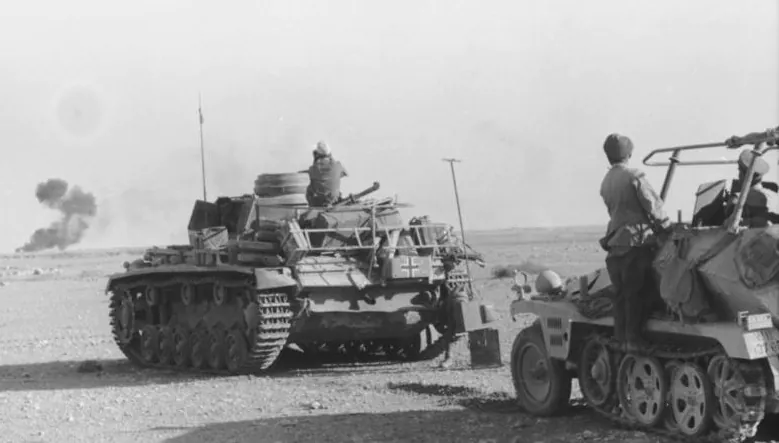
The scorching Libyan desert, May 26, 1942. Under cover of darkness,
10,000 vehicles carrying 50,000 men and 560 tanks began a sweeping arc
around the southern flank of British defenses. At their head rode
Generalfeldmarschall Erwin Rommel, the “Desert Fox,” gambling everything
on one audacious maneuver. Within three weeks, he would achieve his
greatest victory—and Britain would suffer one of its most humiliating
defeats of the war.
The Battle of Gazala was a masterclass in armored warfare, a
desperate gamble that nearly ended in catastrophe, and ultimately, a
triumph of tactical genius over numerical superiority. It was the battle
that made Rommel a legend.
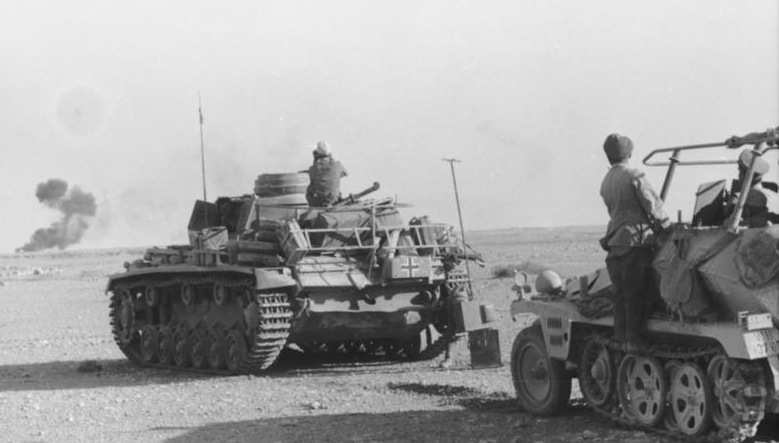
campaign, 1942. (Bundesarchiv)
The Desert Chessboard
By spring 1942, the North African campaign had become a brutal
back-and-forth struggle for control of the Mediterranean’s southern
shore. The stakes were enormous: the Suez Canal, access to Middle
Eastern oil, and the survival of the island fortress of Malta, which sat
astride Axis supply routes like a dagger pointed at Rommel’s throat.
After being pushed back to El Agheila in late 1941, Rommel had
counter-attacked in January, driving the British Eighth Army back 300
miles. The British established a new defensive line stretching 43 miles
south from the coastal town of Gazala into the empty desert—a series of
fortified “boxes” surrounded by minefields, anchored at the southern end
by the remote outpost of Bir Hakeim, held by 3,700 Free French
troops.
Lieutenant-General Neil Ritchie’s Eighth Army was formidable on
paper: 110,000 men, 843 tanks including new American M3 Grants, and air
superiority. Rommel’s Panzerarmee Afrika numbered just 90,000 men and
560 tanks. But numbers alone don’t win battles.
The Flanking Gambit
Rommel knew the British expected him to attack. What they didn’t
expect was where. On the night of May 26, Italian infantry
launched noisy frontal assaults on the northern Gazala Line—a feint. The
real blow came from the south.
Rommel’s mobile force—the Afrika Korps and Italian armored
divisions—executed a wide, sweeping hook around Bir Hakeim, intending to
swing north behind British lines, destroy their armor, and cut off the
infantry in their boxes. It was audacious. It was risky. And within 72
hours, it looked like suicide.
The Free French at Bir Hakeim fought with unexpected ferocity,
disrupting the timetable. Rommel’s panzers advanced too far, too fast,
stretching their supply lines to the breaking point. By May 29, the
Afrika Korps was trapped in a pocket between British minefields to the
west and Allied armor to the north and east—a killing ground that became
known as “the Cauldron.”
Fuel was running out. Ammunition was critically low. British tanks
were closing in from three sides. Rommel’s staff officers began
discussing surrender.
Trapped in the Cauldron
What happened next is why military historians still study Gazala
today.
Instead of panicking, Rommel pulled his forces into a tight defensive
perimeter. He positioned his dreaded 88mm anti-aircraft guns—the most
effective anti-tank weapons in the desert—to create an impenetrable
screen. While British armor battered itself against this steel wall,
Italian engineers worked frantically to clear two paths through the
minefields to the west, reopening supply routes.

during the Battle of Gazala. (Imperial War Museums)
The British, sensing victory, launched piecemeal attacks. But instead
of coordinating their infantry, artillery, and armor, they sent tank
brigades forward alone—straight into Rommel’s concentrated defenses. It
was a slaughter. The 88s picked off British tanks at ranges where the
British couldn’t effectively return fire.
On June 1, Rommel went on the offensive from within the Cauldron,
destroying the 150th Brigade Box and securing his position. A major
British counter-attack, Operation Aberdeen, was a costly disaster.
Rommel had turned the trap into a fortress.
“What difference does it make if you have two tanks to my one,”
Rommel later remarked, “when you spread them out and let me smash them
in detail?”
The Free French Stand
While Rommel consolidated his position, the garrison at Bir Hakeim
continued to defy him. For 15 days, Brigadier General Marie-Pierre
Kœnig’s 1st Free French Brigade held out against repeated ground
assaults and relentless Luftwaffe bombing. They were outnumbered,
outgunned, and surrounded, but they refused to break.
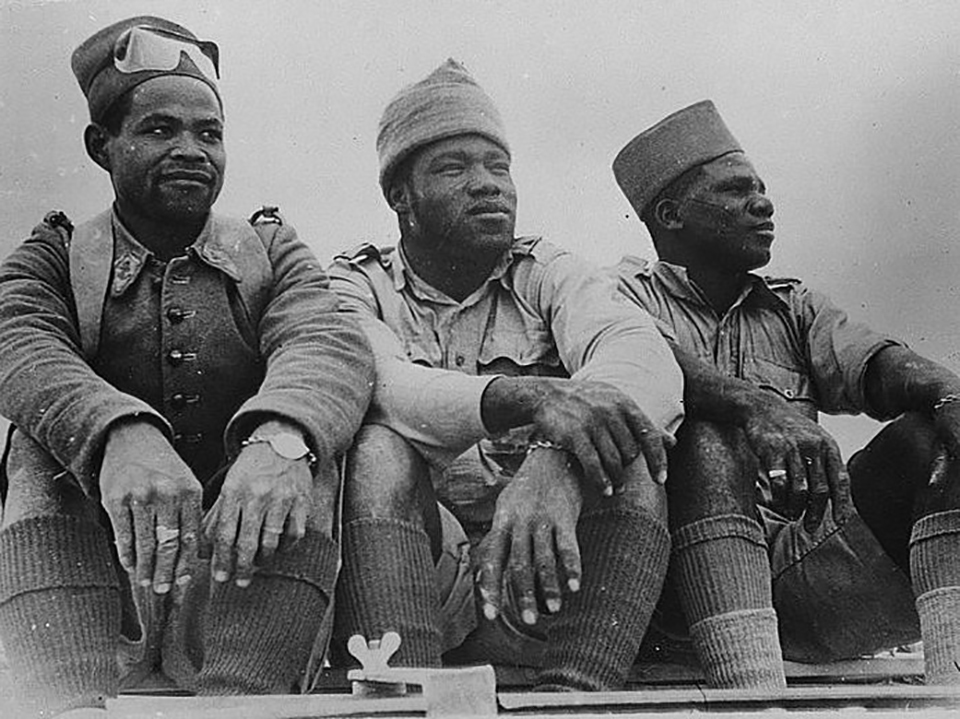
(The National WWII Museum)
The defense of Bir Hakeim was more than a military action—it was a
statement. These were men who had watched their country fall in 1940,
who had been branded traitors by the Vichy regime, who were fighting to
prove that France had not surrendered. Their stubborn resistance tied
down Axis forces and bought precious time for the Eighth Army.
On June 10, with ammunition exhausted and water running low, Kœnig
received orders to evacuate. Under cover of darkness, 2,700 of his men
broke through German lines and escaped into the desert. The stand at Bir
Hakeim became a defining moment for the Free French, celebrated by
Charles de Gaulle and earning the respect even of Rommel himself.
Black Saturday
With Bir Hakeim finally neutralized, Rommel turned his full fury on
the remaining British positions. The fighting around the Knightsbridge
box became the climax of the armored battle.
On June 13—“Black Saturday” to the British—Rommel’s
concentrated panzer divisions shattered what remained of British armor.
In a series of tactical engagements, British tank strength plummeted
from 300 operational vehicles to just 70. The Gazala Line was
finished.
General Ritchie ordered a general retreat on June 14. The Eighth
Army, which had outnumbered Rommel at the battle’s start, was now a
broken force streaming eastward into Egypt. But Rommel wasn’t
finished.
The Fall of Tobruk
Tobruk. The name resonated across the British Empire. In 1941, its
garrison had withstood a 241-day siege, becoming a symbol of defiance.
Now, isolated and weakly defended, it stood in Rommel’s path.
On June 20, German panzers and Stuka dive-bombers launched a
concentrated assault on the fortress’s southeastern perimeter. By
evening, tanks had reached the harbor. The next morning, South African
Major-General Hendrik Klopper surrendered 33,000 troops—the largest
British capitulation since Singapore.
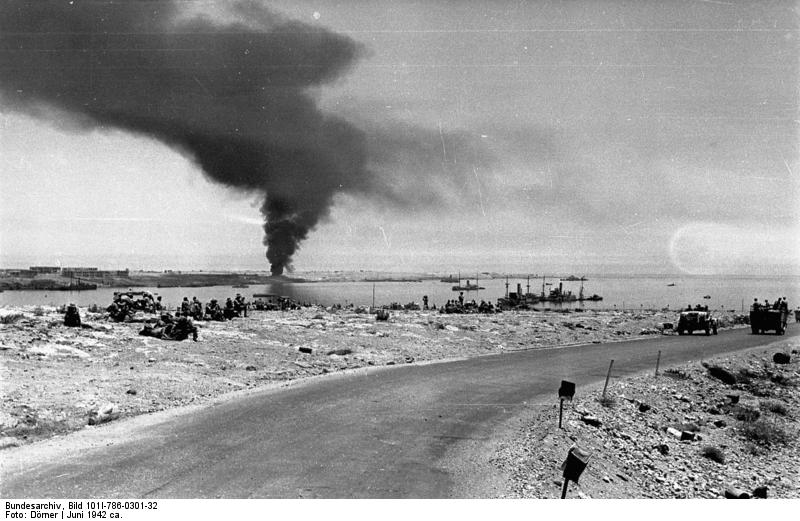
(Bundesarchiv)
The haul was staggering: 2,000 tons of fuel, 5,000 tons of supplies,
and mountains of equipment. For Rommel, it was vindication. Hitler
promoted him to Field Marshal, the youngest in the Wehrmacht. For
Winston Churchill, receiving the news in Washington, it was “one of the
heaviest blows” of the war—a national disgrace.

(Bundesarchiv)
The Price of Victory
The Battle of Gazala cost the Allies approximately 50,000 casualties
and over 540 tanks. Axis losses were significantly lighter: 32,000 men
and 114 tanks. The Eighth Army retreated 300 miles into Egypt, finally
halting at a thin defensive line between El Alamein and the impassable
Qattara Depression.
But Rommel’s greatest victory contained the seeds of his ultimate
defeat. Intoxicated by success, he persuaded Hitler to postpone the
planned invasion of Malta and allow him to pursue the British into
Egypt. It was a strategic blunder. Malta survived, and Royal Navy
submarines and aircraft resumed their devastating attacks on Axis supply
convoys.
By the time Rommel reached El Alamein, his army was exhausted,
undersupplied, and at the end of a 1,400-mile supply line. In October
1942, General Bernard Montgomery—who had replaced the disgraced
Ritchie—would launch the offensive that finally broke the Desert
Fox.
Rommel’s Masterpiece
The Battle of Gazala remains a textbook example of operational art.
Rommel won not through a single brilliant plan, but through his ability
to adapt, improvise, and seize fleeting opportunities. He
demonstrated:
- Audacity: Executing a daring flanking maneuver
against superior forces - Tactical flexibility: Turning the Cauldron from a
death trap into an offensive springboard - Concentration of force: Massing his panzers to
achieve local superiority and defeat dispersed British armor - Exploitation of weakness: Capitalizing ruthlessly
on poor British coordination and rigid command
The British, by contrast, suffered from systemic failures: piecemeal
commitment of forces, poor coordination between arms, rigid command
structures, and intelligence failures that consistently underestimated
Rommel’s capabilities.
In the end, Gazala was a battle won by leadership, flexibility, and
the fighting quality of troops—the intangibles that no amount of
numerical superiority can overcome. It was Rommel’s finest hour, even if
it ultimately led him to overreach.
The Desert Fox had proven once again why he was the most feared
commander in North Africa. But his time was running out. The sands of El
Alamein were waiting.