
When we think of the Eastern Front in World War II, certain names
immediately come to mind: Stalingrad, Kursk, Leningrad. These epic
battles have been immortalized in films, books, and documentaries. But
there’s another name that should be spoken in the same breath—a name
that represents one of the bloodiest campaigns in human history, yet
remains largely forgotten in the West: Rzhev.
Between January 1942 and March 1943, the Soviet Red Army launched a
series of massive offensives against German forces holding a bulge in
the front line near the city of Rzhev, just 150 miles west of Moscow.
The result was a 15-month bloodbath that consumed between 1.1 and 2.3
million Soviet soldiers—more than the United States lost in all of World
War II. The Germans called it the Rzhevfleischwolf—the Rzhev
Meat Grinder. And for good reason.
The Dagger Pointed at Moscow
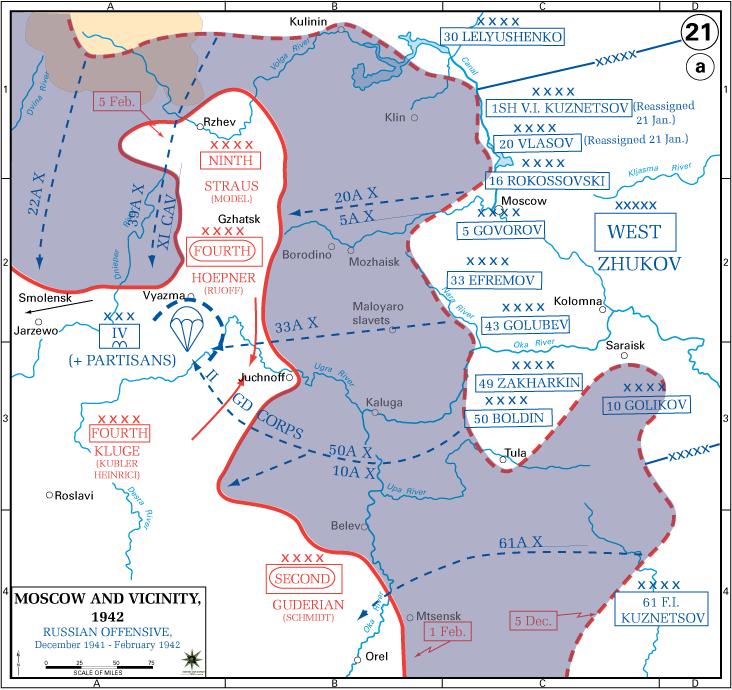
To understand why so many died at Rzhev, you need to understand what
was at stake. In the winter of 1941-42, the Red Army had successfully
pushed the Wehrmacht back from the gates of Moscow in a stunning
counteroffensive. But the Germans hadn’t been driven far. They still
held a massive salient—a bulge in the front line—centered on the city of
Rzhev.
This wasn’t just any piece of territory. The Rzhev salient was a
strategic nightmare for the Soviets. It jutted deep into Soviet-held
territory like a dagger pointed directly at the heart of the Soviet
Union. General Georgy Zhukov, the architect of Moscow’s defense,
described it exactly that way: “a dagger pointed at
Moscow.”
For the Germans, the salient was equally valuable. It served as the
northern anchor for Army Group Center and a potential springboard for a
renewed offensive against the Soviet capital. The city of Rzhev itself
was a critical railway junction on the Volga River, making it the
cornerstone of the German defensive network in the region.
Stalin and his high command, the Stavka, became obsessed with
eliminating this threat. Throughout 1942 and into 1943, they would throw
army after army at the German defenses in a relentless attempt to push
the front line away from Moscow and destroy the formidable German Ninth
Army that held the salient.
The Battles Begin: Winter
1942
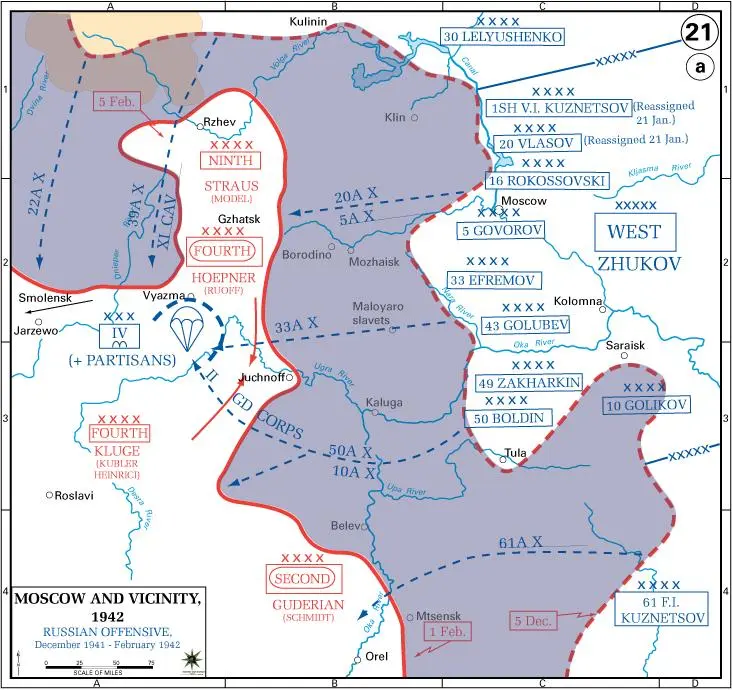
The first major Soviet attempt to eliminate the Rzhev salient came in
January 1942, as part of the broader Rzhev-Vyazma Strategic Offensive.
Fresh from their success at Moscow, Soviet commanders were confident
they could encircle and destroy Army Group Center entirely.
Four Soviet Fronts (the equivalent of Western army groups) attacked
simultaneously, achieving deep penetrations into the German rear. For a
moment, it looked like the Germans might collapse. But the harsh winter
terrain, combined with desperate German resistance, stalled the Soviet
advance. Worse, several Soviet armies—including the 29th and 39th—became
encircled themselves behind German lines.
The Germans, now under the command of the defensive genius
Generalfeldmarschall Walter Model, launched Operation Seydlitz in July
1942 to clear out these trapped Soviet forces. Model, who would earn the
nicknames “Lion of Defense” and “Hitler’s Fireman” for his ability to
stabilize crises, systematically eliminated the encircled Soviet units
and secured the vital Rzhev-Sychevka-Vyazma railway line.
The Summer Offensive:
Zhukov’s Obsession

Battle of Rzhev, summer 1942. (Source: RIA Novosti archive)
Undeterred by the winter’s failures, Zhukov and fellow commander Ivan
Konev launched another massive offensive in July 1942. This time, they
were determined to smash through the German defenses and capture Rzhev
once and for all.
The First Rzhev-Sychyovka Offensive was a brutal affair. The Red Army
committed enormous numbers of men and materiel, but they made little
headway against the deeply entrenched German positions. Model had
prepared his defenses well, creating multiple defensive lines, tactical
reserves, and centralized artillery command.
The offensive devolved into a horrific battle of attrition. Soviet
soldiers attacked again and again, only to be mowed down by German
machine guns and artillery. The casualty figures were staggering, yet
the Red Army gained almost no ground. By October, when the offensive
finally sputtered to a halt, the Germans had won a clear tactical
victory—but at a heavy cost in men and materiel.
Operation Mars: Zhukov’s
Greatest Defeat

during the Battle of Rzhev. (Source: Reddit)
In November 1942, as the world’s attention focused on the dramatic
encirclement of the German Sixth Army at Stalingrad, another massive
Soviet offensive was unfolding at Rzhev. This was Operation Mars, and it
would become one of the Red Army’s most catastrophic failures.
Coordinated by Zhukov himself, Operation Mars was an ambitious
attempt to encircle and destroy the German Ninth Army through
coordinated thrusts from multiple directions. The plan looked good on
paper. In reality, it was a disaster.
Poor weather hampered air support. German resistance was tenacious.
Soviet tactics relied too heavily on costly frontal assaults. And Model,
once again, proved to be a master of defensive warfare, rapidly shifting
reserves to counter Soviet breakthroughs and launching devastating
counter-attacks.
By December, Operation Mars had failed completely. The Red Army had
suffered an estimated 335,000 casualties and lost over
1,600 tanks—all for negligible territorial gain. Some
historians have called it “Zhukov’s greatest defeat,” though the Soviet
Union suppressed information about the disaster for decades.
Why So Many Died: The
Perfect Storm
What made Rzhev such a meat grinder? Why did the casualty figures
reach such astronomical levels?
The answer lies in a perfect storm of factors that heavily favored
the defender:
Terrain and Weather: The battlefield was a nightmare
landscape of thick forests, vast swamps, and rolling country. Roads were
little more than mud tracks that became impassable during the spring and
autumn rasputitsa (mud seasons). Unusually heavy rainfall in
summer 1942 swelled rivers into major obstacles. The extreme Russian
winter froze equipment and inflicted severe frostbite on soldiers.
German Defensive Mastery: Model and his commanders
had created a series of deeply fortified, well-sited defensive
positions. They proved adept at managing reserves, rapidly shifting
units to counter Soviet breakthroughs, and launching effective
counter-attacks to seal off penetrations.
Soviet Tactical Deficiencies: The Red Army suffered
from significant logistical weaknesses, struggling to supply forces with
adequate ammunition, fuel, and reinforcements. Soviet intelligence often
underestimated German capabilities. Most critically, Soviet tactics
frequently relied on costly frontal assaults against prepared defenses—a
recipe for slaughter.
Zhukov himself later acknowledged that his forces lacked sufficient
armor, artillery, and aircraft to breach the German lines effectively.
But Stalin demanded results, and the offensives continued.
The Strategic
Victory Hidden in Tactical Defeat

Orel, Russia, August 1942. (Source: German Federal Archives
(Bundesarchiv))
Here’s the paradox of Rzhev: while the Red Army suffered tactical
defeat after tactical defeat, the campaign was a strategic success.
The relentless Soviet offensives tied down massive German forces—at
times up to 29 divisions, or half of Army Group Center’s strength. These
divisions couldn’t be redeployed to other sectors where they were
desperately needed.
Most critically, the fighting at Rzhev had a direct impact on the
Battle of Stalingrad. While the Red Army was suffering immense losses in
Operation Mars in November-December 1942, those efforts prevented the
Wehrmacht from redeploying vital panzer and infantry divisions to the
south to relieve the encircled German Sixth Army.
In this context, the sacrifice of Soviet soldiers at Rzhev was
instrumental in securing the victory at Stalingrad—the turning point of
the Eastern Front. The blood spilled in the forests and swamps around
Rzhev helped ensure that the German Sixth Army would never be
rescued.
The End: Operation Büffel
By early 1943, the strategic situation had changed dramatically. The
disaster at Stalingrad had cost the Wehrmacht dearly, and the German
High Command desperately needed to shorten their front lines and free up
reserves.
In March 1943, the Germans executed Operation Büffel
(Operation Buffalo)—a well-planned, phased withdrawal from the Rzhev
salient. The retreat shortened their front line and freed up over 20
divisions for use elsewhere.
The final Soviet Rzhev-Vyazma offensive coincided with this
withdrawal. On March 3, 1943, Soviet forces finally entered the ruins of
Rzhev. But their primary target—the German Ninth Army—had escaped
intact. The city the Red Army had fought so hard to capture was a
devastated wasteland, its population reduced from 56,000 to just 150
survivors.
The Forgotten Bloodbath
Despite the staggering casualties and strategic importance, the
Battles of Rzhev remained largely obscure for decades, especially in the
West. Why?
Soviet-era historians downplayed the costly failures and highlighted
successes like Stalingrad and Kursk. The inconclusive nature of the
fighting didn’t fit the narrative of inevitable Soviet triumph. And the
controversy surrounding Zhukov’s performance—particularly in Operation
Mars—made it a sensitive topic.
Even today, while Stalingrad is a household name, Rzhev remains known
primarily to military historians and Russians who live in the region.
Yet the human cost was comparable: estimates suggest 1.1 to 2.3
million Soviet casualties over 15 months, compared to roughly
1.1 million Soviet casualties at Stalingrad.
Lessons from the Meat
Grinder
The Rzhev battles offer sobering lessons about the nature of warfare
on the Eastern Front:
Attrition as Strategy: The Red Army was willing to
accept catastrophic casualties to achieve strategic objectives. This
wasn’t callousness—it was cold calculation. Soviet commanders understood
that tying down German forces at Rzhev helped ensure victory
elsewhere.
The Defender’s Advantage: Even a numerically
inferior force, if well-led and well-positioned, can inflict devastating
casualties on attackers. Model’s defensive mastery at Rzhev demonstrated
this principle repeatedly.
The Fog of War: For decades, the true scale of the
Rzhev battles was hidden from the world. Even in the age of total war,
governments could suppress information about military disasters.
Tactical Defeat, Strategic Victory: Sometimes losing
battles can help win wars. The Red Army’s failures at Rzhev contributed
directly to its triumph at Stalingrad.
Remembering the Fallen
Today, a massive memorial stands near Rzhev—a 25-meter-tall statue of
a Soviet soldier, inaugurated in 2020. It’s a belated recognition of the
hundreds of thousands who died in the forests and fields around the
city.
The inscription reads simply: “To the Soviet soldier.”
For the men who fought and died in the Rzhev Meat Grinder, it’s a
small acknowledgment of an immense sacrifice. They fought in a campaign
that most of the world has forgotten, in battles that brought them
little glory and less success. Yet their blood helped turn the tide of
the war.
The next time you read about Stalingrad or Kursk, remember Rzhev.
Remember the forgotten bloodbath that raged for 15 months in the forests
west of Moscow. Remember the 2 million casualties in a campaign that
most people have never heard of.
Because forgetting the Rzhev Meat Grinder means forgetting one of the
most brutal chapters in the most brutal war in human history.