
On November 30, 1939, the Soviet Red Army—the largest military force in the world—crossed the Finnish border with overwhelming confidence. Joseph Stalin expected his troops to be in Helsinki within weeks, perhaps days. The world expected Finland to fall like a house of cards.
Instead, the Finns fought back with a ferocity that shocked the globe. For 105 brutal days, a nation of 3.7 million people held off a superpower of 170 million. When the guns finally fell silent on March 13, 1940, Finland had lost territory but preserved something far more precious: its independence.
This is the story of the Winter War—a David-and-Goliath struggle fought in temperatures that plunged to -40°C, where Finnish ski troops became ghosts in the snow and Soviet divisions were swallowed whole by the frozen forests.
Stalin’s Demands and Finland’s Defiance
The seeds of the Winter War were planted in the autumn of 1939, as Europe descended into World War II. Stalin had a problem: Leningrad, the Soviet Union’s second-largest city, sat just 32 kilometers from the Finnish border. If a hostile power—say, Nazi Germany—used Finland as a staging ground, the city would be indefensible.
Stalin’s solution was simple: move the border. In October 1939, Soviet diplomats presented Finland with a list of demands:
- Cede the Karelian Isthmus and several islands in the Gulf of Finland
- Lease the Hanko Peninsula to the USSR for a naval base
- Dismantle Finnish fortifications along the border
In exchange, the Soviets offered a larger but strategically worthless chunk of Soviet Karelia. To the Finns, this was extortion dressed up as negotiation. The government, led by President Kyösti Kallio, refused.
Stalin had already secured his western flank through the Molotov-Ribbentrop Pact with Hitler, which secretly designated Finland as part of the Soviet sphere of influence. The Baltic states had already buckled under Soviet pressure. Finland would be next.
On November 26, the Soviets staged the “Shelling of Mainila,” falsely accusing Finland of firing artillery at Soviet troops. It was a transparent pretext, but Stalin didn’t need a good excuse—he had 26 divisions, 3,000 aircraft, and over 2,000 tanks. Four days later, the Red Army invaded.
The Mannerheim Line: Finland’s Shield
The Finnish defense was anchored by the Mannerheim Line, a network of bunkers, trenches, and anti-tank obstacles stretching across the Karelian Isthmus. Named after Field Marshal Carl Gustaf Emil Mannerheim, the 73-year-old commander-in-chief and former Imperial Russian general, the line was Finland’s last hope.
It wasn’t the Maginot Line. Finland couldn’t afford concrete fortresses and underground railways. The Mannerheim Line was built on a shoestring budget with limited resources. But it had one advantage: it was defended by men who knew they were fighting for their homes.
The Red Army’s initial assault was a disaster. Soviet commanders, many of them political appointees who had survived Stalin’s purges by being loyal rather than competent, sent wave after wave of infantry against Finnish positions. The Finns mowed them down. Soviet tanks, unsupported by infantry, were picked off by Finnish anti-tank guns and improvised explosives.
The Finns even gave a name to their homemade incendiary devices: the “Molotov cocktail,” a mocking reference to Soviet Foreign Minister Vyacheslav Molotov, who had claimed that Soviet bombers were dropping “bread baskets” on Finnish cities. If Molotov was bringing food, the Finns joked, they’d send him a drink.
Ghosts in the Snow: Finnish Tactics
North of Lake Ladoga, where the Mannerheim Line didn’t reach, the war took on a different character. Here, the Finns unleashed a style of warfare the Soviets had never encountered.
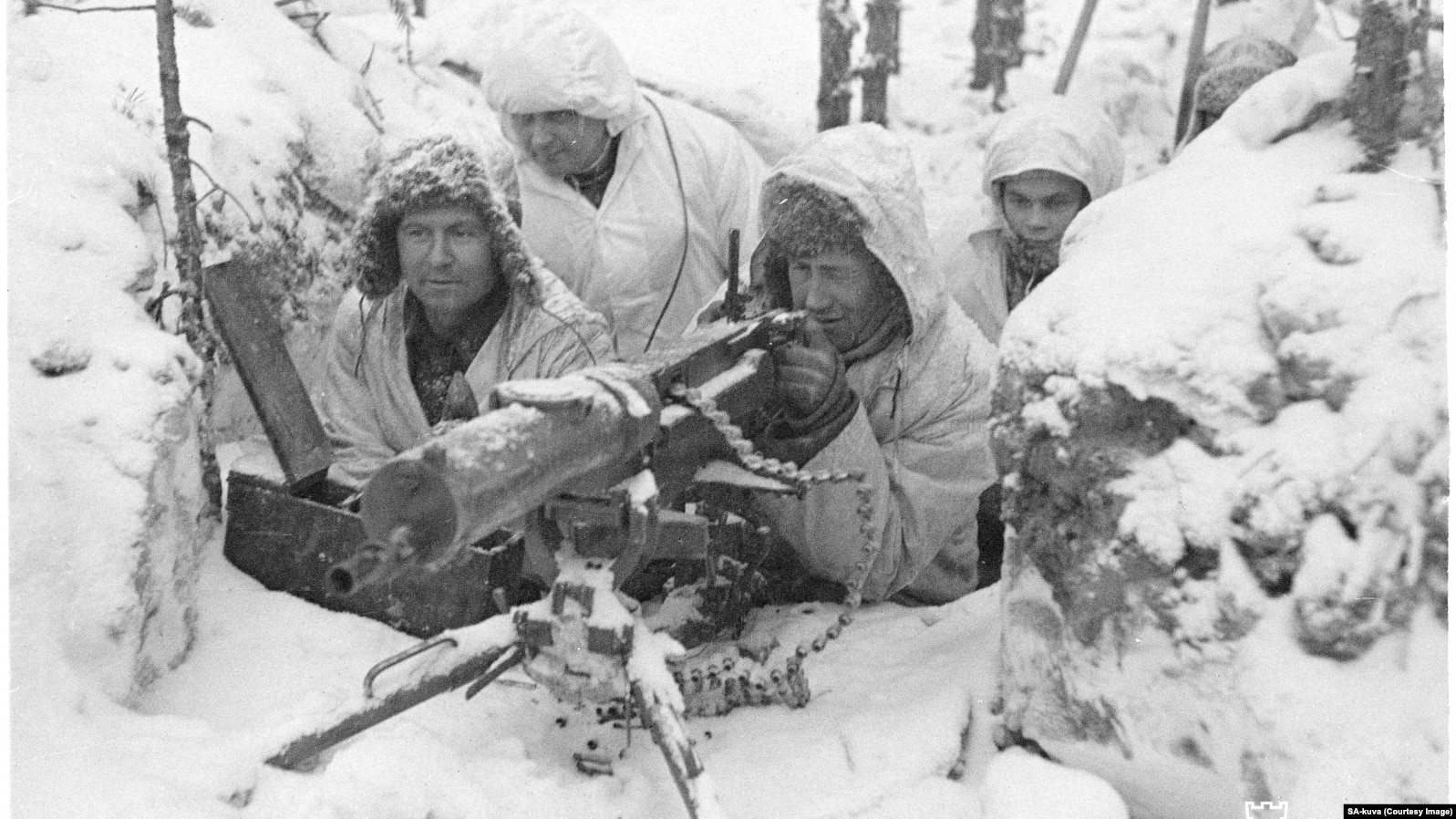
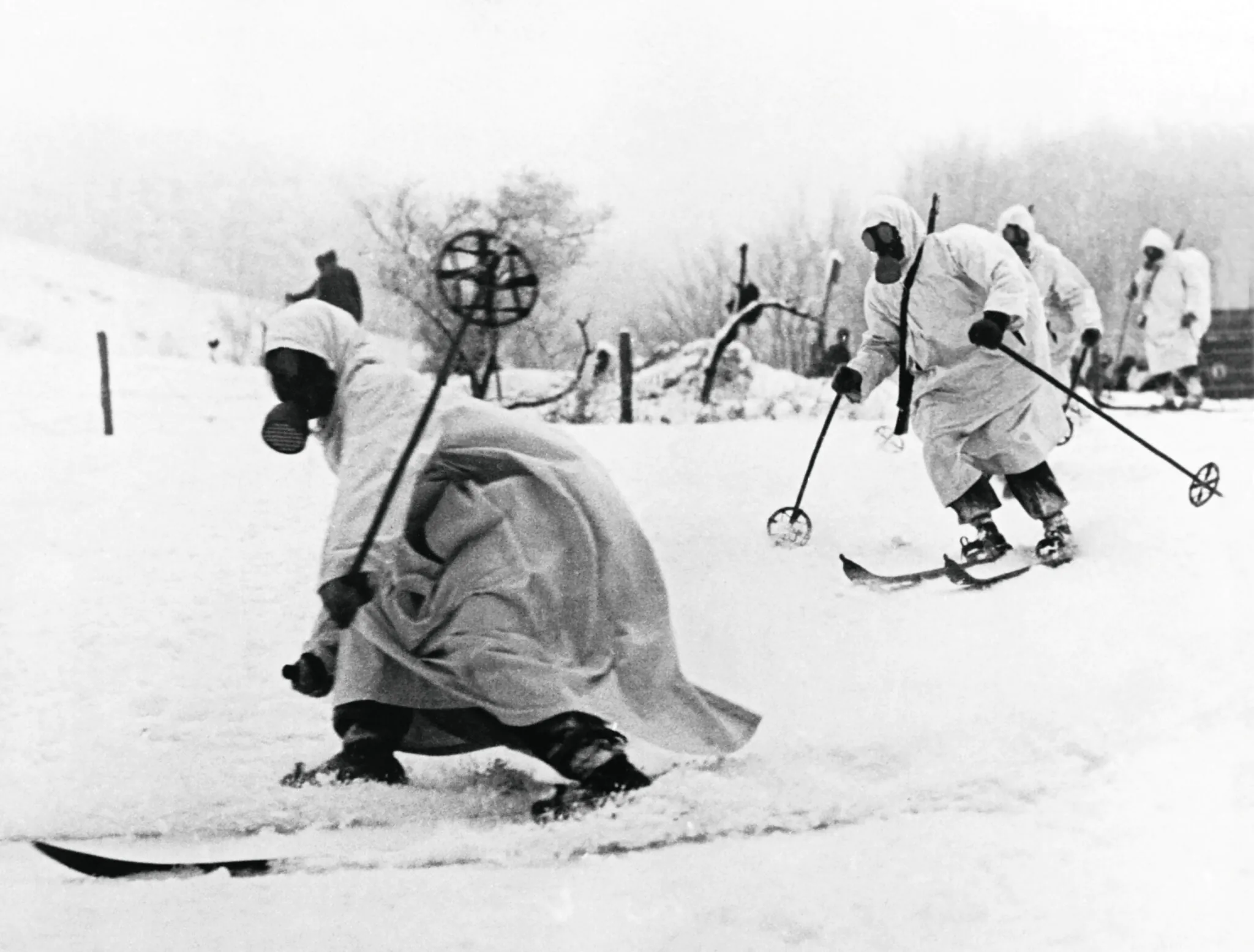
Finnish soldiers, dressed in white winter camouflage and equipped with skis, moved through the forests like ghosts. They knew every trail, every frozen lake, every hiding spot. The Soviets, by contrast, were road-bound. Their massive columns, stretched out for miles, were sitting ducks.
The Finns perfected a tactic called motti—a Finnish word for a stack of firewood. They would strike a Soviet column at multiple points, cutting it into isolated segments. Then, moving freely through the snow, they would surround each segment and destroy it piece by piece.
The most famous example was the Battle of Suomussalmi in December 1939 and January 1940. A Finnish force of about 11,000 men faced two Soviet divisions totaling over 45,000 troops. The Finns encircled the Soviet 163rd Division and annihilated it. Then they turned on the 44th Rifle Division, which was advancing to the rescue along the Raate Road. In a textbook motti battle, the Finns destroyed the entire division, capturing hundreds of tanks, vehicles, and artillery pieces.
The images from Suomussalmi became iconic: frozen Soviet corpses standing upright in the snow, abandoned tanks and equipment stretching for miles, Finnish soldiers on skis gliding past the wreckage. The Red Army had been humiliated.
The Soviet Steamroller
But Finland couldn’t win. The math was too brutal. The Finns had 300,000 men under arms; the Soviets could field millions. Finland had 32 tanks; the Soviets had thousands. The Finnish Air Force had 114 combat aircraft; the Soviets had over 3,000.
In February 1940, Stalin replaced his failed commanders with Semyon Timoshenko, a competent general who had survived the purges. Timoshenko reorganized the assault on the Karelian Isthmus, concentrating overwhelming firepower on narrow sectors of the Mannerheim Line. Soviet artillery fired up to 300,000 shells per day. Bombers pounded Finnish positions around the clock.
On February 11, the Soviets breached the Mannerheim Line at Summa. The Finns fought a desperate retreat, but they were running out of men, ammunition, and time. By early March, the situation was hopeless. Mannerheim advised his government to seek peace.
The Bitter Peace
The Moscow Peace Treaty was signed on March 12, 1940, and took effect the next day. The terms were harsh—harsher than Stalin’s original demands.
Finland lost:
- The entire Karelian Isthmus, including Viipuri, Finland’s second-largest city
- Territory around Lake Ladoga
- Land in the Salla region and the Rybachi Peninsula
- About 9% of its pre-war territory and 12% of its economic capacity
The Soviets also got their naval base at Hanko. And 422,000 Finns—12% of the population—had to be evacuated from the ceded territories. Not a single Finn chose to remain under Soviet rule.
But Finland remained independent. Unlike Estonia, Latvia, and Lithuania, which would be swallowed whole by the USSR later that year, Finland survived as a sovereign nation.
The Price of Defiance
The human cost was staggering. Finland lost 25,904 soldiers killed or missing, with another 43,557 wounded. For a nation of 3.7 million, this was catastrophic.
But the Soviet losses were almost incomprehensible. Official Soviet figures, released decades later, admitted to 126,875 dead or missing and over 200,000 wounded. The true number was likely much higher. Nikita Khrushchev, who later became Soviet Premier, wrote in his memoirs that the cost was “almost a million men.”
The Red Army’s performance shattered its reputation. The world had seen the Soviet colossus stumble against a tiny opponent. Adolf Hitler took note. The Winter War convinced him that the Soviet Union was weak, its military incompetent, its leadership paralyzed by fear. This assessment would lead him to launch Operation Barbarossa in 1941—a decision that would ultimately doom Nazi Germany.
Legacy of the Winter War
The Winter War became a defining moment in Finnish history. The “Spirit of the Winter War”—the unity, resilience, and determination shown by the Finnish people—remains a source of national pride. The war proved that a small nation could resist a superpower and survive.
But the peace was fragile. The loss of Karelia and the humiliation of the treaty fueled a desire for revenge. When Hitler invaded the Soviet Union in 1941, Finland joined the attack, hoping to reclaim its lost territories. The Continuation War (1941-1944) would be even more costly and would end with Finland once again forced to make peace with Moscow.
Yet through it all, Finland remained free. In a Europe divided between Nazi Germany and the Soviet Union, where small nations were crushed or absorbed, Finland’s survival was nothing short of miraculous.
On March 13, 1940, as the last shots of the Winter War echoed across the frozen forests, the Finns had lost land but won something more important: the right to determine their own future. In the darkest winter of the 20th century, that was a victory worth celebrating.