
Battle of
Tarawa: 76 Hours of Hell in the Pacific
“The water never runs red,” a Marine Corps saying goes. But on
November 20, 1943, the lagoon surrounding a tiny coral atoll called
Tarawa proved that saying wrong. For 76 hours, U.S. Marines fought one
of the bloodiest battles in their storied history—a battle that would
shock the American public and forever change how amphibious assaults
were conducted.
A Fortress in Paradise
Tarawa Atoll sits in the Gilbert Islands, a scattered chain of coral
atolls in the Central Pacific. To most Americans in 1943, it was an
unknown speck on the map. But to military planners, it was a crucial
stepping stone in the “island-hopping” campaign toward Japan. The
atoll’s main island, Betio—just three miles long and 800 yards at its
widest—housed a Japanese airstrip that could support the next phase of
the Pacific offensive: the invasion of the Marshall Islands.
The Japanese understood Betio’s strategic value. For nearly a year,
they had transformed this tiny island into one of the most heavily
fortified positions in the Pacific. Rear Admiral Keiji Shibasaki
commanded a garrison of 4,800 men, including elite troops from the 7th
Sasebo Special Naval Landing Force. They constructed over 100 concrete
and log pillboxes with interlocking fields of fire, installed powerful
coastal artillery including four 8-inch Vickers guns, and ringed the
island with a formidable seawall, barbed wire, and anti-boat
obstacles.
Shibasaki was so confident in his defenses that he famously boasted
it would take “one million men one hundred years” to conquer Tarawa.
The Fatal Miscalculation
American planners knew Betio would be tough, but they made a
catastrophic error that would cost hundreds of lives: they miscalculated
the tides.
The assault plan called for landing craft to cross the coral reef
surrounding the island during high tide. The Higgins boats (LCVPs) used
to transport Marines had a four-foot draft and needed at least five feet
of water to clear the reef. Planners expected the tide to provide that
depth.
They were wrong.
November 20 brought a neap tide—an unusually low tide that left only
three feet of water over the reef. This error occurred despite warnings
from individuals with local knowledge who had cautioned about the
unpredictability of Tarawa’s tides. The consequences would be
devastating.
The pre-invasion bombardment, though intense, lasted only three
hours—far too short to neutralize the heavily reinforced Japanese
bunkers. Many defenders emerged from their shelters shaken but alive,
ready to man their guns as the first waves of Marines approached.
Wading Into Hell
At 8:30 a.m. on November 20, the assault began. The first waves rode
in tracked amphibious vehicles (LVTs or “Amtracs”) that could crawl over
the reef. These Marines made it to the beach, though under withering
fire. But the subsequent waves, carried in the deeper-draft Higgins
boats, became stranded on the reef hundreds of yards from shore.
The Marines had no choice. They had to disembark and wade through
chest-deep water, fully exposed to Japanese machine-gun and artillery
fire.
“The water was red with blood,” one survivor recalled. Men were cut
down by the hundreds before ever reaching the sand. Those who survived
the horrific trek arrived exhausted and had to immediately take cover
behind the log seawall—the only protection available on the beach.
The first day saw 5,000 Marines land at a cost of 1,500 casualties.
They held only a few shallow, isolated beachheads. The situation was so
dire that Major General Julian Smith, commander of the 2nd Marine
Division, reported to his superior that the “issue is in doubt.”
The Rock of Tarawa
Amid the chaos, one man became the embodiment of Marine Corps
determination: Colonel David M. Shoup.
Wounded while en route to the beach, Shoup established a command post
near the pier and became the indomitable heart of the American effort.
His calm and decisive leadership organized the chaotic battle. When
asked for a situation report, he sent back a message that captured both
the grim reality and the unyielding spirit of the Marines:
“Casualties many; percentage of dead not known; combat efficiency: We
are winning!”
For his extraordinary heroism at Tarawa, Shoup would be awarded the
Medal of Honor. He later became Commandant of the Marine Corps.
Turning the Tide
Over the next two days, the Marines fought a brutal, close-quarters
battle. They used flamethrowers and demolition charges to systematically
reduce the Japanese pillboxes one by one. The few tanks that made it
ashore provided crucial fire support. Naval gunfire, directed by
observers on the beach, pounded Japanese positions.
On November 22, the 6th Marine Regiment, held in reserve, finally
landed and began clearing the southern and eastern parts of the island.
American forces consolidated their positions and pushed eastward across
the airstrip.
In the early morning hours of November 23, the remaining Japanese
defenders launched a final, desperate banzai charge. It was repelled
with heavy losses. By 1:30 p.m., Colonel Shoup declared the island
secure.
The Terrible Cost
The Battle of Tarawa was an American victory, but the price was
staggering. In just 76 hours, the 2nd Marine Division suffered 3,166
casualties, including 1,009 killed in action. The Marines had suffered
nearly as many combat deaths as during the entire six-month Guadalcanal
campaign.
The Japanese garrison was effectively annihilated. Of approximately
4,800 Japanese and Korean personnel on the island, an estimated 4,690
were killed. Only 17 Japanese soldiers and 129 Korean laborers were
captured alive.
When graphic newsreel footage and photographs from the battle were
released to the public—with President Roosevelt’s approval—the American
people were shocked. The brutal reality of the Pacific War had come
home.
Lessons Written in Blood
The horrific casualties at Tarawa sparked public outcry and military
soul-searching. But the battle also provided invaluable lessons that
would save countless lives in future operations.
Improved Intelligence: The tidal disaster led to the
creation of specialized Underwater Demolition Teams (UDTs), forerunners
of the Navy SEALs, tasked with conducting pre-invasion hydrographic
surveys and clearing beach obstacles.
Enhanced Naval Bombardment: Future operations
featured days or even weeks of sustained shelling using armor-piercing
rounds to systematically destroy defenses before troops landed.
Advanced Amphibious Vehicles: Production of LVTs was
dramatically increased, and new, more heavily armored and armed versions
were developed to transport troops and provide fire support all the way
to the beach.
Better Coordination: The battle highlighted the need
for improved inter-service coordination and more robust, waterproofed
communication equipment.
These lessons were immediately applied to subsequent invasions. At
Kwajalein in the Marshall Islands just two months later, casualties were
dramatically lower despite facing similar defenses.
A Square Mile of Hell
Admiral Chester Nimitz defended the operation as a necessary, if
costly, step in the Central Pacific drive. He was right. The lessons
learned at Tarawa directly contributed to the success of larger
amphibious assaults at Saipan, Iwo Jima, and Okinawa.
The Battle of Tarawa became a symbol of the U.S. Marine Corps’
courage and tenacity—a “square mile of hell” that tested the service to
its limits and ultimately forged it into a more effective fighting
force. The name “Tarawa” remains synonymous with the ultimate trial by
fire in amphibious warfare.
For the Marines who fought there, Tarawa was more than a battle. It
was a crucible that proved what they had always believed: that no
fortress, no matter how formidable, could withstand the determination of
the United States Marine Corps.
The 1,009 Marines who died at Tarawa paid the ultimate price. But
their sacrifice taught lessons that saved thousands of lives in the
battles to come. In the grim arithmetic of war, Tarawa was a terrible
but necessary education—76 hours of hell that helped pave the road to
Tokyo.
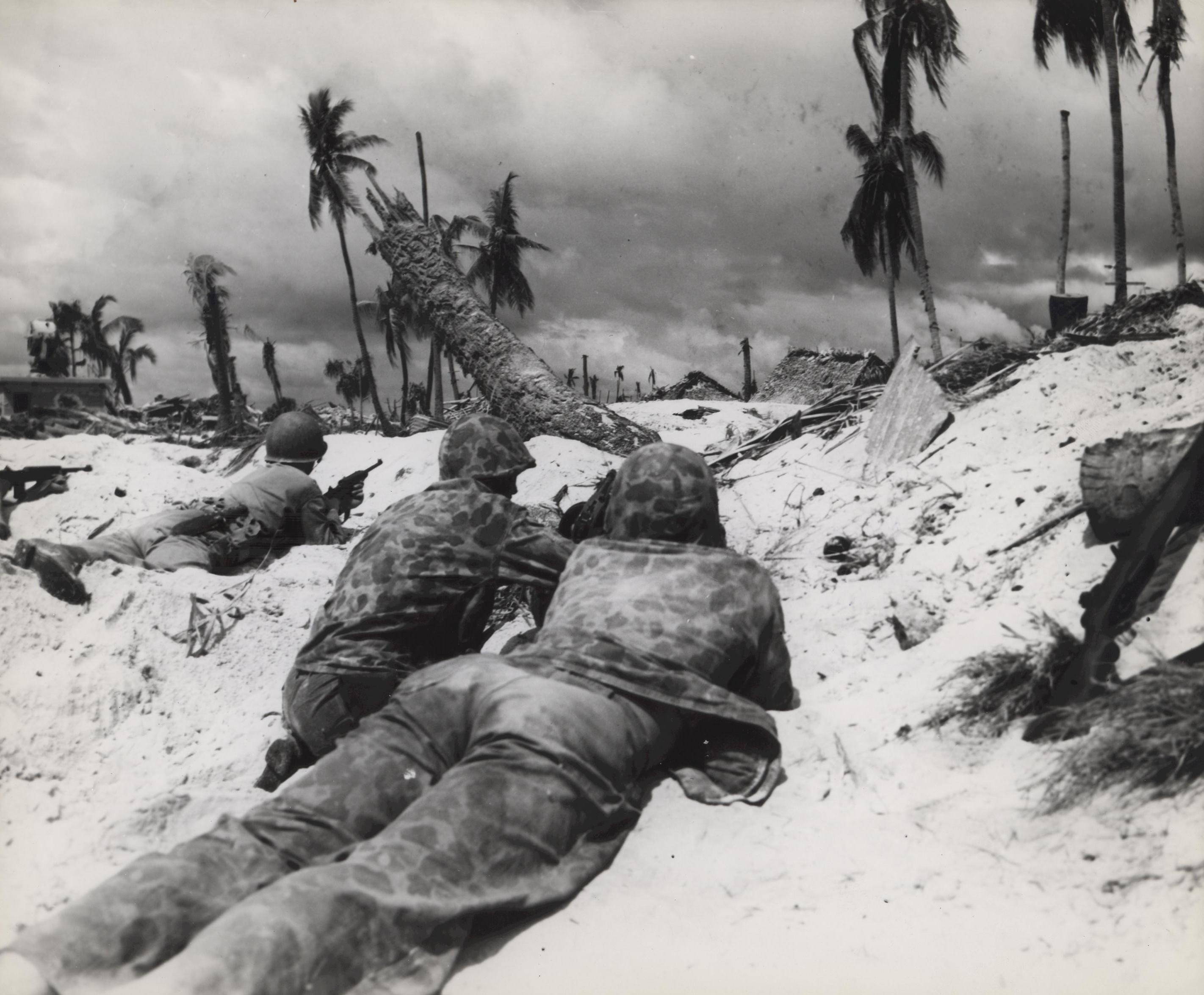
November 1943, after its capture by U.S. Marines. The image, taken from
a USS Essex (CV-9) aircraft, looks north, showing the extensive damage
to the island’s infrastructure and the remnants of the battle. (Source:
Naval History and Heritage Command)

were blocked by the coral reef, forcing the Marines to wade several
hundred yards to the beach under heavy Japanese fire. (Source: Naval
History and Heritage Command)

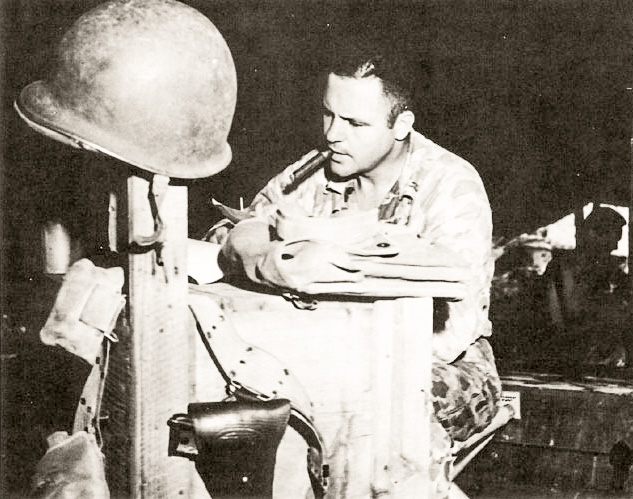
He was awarded the Medal of Honor for his leadership during the battle.
(Source: U.S. Marine Corps)
destroyed Japanese fortifications and equipment. Several LVTs and a
Japanese landing craft are visible on the beach. (Source: Naval History
and Heritage Command)