
The
Ghost Army: How Artists and Inflatable Tanks Deceived Hitler
Imagine a military unit where fashion designers, painters, and sound
engineers were more valuable than sharpshooters. Where rubber tanks and
recorded sound effects became weapons of war. Where a small group of
creative minds could impersonate an entire army division and fool one of
history’s most formidable military machines.
This wasn’t fiction—it was the Ghost Army, one of World War II’s most
extraordinary and closely guarded secrets.
A Different Kind of Soldier
On January 20, 1944, the U.S. Army activated the 23rd Headquarters
Special Troops, a unit unlike any other in military history. While most
soldiers trained with rifles and grenades, these 1,100 men wielded
paintbrushes, inflatable decoys, and sound equipment. Their mission? To
deceive, confuse, and misdirect the German army through elaborate
tactical illusions.
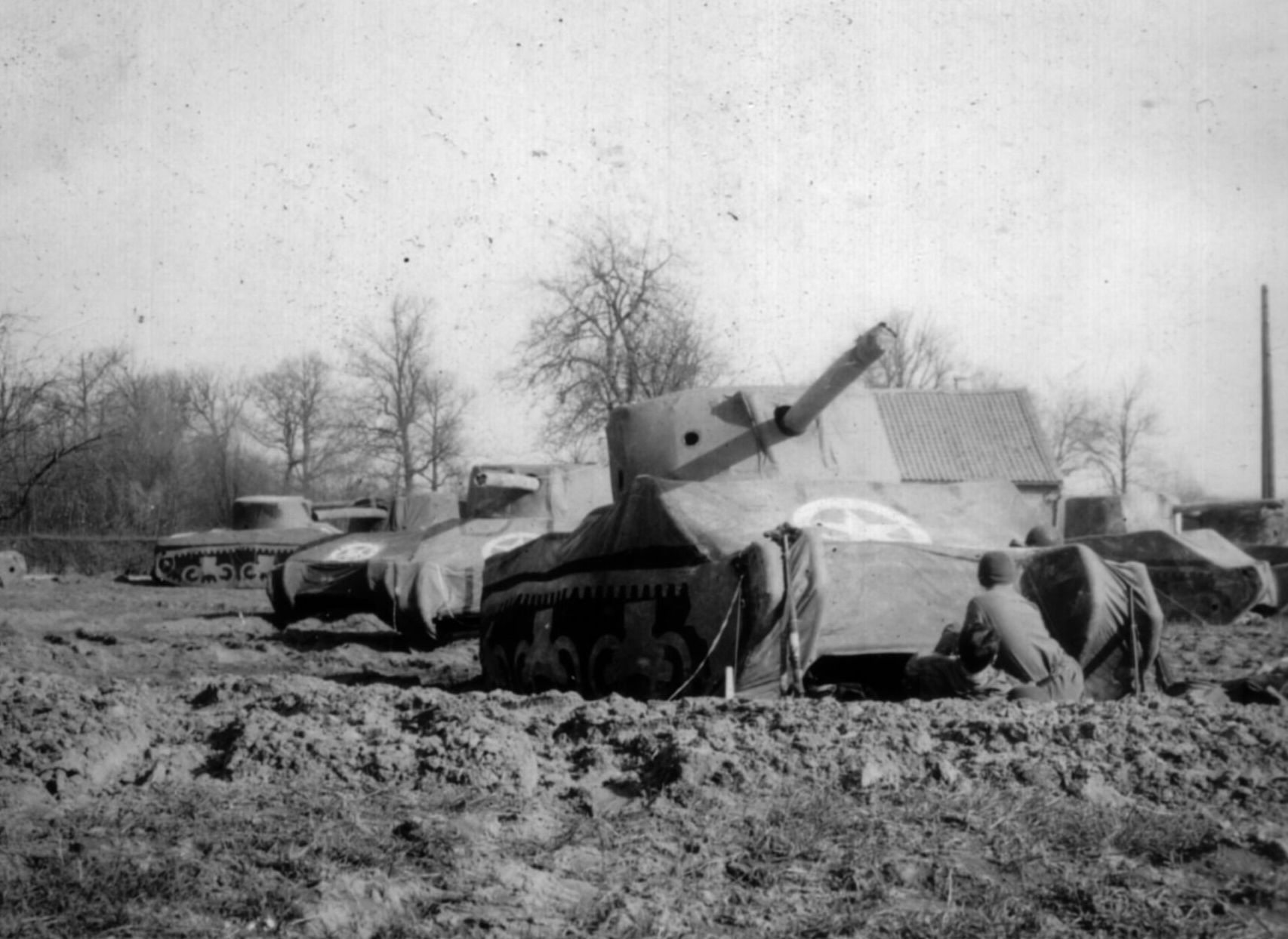
World War II deception operations. Photo: U.S. Army Signal Corps,
1944-1945. Courtesy of The National WWII Museum, New Orleans.
The Ghost Army’s recruitment process was equally unconventional. Army
planners deliberately sought out artists, architects, actors, set
designers, and engineers—people whose creativity could be weaponized.
They recruited from art schools like the Pratt Institute and the
Cleveland Institute of Art, from advertising agencies, and from the
entertainment industry. These weren’t your typical combat soldiers, but
their contribution to the war effort would prove invaluable.
Among their ranks were future luminaries: Bill Blass, who would
become an iconic American fashion designer; Ellsworth Kelly, destined to
be a celebrated painter and sculptor; and Art Kane, who would later
photograph some of music’s biggest names. For decades after the war,
these men couldn’t speak about their service—their work remained
classified as top secret until 1996.
The Art of Deception
The Ghost Army was structured into four specialized components, each
contributing to a multi-sensory deception campaign:
The 603rd Engineer Camouflage Battalion formed the
visual deception arm. These 379 artists and engineers deployed an
arsenal of inflatable rubber equipment—M-4 Sherman tanks, artillery
pieces, jeeps, trucks, and even airplanes. These weren’t crude fakes;
they were carefully crafted illusions designed to fool German aerial
reconnaissance. The artists ensured the decoys were imperfectly
camouflaged, making them just visible enough to be spotted and reported
by enemy observers.
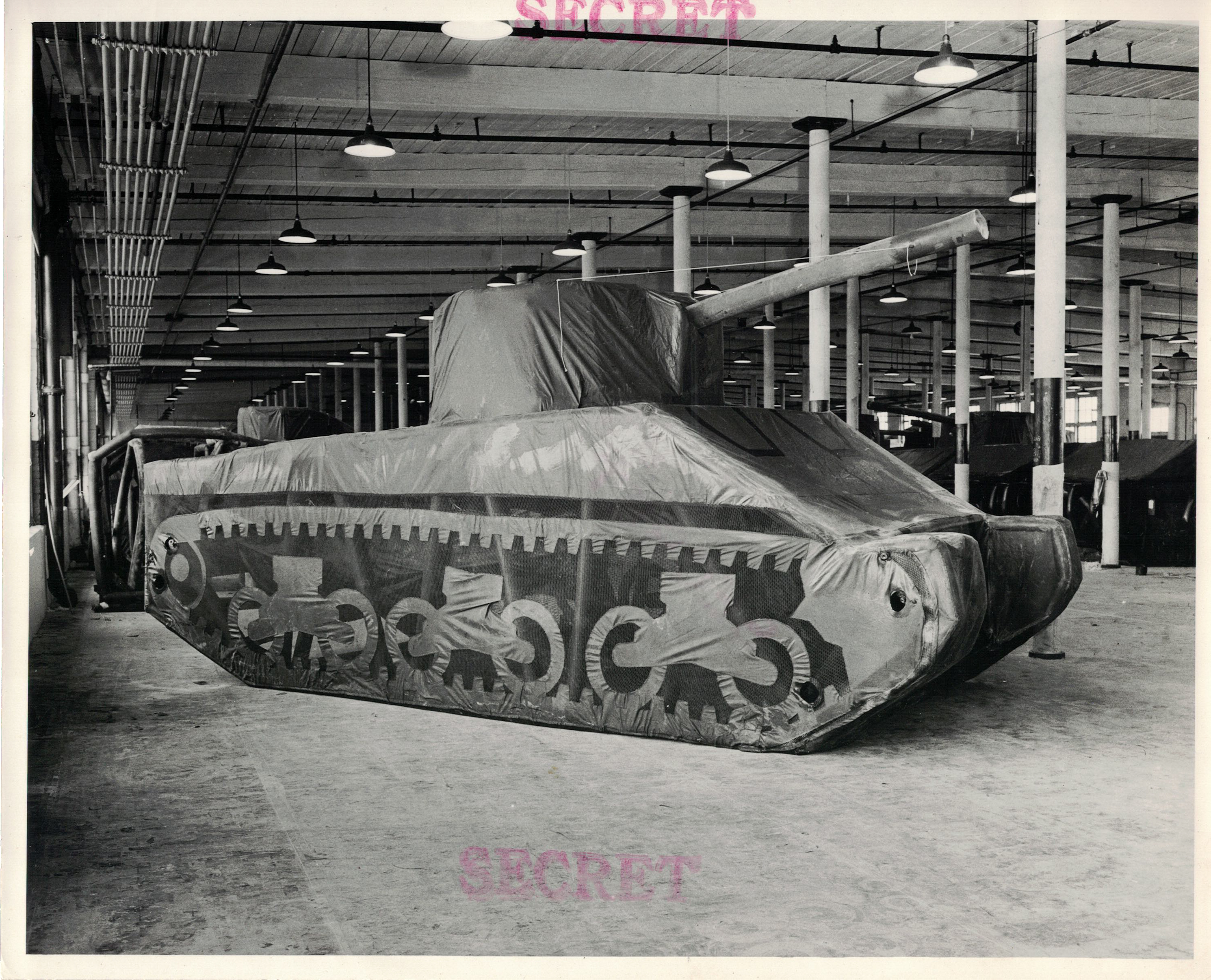
units. Photo: U.S. Army, 1944. Courtesy of The National WWII Museum, New
Orleans.
Within hours, the 603rd could construct entire phantom military
installations—complete motor pools, artillery batteries, and troop
bivouacs. They even hung fake laundry on lines and used bulldozers to
carve convincing tank tracks into the ground. Every detail mattered in
selling the illusion.
The 3132 Signal Service Company Special brought
sonic warfare to the battlefield. Working with cutting-edge technology
from Bell Labs, they recorded the sounds of armored and infantry units
at Fort Knox, Kentucky. These recordings were then mixed for specific
scenarios and broadcast through powerful speakers mounted on halftracks.
The sound could carry up to 15 miles, projecting the noise of tank
columns, pontoon bridge construction, or large infantry formations
moving through the night.
The Signal Company Special handled radio deception,
creating fake radio traffic that mimicked real military units. Their 296
operators were so skilled they could replicate the unique Morse code
“fist” of individual radio operators from other divisions, convincing
German intelligence that entire divisions were in locations they had
already vacated.
Finally, the 406th Engineer Combat Company provided
security for these operations, which often took place dangerously close
to the front lines. They also contributed to the visual deception by
creating physical evidence of the phantom army’s presence.
Masters of Illusion in
Action
The Ghost Army’s traveling road show of deception could simulate the
presence of two full divisions—approximately 30,000 men—with just 1,100
soldiers. Between June 1944 and the war’s end, they conducted over 20
deception operations across France, Belgium, Luxembourg, and
Germany.
Their first major contribution came before D-Day, as part of
Operation Fortitude. The Ghost Army helped create
phantom divisions and generated false radio traffic that convinced the
German High Command the main Allied invasion would target Pas-de-Calais
rather than Normandy. This deception kept crucial German divisions away
from the actual landing beaches on June 6, 1944.

World War II. Photo: U.S. Army Signal Corps, 1944-1945. Courtesy of U.S.
Army / National Archives.
During the Siege of Brest in August and September
1944, the unit deployed dummy tanks and sound effects to convince German
defenders they were surrounded by a much larger American force than
actually existed. The psychological impact was significant—the Germans
believed they faced overwhelming odds.
Perhaps their most critical operation came in September 1944 near
Metz, when a dangerous gap opened in General George
Patton’s line. The Ghost Army was rushed in to hold the position. For
seven days, this small unit used inflatable tanks and sound trucks to
impersonate a full-strength division. The Germans never attacked, and
when reinforcements finally arrived, the deception had worked
perfectly.
During the Battle of the Bulge, the Ghost Army’s
radio deception helped confuse German intelligence about Allied troop
movements, drawing attention away from Patton’s relief effort for the
besieged town of Bastogne.
The Rhine River Masterpiece
The Ghost Army’s final and most spectacular operation came in March
1945, supporting the U.S. Ninth Army’s crossing of the Rhine
River—Germany’s last major defensive barrier.
Operation Viersen was deception on a grand scale.
The Ghost Army set up a massive illusion 10 miles south of the actual
crossing point, impersonating two full divisions with over 600
inflatable vehicles. They broadcast the sounds of pontoon bridge
construction and artillery fire. They generated intense radio traffic.
They created every indication that a major river crossing was imminent
at their location.
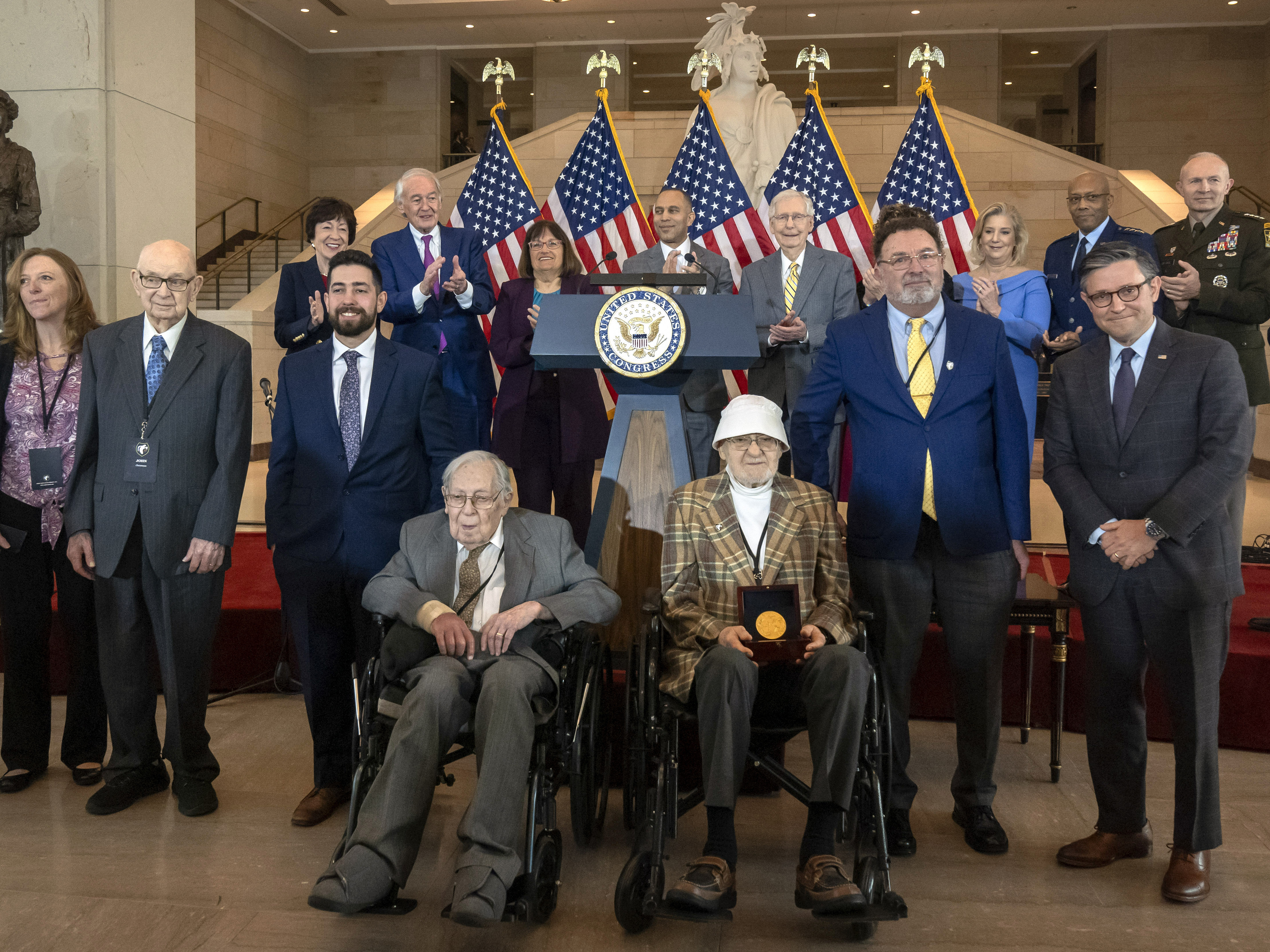
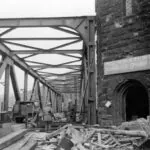
2024. Photo: AP Photo, March 21, 2024.
The Germans took the bait. Enemy units and artillery fire
concentrated on the phantom force while the Ninth Army crossed the Rhine
with minimal casualties. The deception had worked flawlessly, and
countless American lives were saved.
The Long Silence and
Belated Recognition
When the war ended, the Ghost Army’s work didn’t make headlines.
Instead, it disappeared into classified files. The U.S. Army wanted to
preserve these innovative tactics for potential future use, and veterans
were sworn to secrecy. For over 50 years, these men couldn’t share their
extraordinary stories, even with their families.
It wasn’t until 1996 that the Ghost Army’s records were declassified.
Finally, the world could learn about this remarkable unit that had waged
war with creativity and imagination, turning rubber, sound waves, and
radio signals into potent weapons.
The Ghost Army is credited with saving an estimated 15,000 to 30,000
Allied lives. Their operations bought crucial time for troop movements,
plugged gaps in the front lines, and minimized casualties during major
offensives. They proved that tactical deception, when creatively and
scientifically applied, could be as powerful as any conventional
weapon.
In February 2022, the U.S. Congress finally awarded the Ghost Army
the Congressional Gold Medal, one of the nation’s highest civilian
honors. It was long-overdue recognition for a unit that had changed the
course of the war through the power of illusion.
Legacy of Creative Warfare
The Ghost Army represents a unique chapter in military history—a
testament to the value of unconventional thinking on the battlefield.
These weren’t traditional warriors, but artists and engineers who
understood that sometimes the most effective weapon is the one that
exists only in the enemy’s mind.
Their legacy endures in modern military doctrine, where psychological
operations and tactical deception remain crucial components of warfare.
But perhaps more importantly, the Ghost Army reminds us that creativity,
imagination, and ingenuity can be as powerful as any physical force.
In a war defined by industrial-scale destruction and technological
might, a small group of artists with inflatable tanks and sound effects
proved that sometimes the pen—or in this case, the paintbrush—really is
mightier than the sword.
The Ghost Army’s story remained classified for over 50 years, but
their contribution to Allied victory in World War II was immeasurable.
Through creativity, courage, and an unconventional approach to warfare,
these 1,100 soldiers saved thousands of lives and helped bring the war
to a swifter conclusion.