

The
Blitz: How London Refused to Break Under Hitler’s Bombs
On the afternoon of September 7, 1940, Londoners looked up to see
something that stopped them cold: a formation of 348 German bombers,
escorted by 617 fighters, darkening the sky above the Thames. For hours,
high-explosive and incendiary bombs rained down on the docklands and the
East End. By nightfall, 430 people were dead, 1,500 injured, and the sky
over London glowed orange. It was the beginning of the Blitz — and the
start of one of the most extraordinary chapters in the history of
civilian endurance.

docklands guided subsequent waves of German bombers. Source:
Imperial War Museums / Wikimedia Commons (Public Domain)
Why Hitler
Turned His Bombers on Britain’s Cities
The Blitz did not begin as a deliberate strategy — it began as a
mistake that spiraled into a catastrophe. By the summer of 1940, Germany
had conquered France and stood poised to invade Britain. But Operation
Sea Lion, Hitler’s amphibious invasion plan, required the Luftwaffe to
first destroy the Royal Air Force. Through July and August, the Battle
of Britain raged over southern England, with German bombers hammering
RAF airfields, radar stations, and aircraft factories.
The RAF was battered but holding. Then, in late August, a German
bomber accidentally dropped bombs on civilian areas of London. Churchill
ordered a retaliatory raid on Berlin. The attack was minor, but it
infuriated Hitler, who had publicly promised the German people their
capital was untouchable. In a rage, he ordered the Luftwaffe to abandon
its attacks on RAF infrastructure and instead bomb British cities into
submission.
It was one of the most consequential strategic blunders of the war.
By shifting targets from RAF airfields to civilian centers, Hitler gave
Fighter Command the breathing room it desperately needed — and set in
motion a campaign that would ultimately fail.
Black Saturday and 57
Nights of Fire
The first raid on September 7 — “Black Saturday” — was followed by 56
more consecutive nights of bombing. London burned night after night. The
Luftwaffe initially flew daylight raids, but RAF fighters extracted such
a heavy toll that the Germans switched to night bombing, where they were
harder to intercept but also less accurate.
The scale was staggering. Raids involved 200 to 600 bombers at a
time, dropping a lethal mix of high-explosive bombs (some weighing up to
2,500 kilograms), parachute mines, and vast quantities of small
incendiary devices designed to start uncontrollable fires. The East End
— home to London’s working-class dockworkers and their families — bore
the worst of it.

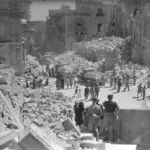
destruction across the city was immense, with over a million homes
damaged or destroyed. Source: Imperial War Museums (IWM H5603) /
Wikimedia Commons (Public Domain)
Coventry: A City
Erased in a Single Night
While London endured the longest campaign, the most devastating
single raid fell on Coventry. On the night of November 14–15, 1940, 515
German bombers executed Operation Moonlight Sonata with terrifying
precision. Pathfinder aircraft using electronic navigation beams marked
the target with flares; then wave after wave of bombers dropped 500 tons
of high explosives and over 30,000 incendiaries.
The combination was deliberate and devastating: high-explosive bombs
shattered water mains and blew roofs off buildings, exposing their
interiors; incendiaries then ignited the exposed timbers. The resulting
firestorm overwhelmed the city’s fire services. By morning, 568 people
were dead, the medieval Cathedral of St Michael was a gutted shell, and
much of the city center had ceased to exist. The Germans were so
impressed by the destruction that they coined a new word:
Koventrieren — “to Coventrate” — meaning to obliterate a city
entirely.
On December 29, London itself experienced something similar. The
Luftwaffe targeted the City of London — the ancient financial heart of
the capital — with tens of thousands of incendiaries. The resulting
firestorm threatened to consume everything. St Paul’s Cathedral was
completely encircled by flames. Through the heroic efforts of
firefighters and volunteer fire-watchers, the cathedral survived, its
dome rising defiantly above the smoke in what became one of the war’s
most iconic images.
Life
Underground: Shelters, Blackouts, and the Tube
For ordinary Londoners, the Blitz transformed daily life into a
strange, exhausting routine of survival. The government had distributed
over 2 million corrugated steel Anderson shelters for
garden installation, and indoor Morrison shelters —
essentially steel cages — for those without gardens. But the most famous
refuge was entirely unofficial: London’s Underground stations.
Each night, tens of thousands of Londoners descended into the Tube,
spreading blankets on platforms and in tunnels, creating a subterranean
city within the city. At peak, up to 150,000 people sheltered in the
Underground each night. A community life developed — people reserved
spots, organized sing-alongs, and shared food. It was cramped, smelly,
and far from safe (several stations were hit), but it offered something
precious: the feeling of being together.
Above ground, the blackout governed every waking
hour. All lights had to be extinguished or covered after dark to deny
German navigators the glow of the city. Wardens patrolled streets,
shouting at anyone who let a sliver of light escape. Accidents in the
darkened streets killed more people in the early months of the war than
German bombs.

devastating German raid of November 14–15, 1940. The medieval
cathedral’s destruction shocked the world. Source: Imperial War
Museums / Wikimedia Commons (Public Domain)
The ‘Blitz Spirit’:
Defiance as a Way of Life
The German theory behind the Blitz — borrowed from pre-war airpower
theorists — held that sustained bombing of civilian populations would
cause mass panic, social breakdown, and demands for peace. It was
spectacularly wrong.
Instead of breaking, British society cohered. The shared experience
of danger and hardship created bonds across class lines that peacetime
Britain rarely managed. Shopkeepers posted “Business as Usual” signs on
bombed-out premises. Pubs stayed open. The BBC broadcast news of the
raids with matter-of-fact calm. Civil defense volunteers — Air Raid
Precautions (ARP) wardens, auxiliary firefighters, rescue workers —
became the unsung heroes of the home front, working through the night to
pull survivors from rubble and fight fires.
Winston Churchill understood the power of this spirit and amplified
it. He toured bomb-damaged neighborhoods, was photographed in the ruins,
and delivered radio broadcasts that turned defiance into a national
identity. “We shall never surrender,” he had promised in June 1940. The
Blitz gave those words their full meaning.
Britain’s
Defense: Radar, Fighters, and Barrage Balloons
The Blitz was not simply endured — it was contested. Air Chief
Marshal Sir Hugh Dowding had built the Dowding System,
a revolutionary integrated air defense network that combined coastal
radar (the Chain Home system), reports from the civilian Observer Corps,
and centralized fighter control rooms. This allowed RAF commanders to
dispatch Spitfires and Hurricanes precisely where they were needed,
rather than flying exhausting standing patrols.
As the Luftwaffe shifted to night raids, the RAF developed
night-fighting capabilities, equipping Bristol Beaufighters and later De
Havilland Mosquitoes with airborne radar. Ground defenses added layers:
thousands of anti-aircraft guns (whose accuracy improved dramatically
with gun-laying radar), searchlights to illuminate bombers, and
barrage balloons — tethered steel-cable obstacles that
forced bombers to fly higher and less accurately.
None of these defenses could stop the raids entirely, but together
they imposed costs on the Luftwaffe and protected enough of Britain’s
industrial capacity to keep the war effort running.
The Final Toll — and
Why the Blitz Failed
By the time the main Blitz campaign ended with a massive final raid
on May 10–11, 1941, the human cost was devastating: over 43,000
civilians killed, between 46,000 and 139,000 injured, and more than a
million homes in London alone damaged or destroyed. The Luftwaffe had
dropped approximately 20,000 bombs on the capital.
Yet the Blitz failed on every strategic measure. British war
production was disrupted but never halted — output actually increased
through the campaign. Civilian morale did not collapse. The RAF was not
destroyed. And Britain did not sue for peace.
The campaign ended not because Britain was beaten, but because Hitler
turned east. In June 1941, the bulk of the Luftwaffe was redeployed to
support Operation Barbarossa, the invasion of the Soviet Union. Britain
had survived.
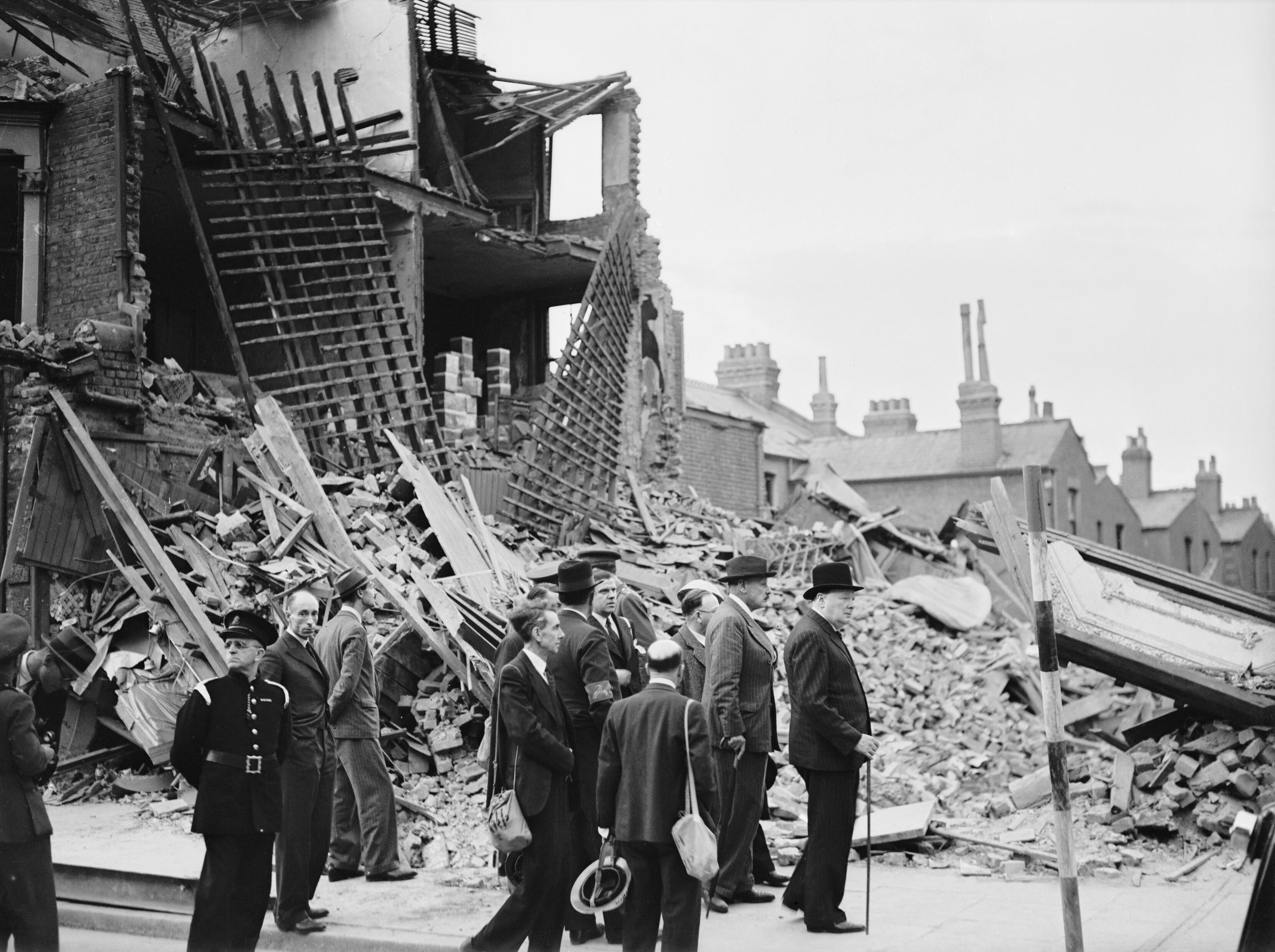
September 8, 1940 — just one day after the first major Blitz raid. His
public appearances in devastated neighborhoods were crucial to
sustaining civilian morale. Source: Imperial War Museums (IWM H3978)
/ Wikimedia Commons (Public Domain)
A Legacy Written in
Rubble and Resolve
The Blitz left physical scars on British cities that took decades to
heal — and some that never fully did. But its deeper legacy is the story
of what ordinary people can endure when they refuse to be broken. The
“Blitz Spirit” became a touchstone of British national identity, invoked
in every subsequent crisis as a reminder of what the country had already
survived.
For historians, the Blitz also delivered a clear verdict on the
theory that bombing civilian populations into submission is an effective
war strategy. It isn’t. The people of London, Coventry, Liverpool, and
dozens of other cities proved that human resilience, when properly
supported and led, can outlast even the most sustained aerial
assault.
Eighty-five years on, the image of St Paul’s Cathedral rising above
the smoke remains one of the most powerful photographs of the twentieth
century — a symbol not of destruction, but of defiance.
Sources: Imperial War Museums, The National Archives (UK),
National WWII Museum, BBC History, Britannica, Wikipedia.