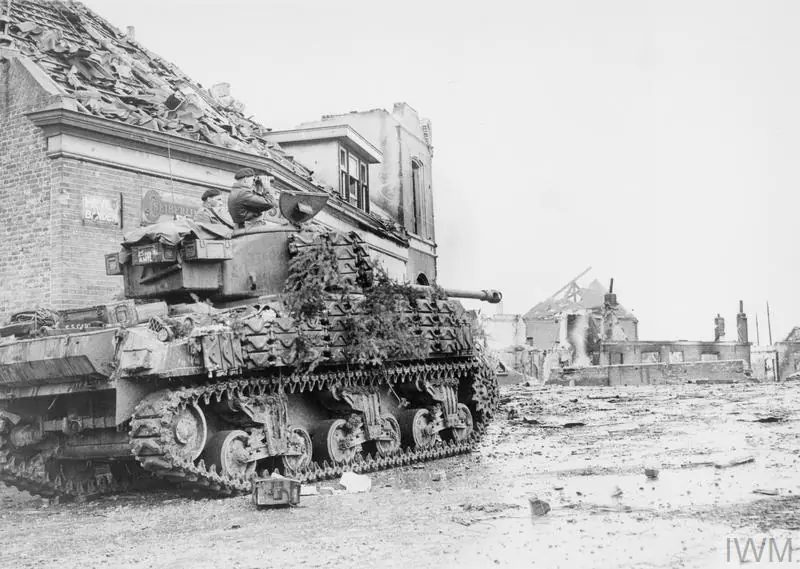
The Sherman Tank: America’s Workhorse of World War 2
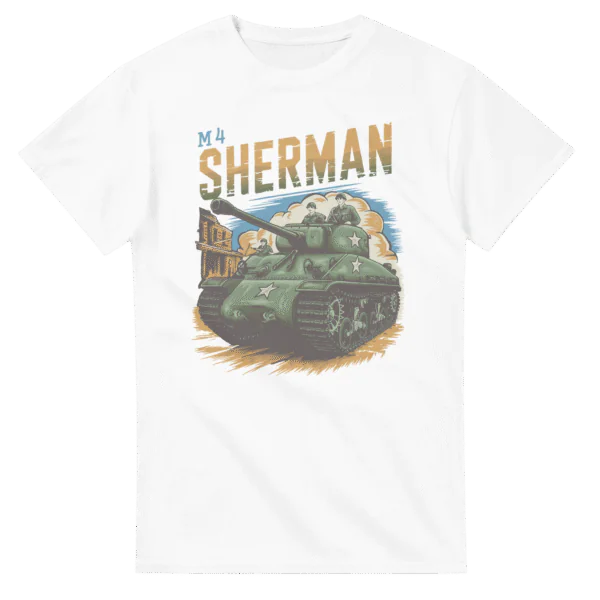
It wasn’t the fastest. It wasn’t the most heavily armored. Against a German Tiger or Panther, a Sherman crew knew they were in a fight they might not survive. And yet, the M4 Sherman tank is arguably the single most important armored vehicle of the Second World War — not because it was the best tank on the battlefield, but because it was everywhere on the battlefield.
From the deserts of North Africa to the hedgerows of Normandy, from the frozen Ardennes to the volcanic sands of Iwo Jima, the Sherman was the iron backbone of Allied armored power. Nearly 50,000 were built. Thousands more were shipped to Britain, the Soviet Union, France, and a dozen other nations. When the war ended, it was the Sherman — reliable, available, and relentlessly produced — that had helped grind the Axis into defeat.

From Drawing Board to Desert: The Sherman’s Origins
By 1941, American tank designers faced an urgent problem. The M3 Lee medium tank — rushed into production as an emergency measure — was already obsolete. Its main gun was mounted in a side sponson with limited traverse, giving it a dangerously high profile and poor tactical flexibility. Something better was needed, and fast.
The solution was the T6 prototype, approved by the Army Ordnance Department in April 1941. The design philosophy was distinctly American: prioritize mass production, standardize parts, and above all, make it reliable. The first production models rolled off the assembly line at Lima Locomotive Works in February 1942, and within months, the first Shermans were already in British hands via the Lend-Lease program.
The tank that emerged was a pragmatic compromise. Weighing around 30–38 tonnes depending on variant, the Sherman carried a five-man crew: commander, gunner, loader, driver, and assistant driver. Its initial armament was a 75mm M3 gun — excellent for blasting infantry, bunkers, and light vehicles, though it would later prove inadequate against Germany’s heavier tanks. The engine varied by variant, but all versions shared one crucial trait: they ran. Day after day, mile after mile, the Sherman kept moving when German tanks were sitting in repair shops.
A Family of Tanks: The Sherman Variants
The “Sherman” was never a single vehicle — it was a family of continuously evolving machines. The M4A1 featured a distinctive one-piece cast hull with rounded edges. The M4A2 used a twin diesel engine and was the variant most commonly shipped to the Soviet Union and British Commonwealth. The M4A3, powered by a Ford V-8 engine, became the U.S. Army’s preferred model by late 1944. The M4A4, built by Chrysler using a bizarre five-engine “multibank” powerplant, went almost entirely to Britain.
As the war progressed, the Sherman was upgraded to address its growing vulnerabilities. The most critical improvement was the introduction of “wet stowage” — surrounding ammunition racks with a water-glycol mixture to prevent the catastrophic fires that had plagued early models. The higher-velocity 76mm M1 gun replaced the original 75mm in many late-war variants, giving crews a fighting chance against German armor. And the Horizontal Volute Spring Suspension (HVSS) system, introduced in mid-1944, improved mobility and reduced ground pressure on soft terrain.
The most celebrated upgrade was the M4A3(76)W HVSS — nicknamed the “Easy Eight” — which combined the 76mm gun, wet stowage, and improved suspension into the most capable American Sherman of the war. Meanwhile, the British created their own solution: the Sherman Firefly, armed with the devastating Ordnance QF 17-pounder gun, which could punch through a Tiger’s frontal armor at combat range. German tank commanders quickly learned to identify and prioritize Fireflies as targets.

Steel Against Steel: The Sherman in Combat
When the Sherman first entered combat at the Second Battle of El Alamein in October 1942, it was a revelation. Against the Panzer IIIs and early Panzer IVs of Rommel’s Afrika Korps, it was superior in firepower and reliability. British crews were delighted. American tankers who followed in Operation Torch felt the same confidence.
By 1944, the picture had changed dramatically.
In the bocage country of Normandy, Sherman crews discovered that the hedgerows that divided the French countryside were perfect ambush terrain for German anti-tank guns and the new generation of German armor. A Panther’s sloped 100mm frontal plate was largely immune to the Sherman’s 75mm gun at standard combat distances. A Tiger I could destroy a Sherman from over 2,000 meters — a range at which the Sherman’s gun was useless against the Tiger’s front armor. The grim nicknames spread through the ranks: “Ronson” (after the lighter’s slogan, “Lights up the first time, every time”) and “Tommy Cooker” (the British term for a portable stove).
The fear of fire was real and pervasive. Crews packed sandbags against their hulls, welded spare track links to the front, and did everything they could to add improvised protection — even though General Patton eventually banned sandbags as adding weight without meaningful protection. Veterans recalled the particular horror of watching a Sherman “brew up” — the slang for catching fire — and the desperate scramble to escape through the hatches before the ammunition cooked off.
And yet, the Sherman’s combat record is more nuanced than its critics allow. Against the most common threats — infantry, towed anti-tank guns, light vehicles, and fortifications — the Sherman’s 75mm high-explosive shell was devastatingly effective. Its mechanical reliability meant that while a Panther might be technically superior, a broken-down Panther contributed nothing to the battle. American doctrine never intended the Sherman to fight heavy tanks alone; tank destroyers like the M10 and M36 were supposed to handle that role, while Shermans supported infantry and exploited breakthroughs.
In the Pacific, where Japanese tanks were rarely a serious threat, the Sherman functioned as mobile artillery — its HE shells and machine guns ideal for destroying bunkers and fortifications on islands like Iwo Jima and Okinawa. Flamethrower variants, nicknamed “Zippos,” proved particularly effective in clearing cave complexes.

The Arsenal of Democracy: Production and Lend-Lease
The true story of the Sherman is a story of industrial scale that staggers the imagination. Between February 1942 and July 1945, 49,234 M4 Sherman tanks were produced — a total surpassed only by the Soviet T-34. Ten manufacturers contributed to this effort, including Ford, Chrysler, Baldwin Locomotive Works, and Lima Locomotive Works. At peak production, American factories were completing dozens of Shermans every single day.
Approximately 21,000 of these tanks were exported under Lend-Lease. The British Commonwealth received 17,181 Shermans — more than any other recipient. The Soviet Union received 4,102 diesel-powered M4A2s, which Soviet crews nicknamed the “Emcha” (from the Russian pronunciation of “M4”). Soviet tankers generally appreciated the Sherman’s reliability, spacious interior, and high-quality radio equipment, deploying it in major operations from the Caucasus to the final assault on Berlin. Free French forces received 656 Shermans, which rolled through the streets of liberated Paris in August 1944.
This industrial achievement was the Sherman’s greatest contribution to Allied victory. When a Sherman was destroyed, another was already on a ship crossing the Atlantic. When a German Tiger broke down — which happened frequently — there was no replacement waiting. The mathematics of industrial warfare were brutal and simple: quantity, reliability, and availability are qualities in themselves.
The Controversy and the Reassessment
The Sherman’s performance in Normandy sparked what Allied newspapers called the “Sherman Tank Scandal.” Tank crews and some officers felt that Army leadership had pursued a flawed doctrine, prioritizing a light, mobile design at the expense of survivability and firepower. Critics pointed to General Lesley McNair’s insistence on keeping tanks light and fast, and the Ordnance Department’s slow response to the threat posed by German heavy armor.
These criticisms were not without merit. The transition to the 76mm gun was delayed. The Army was slow to acknowledge that its tank destroyers were not always available when Shermans needed them. Crews paid for these institutional failures with their lives.
But modern historians have largely reframed the debate. The Sherman was not designed as a tank-versus-tank duelist — it was a mass-produced weapon of industrial warfare, and in that role, it excelled beyond any reasonable expectation. The combined arms doctrine, however imperfectly executed, ultimately leveraged the Sherman’s strengths. And the “wet stowage” fix, the 76mm gun, and the Easy Eight upgrades demonstrated that the system could adapt.

Legacy: The Tank That Kept Fighting
The Sherman’s story didn’t end in 1945. Its reliability and the vast surplus of available vehicles made it attractive to armies worldwide during the early Cold War. M4A3E8 Easy Eights fought in Korea, where their mobility proved better suited to mountainous terrain than the heavier M26 Pershing.
The most remarkable post-war chapter belongs to Israel. The Israeli Defense Forces acquired hundreds of Shermans and subjected them to radical upgrades — new engines, improved suspension, and most dramatically, powerful French 75mm and later 105mm guns. These modified tanks, the M-50 Super Sherman and M-51 Isherman, fought with distinction in the 1956, 1967, and 1973 Arab-Israeli Wars. A tank designed in 1941 was still winning battles in 1973 — a testament to the soundness of its fundamental design.
Today, the M4 Sherman stands as a symbol of something larger than any individual battle. It represents the industrial philosophy that won the Second World War: not the perfect weapon, but the right weapon, built in the right numbers, at the right time. It was never the king of the battlefield. But it was always there — reliable, available, and relentless — and in the end, that was enough.
The M4 Sherman remains one of the most studied and debated tanks in military history. Preserved examples can be found at the National World War II Museum in New Orleans, the Tank Museum in Bovington, England, and dozens of other institutions worldwide.