
The Battle of the Coral Sea: The First Carrier Battle in History
In the spring of 1942, the Imperial Japanese Navy was riding a wave of seemingly unstoppable conquest. Pearl Harbor, Singapore, the Philippines, Wake Island — one by one, the dominoes had fallen. Now Japan’s strategists set their sights on Port Moresby, the last Allied stronghold in New Guinea, whose capture would open the door to Australia itself. What followed, from May 4 to May 8, 1942, was unlike any naval battle the world had ever seen: two powerful fleets locked in mortal combat across hundreds of miles of open ocean — and never once laid eyes on each other.
The Battle of the Coral Sea was the first naval engagement in history fought entirely by carrier-based aircraft. It would prove to be a battle where the side that “lost” on paper actually won the war.

Japan’s Grand Design: Operation MO
By early 1942, Japan’s military planners had crafted an ambitious scheme known as Operation MO. The centerpiece was the seizure of Port Moresby in southeastern New Guinea. With its large airfields, Port Moresby would allow Japanese bombers to strike northern Australia, sever Allied supply lines across the Pacific, and cement Japan’s defensive perimeter across the southwestern Pacific.
Alongside Port Moresby, Japan planned to occupy Tulagi in the Solomon Islands, establishing a seaplane base for reconnaissance and forward operations. The operation was bold, well-resourced, and — the Japanese believed — secret.
They were wrong.
U.S. Navy cryptanalysts at Pearl Harbor and Melbourne had partially cracked Japan’s primary naval code, JN-25b. American intelligence knew the scope, objectives, and timeline of Operation MO before the first Japanese ship left port. Rear Admiral Frank Jack Fletcher was dispatched with two fleet carriers — USS Yorktown and USS Lexington — to intercept the invasion force. The trap was set.
The Opposing Fleets
The forces that converged on the Coral Sea in early May 1942 represented the cutting edge of naval power.
Allied Forces under Rear Admiral Fletcher included the carriers Yorktown and Lexington, together carrying 128 aircraft — F4F Wildcats, SBD Dauntless dive bombers, and TBD Devastator torpedo planes. Eight cruisers (including the Australian HMAS Hobart) and 14 destroyers rounded out the force.
Japanese Forces under Vice Admiral Takeo Takagi and Rear Admiral Tadaichi Hara were formidable: the modern fleet carriers Shōkaku and Zuikaku, each carrying 84 aircraft, plus the light carrier Shōhō assigned to escort the invasion convoy. Their 139 aircraft included the feared A6M Zero fighters, D3A “Val” dive bombers, and B5N “Kate” torpedo planes — all battle-hardened from Pearl Harbor and beyond.
For five days, these two forces would stalk each other across the Coral Sea in a deadly game of cat and mouse.

“Scratch One Flattop!” — May 7, 1942
The battle’s first major blow came on May 7, and it was delivered by American dive bombers and torpedo planes against the light carrier IJN Shōhō.
Acting on a scouting report — later discovered to be a misidentification — American aircraft located what they believed to be the main Japanese carrier force. What they found instead was the Shōhō, providing air cover for the invasion convoy. The attack was swift and overwhelming. At least nine bombs and four torpedoes slammed into the small carrier. She sank in minutes.
Lieutenant Commander Robert E. Dixon’s radio message back to Lexington became one of the most celebrated transmissions of the Pacific War: “Scratch one flattop!”
The loss of Shōhō and her air cover was enough to force the Port Moresby invasion convoy to turn back — the first time in the war that a major Japanese offensive had been halted. Meanwhile, Japanese aircraft, misidentifying the fleet oiler USS Neosho and destroyer USS Sims as an American carrier and cruiser, launched a massive strike against them. The Sims was sunk; the Neosho was left a burning wreck.
The Carrier Duel — May 8, 1942
May 8 brought the main event: a simultaneous exchange of carrier air strikes that would determine the battle’s outcome.
Both sides finally had accurate intelligence on each other’s positions. Both launched their aircraft almost simultaneously. The result was a furious, parallel air battle fought across hundreds of miles of ocean.
American strikes found the Japanese carriers. Dive bombers from Yorktown and Lexington scored three direct bomb hits on Shōkaku, starting fires that rendered her unable to launch aircraft. Zuikaku escaped into a rain squall, but her air group suffered devastating losses — experienced pilots who could not easily be replaced.
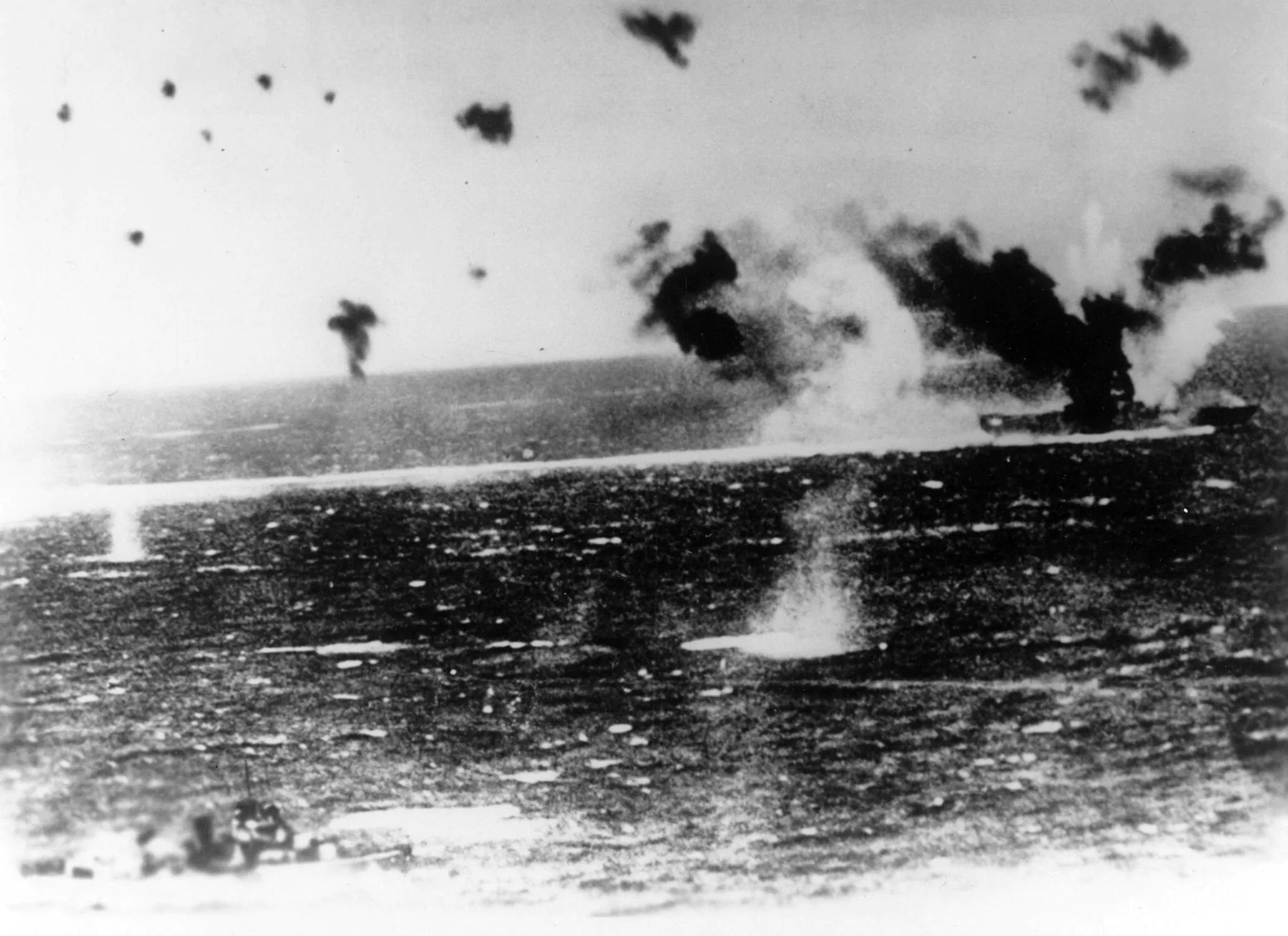
Japanese strikes hit back hard. The more nimble Yorktown took a single bomb hit — serious, but survivable. The Lexington was not so fortunate. Two torpedoes and multiple bombs struck the great carrier. Initial damage reports were cautiously optimistic; the fires seemed controllable. Then, hours later, leaking aviation fuel vapors ignited a catastrophic series of internal explosions. The fires raged beyond control. Captain Frederick Sherman gave the order to abandon ship. Survivors were rescued by escorting destroyers, and the Lexington — “Lady Lex,” one of the U.S. Navy’s most beloved ships — was scuttled by the destroyer USS Phelps to prevent capture.

The Ledger of Loss
When the smoke cleared, the balance sheet looked grim for the Allies:
- Allied losses: USS Lexington (fleet carrier), USS Sims (destroyer), USS Neosho (oiler); Yorktown damaged; 69 aircraft lost; approximately 715 personnel killed.
- Japanese losses: IJN Shōhō (light carrier), one destroyer, several smaller vessels; Shōkaku severely damaged; 69–97 aircraft destroyed; approximately 966 personnel killed.
On paper, Japan had won. They sank a 33,000-ton fleet carrier at the cost of an 11,000-ton light carrier. By the cold arithmetic of tonnage, it was a Japanese tactical victory.
But wars are not won by arithmetic alone.
A Strategic Victory in Defeat
The Battle of the Coral Sea was, in every way that mattered, an Allied strategic victory — and its consequences would echo for the rest of the Pacific War.
First and most immediately: Port Moresby was saved. The invasion convoy turned back and never returned by sea. Australia remained a viable Allied base for the counteroffensive that would eventually roll back Japanese power across the Pacific.
Second, and more profoundly: the battle crippled Japan’s carrier strength at the worst possible moment. Shōkaku required months of repairs. Zuikaku’s air group had been so badly mauled that the carrier could not be reconstituted in time for the next major operation. Two of the six carriers that had struck Pearl Harbor — two of Japan’s finest — would be absent from the Battle of Midway, just one month away.

The Ghost That Won Midway
The story of the Yorktown is one of the war’s most remarkable footnotes. Damaged at Coral Sea, she limped back to Pearl Harbor. Naval engineers estimated she needed 90 days of repairs. Admiral Chester Nimitz gave them 72 hours.
In a heroic around-the-clock effort, shipyard workers patched the Yorktown sufficiently to sail. Japanese intelligence, believing her sunk or permanently disabled, did not account for her presence at Midway. When the decisive battle came on June 4–7, 1942, the Americans had three carriers to Japan’s four — not the two Japan expected. Yorktown’s dive bombers helped sink three Japanese carriers in a single morning.
The absence of Shōkaku and Zuikaku, and the unexpected presence of Yorktown, tipped the balance at Midway. Japan lost four fleet carriers in two days. The Imperial Japanese Navy never fully recovered its offensive capability.
The Battle That Changed Everything
The Battle of the Coral Sea is often overshadowed by the more dramatic victory at Midway. But without Coral Sea, there may have been no Midway victory to celebrate. The battle stopped Japan’s southern advance, preserved Australia as an Allied stronghold, and — crucially — depleted the carrier strength and experienced pilots that Japan desperately needed one month later.
It was a battle where the losing side won, and the winning side lost. A battle where fleets fought across hundreds of miles without ever seeing each other. A battle that, 84 years later, still stands as one of the most consequential naval engagements in history — and the moment the tide in the Pacific began, almost imperceptibly, to turn.
The Battle of the Coral Sea was fought May 4–8, 1942. This year marks the 84th anniversary of this pivotal engagement.