
The
Battle of Kursk: The Largest Tank Battle in History
In the sweltering summer of 1943, the rolling steppes of central
Russia became the stage for the most massive armored clash in human
history. Over 6,000 tanks, nearly 4 million soldiers, and thousands of
aircraft converged on a bulge in the front lines near the city of Kursk.
What followed was a titanic struggle that would determine the fate of
the Eastern Front—and perhaps the entire Second World War.
The Battle of Kursk was Germany’s last roll of the dice in the East,
a desperate attempt to regain the initiative after the catastrophic
defeat at Stalingrad. It ended in complete failure, marking the
definitive turning point where the Wehrmacht lost its offensive power
forever and the Red Army began its inexorable march to Berlin.

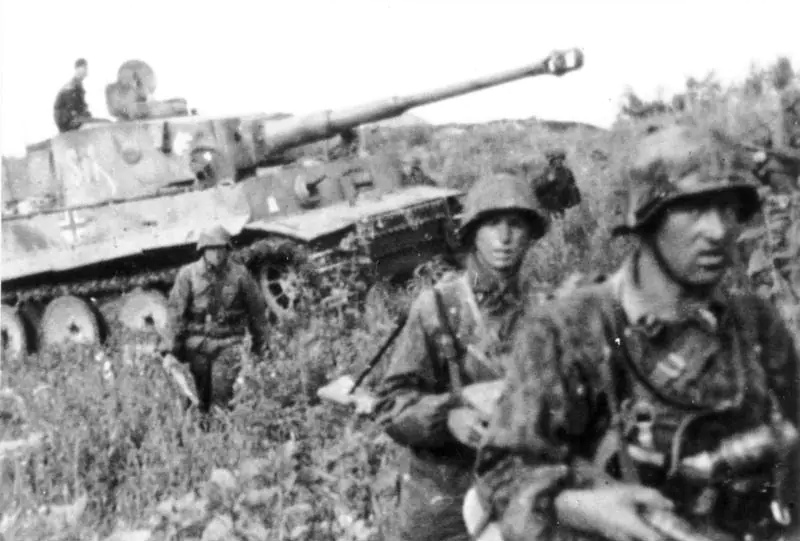
during Operation Citadel. The Battle of Kursk was the first time the
Tiger I tank was used in large numbers. (Photo: Friedrich
Zschäckel/Bundesarchiv)
Hitler’s Gamble: Operation
Citadel
By spring 1943, the Eastern Front had stabilized into an uneasy
stalemate. The front line formed a massive bulge—a salient—around the
city of Kursk, protruding 250 kilometers into German-held territory. To
Hitler and his generals, this salient represented both a threat and an
opportunity.
The plan was elegantly simple: launch simultaneous attacks from the
north and south, pinch off the salient at its base, and trap hundreds of
thousands of Soviet troops in a massive encirclement. The operation was
codenamed Citadel, and Hitler believed it would restore
German prestige, weaken Soviet offensive potential, and yield a massive
haul of prisoners for Germany’s slave labor programs.
Field Marshal Erich von Manstein, commanding Army Group South, would
drive north with the elite 4th Panzer Army. From the opposite direction,
General Walter Model’s 9th Army would strike south from the Orel area.
If all went according to plan, they would meet somewhere in the middle,
sealing the fate of the Soviet forces inside the pocket.
But there was a problem: Hitler kept delaying the offensive. He
wanted to wait for new weapons—the powerful Panther and Tiger tanks—to
arrive in sufficient numbers. Each week of delay gave the Soviets more
time to prepare. Some German commanders, including the legendary panzer
expert Heinz Guderian, warned that the attack was a mistake. They were
overruled.
The Soviets Knew Everything
What the Germans didn’t fully appreciate was that the Soviets knew
almost everything about Operation Citadel. Through a combination of
aerial reconnaissance, interrogation of prisoners, partisan
intelligence, and—crucially—information from the Lucy spy ring in
Switzerland, Soviet intelligence had pieced together the German plan in
remarkable detail.
Marshal Georgy Zhukov, Stalin’s deputy supreme commander and the
architect of the Stalingrad victory, advocated a bold strategy: let the
Germans attack. Rather than launching a preemptive offensive, the Red
Army would deliberately absorb the German blow, bleed the panzer
divisions white on prepared defenses, and then unleash devastating
counter-offensives when the enemy was exhausted.
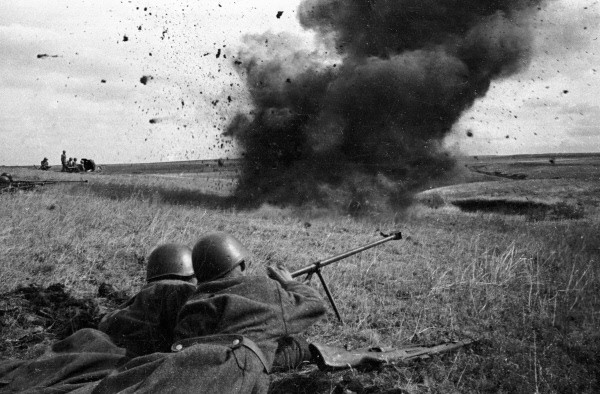
Kursk Bulge, armed with PTRD-41 anti-tank rifles. (Photo: Natalia
Bode/RIA Novosti, 20 July 1943)
The defensive preparations were staggering in scale. The Soviets
constructed multiple defensive belts extending up to 300 kilometers
deep. They dug over 2,500 miles of trenches, laid nearly one million
mines, and positioned thousands of anti-tank guns in carefully sighted
“killing zones” designed to channel German armor into pre-planned fields
of fire.
General Konstantin Rokossovsky’s Central Front defended the northern
face of the salient, while General Nikolai Vatutin’s Voronezh Front held
the south. Behind them, a massive strategic reserve—the Steppe Front
under General Ivan Konev—waited to deliver the knockout blow.
The Soviets amassed approximately 1.3 to 1.9 million soldiers, over
5,000 tanks, 25,000 guns and mortars, and 2,700 aircraft. They had
achieved numerical superiority and were fighting on ground of their own
choosing, behind fortifications they had spent months perfecting.
The Storm Breaks: July 5,
1943
Operation Citadel began on July 5, 1943. In the north, Model’s 9th
Army immediately ran into a wall of steel and fire. The Soviet defenses
were far deeper and more formidable than German intelligence had
estimated. Despite throwing hundreds of tanks into the assault, Model’s
forces made only minimal gains, advancing just a few miles at enormous
cost. Within days, the northern pincer had effectively stalled.
The southern attack fared better—at least initially. Von Manstein’s
forces, spearheaded by the II SS Panzer Corps (containing the elite
Leibstandarte, Das Reich, and Totenkopf divisions), managed to penetrate
deeper into Vatutin’s defenses. But every mile was bought with blood and
burning tanks. The Soviets fought with ferocious determination,
contesting every village, every hill, every kilometer of ground.
The German advance became a grinding battle of attrition, exactly
what Zhukov had planned. The vaunted new Panther tanks, rushed into
service before their mechanical problems were fully resolved, broke down
in alarming numbers. The Tigers, while formidable, were too few to make
a decisive difference.
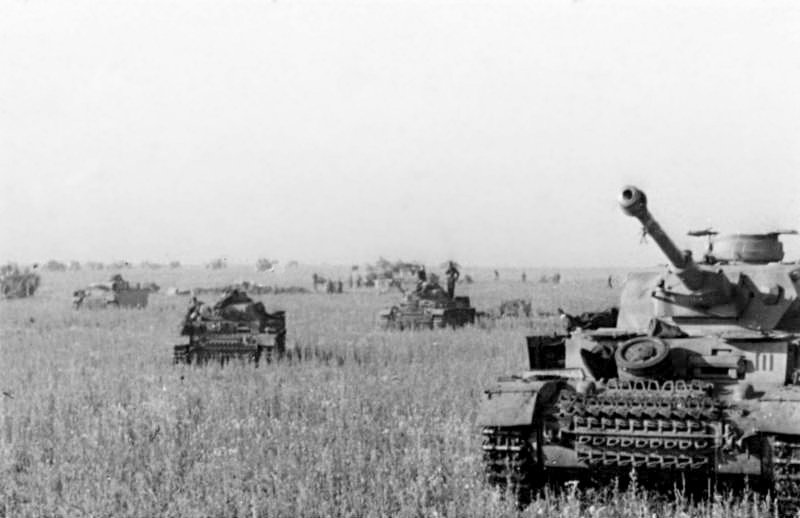
of Operation Citadel near Belgorod. (Photo: Merz/Bundesarchiv, Summer
1943)
Prokhorovka: The Clash of
Steel Giants
By July 12, the German southern thrust had reached the area around
the small town of Prokhorovka. Here, von Manstein’s forces collided with
a massive Soviet counter-attack: the 5th Guards Tank Army under General
Pavel Rotmistrov, unleashed from the strategic reserve.
What followed was one of the largest tank battles in history.
Hundreds of tanks—estimates range from 500 to over 800—engaged in a
chaotic, close-quarters melee across the open steppe. Soviet T-34s
charged directly at the German lines, closing the distance to negate the
range advantage of German guns. The battle devolved into a swirling,
confused brawl fought at point-blank range, with tanks ramming each
other and infantry fighting hand-to-hand amid the burning wrecks.
The Soviets suffered appalling losses at Prokhorovka—perhaps 300 to
400 tanks destroyed or damaged. But they achieved their objective: the
German advance was stopped cold. The II SS Panzer Corps, though still
combat-effective, could not break through. The southern pincer, like the
northern one, had been blunted.

resulted in heavy losses of tanks on both sides. (Photo: Bundesarchiv,
23 September 1943)
The Tide Turns
On July 12—the same day as Prokhorovka—the Soviets launched their
first major counter-offensive, Operation Kutuzov, against the German
salient around Orel, north of Kursk. This powerful attack forced the
Germans onto the defensive and compelled them to withdraw units from the
Kursk offensive to contain the new threat.
The next day, July 13, Hitler officially canceled Operation Citadel.
The Allied invasion of Sicily on July 10 had added to his concerns,
requiring the diversion of forces to Italy. But the fundamental reason
was clear: the offensive had failed. The Germans had suffered enormous
losses—perhaps 200,000 to 500,000 casualties and 760 to 1,200 tanks
destroyed—without achieving any strategic objective.
The Soviets weren’t finished. On August 3, they launched Operation
Rumyantsev against Army Group South. The depleted German forces, their
panzer divisions shattered at Kursk, could not hold. Belgorod fell, and
on August 23, the Soviets recaptured Kharkov, the city that had changed
hands multiple times during the war. The Battle of Kursk was over.
The Point of No Return
The Battle of Kursk was a catastrophic defeat for Nazi Germany. While
Soviet casualties were numerically higher—approximately 863,000 men and
over 6,000 tanks—the Soviet Union’s vast reserves of manpower and
industrial capacity allowed it to absorb these losses and rebuild.
Germany could not.
More importantly, Kursk marked the permanent transfer of strategic
initiative on the Eastern Front to the Red Army. After Kursk, Germany
never again launched a major strategic offensive in the East. The
Wehrmacht was forced into a long, grinding, defensive retreat that would
end only in the ruins of Berlin two years later.
The battle demonstrated that the era of blitzkrieg was over. Against
a well-prepared, deeply layered defense backed by massive reserves, the
German tactic of rapid breakthrough and encirclement no longer worked.
The war had become a brutal contest of attrition—a contest Germany could
not win.
Kursk also showcased the maturation of the Red Army. This was the
first time Soviet forces had defeated a major German summer offensive.
It proved that Soviet commanders had mastered operational art, that
Soviet intelligence was first-rate, and that Soviet soldiers, fighting
for their homeland, were more than a match for the supposedly invincible
Wehrmacht.
Legacy of the Largest Battle
The Battle of Kursk remains the largest tank battle ever fought, a
distinction it will likely hold forever. It was a clash of titans, a
collision of industrial-age armies on a scale never seen before or
since.
For the Soviet Union, Kursk was vindication. After the disasters of
1941 and the desperate struggles of 1942, the Red Army had proven it
could not only withstand the best Germany could throw at it but could
destroy the enemy in the process. The road to Berlin was open.
For Germany, Kursk was the beginning of the end. The panzer divisions
that had conquered Poland, France, and the Balkans were broken on the
steppes of Russia. The myth of German invincibility was shattered. From
Kursk onward, the question was not whether Germany would lose the war,
but when.
In the summer of 1943, amid the smoke and thunder of the largest
armored battle in history, the fate of the Eastern Front—and the Second
World War—was decided.
Word Count: 1,652