
The Battle of the Bismarck Sea: When Allied Airpower Destroyed a Japanese Convoy
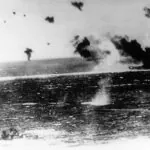
On the morning of March 3, 1943, Japanese Rear Admiral Masatomi Kimura watched in horror as his convoy disintegrated around him. Within twenty minutes, every transport ship under his protection was either sinking, on fire, or dead in the water. The sea churned with explosions as Allied bombers roared overhead at wavetop height, their machine guns blazing and bombs skipping across the water like thrown stones before smashing into Japanese hulls.
The Battle of the Bismarck Sea would last just three days, but its impact would reverberate throughout the Pacific War. It was a masterclass in the devastating potential of coordinated air power—and a death sentence for Japan’s ambitions in New Guinea.
The Desperate Gamble
By early 1943, Japan’s strategic position in the South Pacific was deteriorating rapidly. The grueling Guadalcanal campaign had ended in February with a Japanese withdrawal, and Allied forces were advancing steadily in New Guinea. The capture of Buna and Gona had given the Allies critical footholds on the island’s northern coast.

Lieutenant General Hitoshi Imamura, commanding Japanese forces from his headquarters at Rabaul, faced a critical decision. The garrison at Lae, a vital Japanese stronghold on New Guinea’s northeastern coast, desperately needed reinforcement. The 51st Division—some 6,900 troops—had to reach Lae to prevent an Allied breakthrough.
The problem was simple but deadly: Allied air power dominated the skies over the Bismarck Sea. An earlier convoy in January had lost one transport to air attack, though most troops had made it ashore. Japanese war games predicted catastrophic losses for any new convoy attempt. The alternative—a grueling overland march through New Guinea’s mountainous jungle—was deemed even worse.
The decision was made. Operation 81 would proceed.
A Convoy Doomed Before It Sailed
On the night of February 28, 1943, eight transport ships departed Simpson Harbour at Rabaul, escorted by eight destroyers—a first-rate escort force that included the flagship Shirayuki. The transports carried the 51st Division’s troops, equipment, ammunition, and critically, drums of aviation fuel aboard the Kembu Maru.
What the Japanese didn’t know was that Allied codebreakers had been reading their mail for weeks.

The joint American-Australian Fleet Radio Unit in Melbourne had intercepted and decrypted Japanese naval communications, providing nearly a month’s advance warning. Allied commanders knew the convoy was coming, where it was going, and approximately when it would arrive.
Lieutenant General George C. Kenney, commander of Allied Air Forces in the South West Pacific, had been preparing for this moment. Dissatisfied with the poor results of conventional high-altitude bombing against maneuvering ships, Kenney had championed a revolutionary new tactic: skip bombing.
The Secret Weapon: Skip Bombing
The concept was brilliantly simple. Instead of dropping bombs from high altitude and hoping for a hit, modified B-25 Mitchell and A-20 Havoc bombers would approach at extremely low altitude—50 to 100 feet above the water. They would release bombs with delayed fuzes that would skip across the water’s surface like a stone and strike the ship’s hull at or below the waterline before exploding.
To execute these suicidal-seeming attacks, the bombers needed protection. Under the direction of Major Paul “Pappy” Gunn, the aircraft were transformed into flying gun platforms, bristling with forward-firing .50-caliber machine guns that could suppress anti-aircraft fire during the attack run.
But Kenney’s plan went beyond just skip bombing. Based on a proposal by RAAF Group Captain Bill Garing, the Allies developed a coordinated, multi-layered attack sequence designed to overwhelm the convoy’s defenses:
- High-altitude B-17 Flying Fortresses would strike first, dispersing the convoy formation
- RAAF Bristol Beaufighters would follow at mast-height, strafing ships with cannons to neutralize gun crews
- Modified B-25s and A-20s would deliver the killing blow with skip bombing
- P-38 Lightning fighters would provide top cover against Japanese fighters
Allied aircrews rehearsed the complex choreography over a shipwreck in Port Moresby harbor. Everything was ready.
March 3: Twenty Minutes of Hell
The convoy had been spotted on March 1 and attacked the following day, losing the transport Kyokusei Maru to B-17 bombers. But Admiral Kimura made a fatal decision that night. Believing poor weather would continue to provide cover, he ordered the convoy to circle in the Huon Gulf overnight rather than pressing on to Lae under darkness.
When dawn broke on March 3, the weather had cleared. The Japanese ships were exposed and vulnerable.

At approximately 10:00 AM, the Allied attack began. B-17s bombed from medium altitude, forcing the tightly-packed convoy to scatter. Moments later, thirteen RAAF Beaufighters screamed in at mast-height, their 20mm cannons and machine guns raking the decks and bridges of the transports and destroyers.
Then came the skip-bombers.
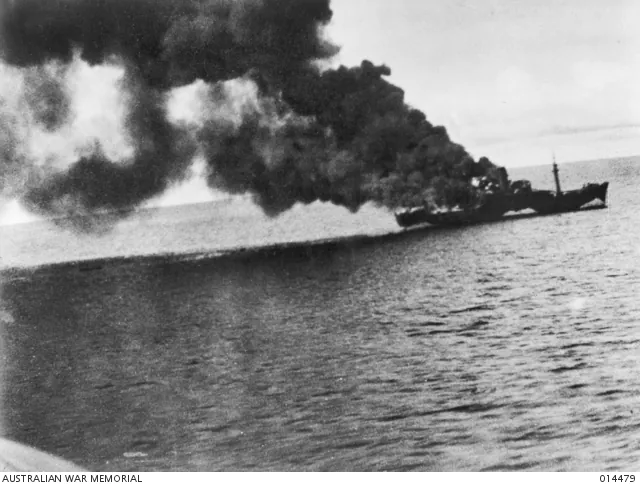
Twelve B-25s and twelve A-20s descended to wavetop level, their forward guns blazing as they lined up their targets. The effect was catastrophic. Bombs skipped across the water and slammed into Japanese hulls with devastating accuracy. The fuel-laden Kembu Maru exploded in a massive fireball. The flagship destroyer Shirayuki had its stern blown off and sank rapidly. The destroyers Arashio and Tokitsukaze were crippled and left burning.
Within twenty minutes, every one of the seven remaining transports was sunk, sinking, or on fire. The sea was littered with debris, burning oil, and thousands of Japanese soldiers struggling in the water.
The Grim Aftermath
Allied aircraft returned on March 4 to finish off the crippled destroyers. The Asashio was sunk while attempting to rescue survivors. U.S. Navy PT boats joined the attack, targeting Japanese personnel in lifeboats and rafts—a controversial action that would haunt many of the participants for years.

The final tally was staggering:
Japanese losses: – All eight transports sunk – Four of eight destroyers sunk – Approximately 2,890 soldiers and sailors killed – Only 1,200 of the 6,900 embarked troops eventually reached Lae – 15-20 fighter aircraft destroyed
Allied losses: – 13 aircrew killed – Two bombers destroyed – Four fighters shot down
The disparity was almost unbelievable. In three days, Allied air power had achieved what would have required a major naval engagement in an earlier era—and done so with minimal losses.
The Battle That Changed Everything
The Battle of the Bismarck Sea sent shockwaves through the Japanese high command. It marked the definitive end of major Japanese attempts to reinforce their New Guinea garrisons by surface convoy. Without the 51st Division, Japan could mount no further large-scale offensives in New Guinea.
Forced to abandon large convoys, the Japanese resorted to inefficient and insufficient methods: submarines, nighttime barge runs, and small coastal vessels. Japanese troops in New Guinea would remain chronically short of food, medicine, and ammunition for the remainder of the war.
For the Allies, the victory validated revolutionary tactics and confirmed that the combination of intelligence, technology, and tactical innovation could produce decisive results. Skip bombing became standard practice for the Fifth Air Force. The battle paved the way for subsequent Allied landings at Lae and Finschhafen, accelerating the campaign to isolate the Japanese fortress at Rabaul.
Legacy of Innovation
The Battle of the Bismarck Sea demonstrated that surface fleets, no matter how well-escorted, were vulnerable to concentrated, coordinated air attack. It was a lesson that would be reinforced throughout the Pacific War, from the Philippine Sea to Leyte Gulf.
But perhaps more importantly, it showed what could be achieved when intelligence, innovation, and courage combined. The codebreakers who provided the warning, the engineers who modified the bombers, the planners who choreographed the attack, and the aircrews who executed it with precision—all played essential roles in a victory that helped turn the tide in the Pacific.
In just three days in March 1943, the Allies had severed Japan’s lifeline to New Guinea. The road to Tokyo had become a little shorter, and the outcome of the Pacific War a little more certain.